
Photo Description: A bright ocean wave scene with a soft light blue semi-transparent overlay panel centered over the image. Dark teal text reads "What Is Anxiety, Really? A Trauma Informed Guide" with "Anxiety Therapy Phoenix" as a subtitle below, followed by a coral dividing line and the author credit "By Kandace Ledergerber, LPC/LMHC, Certified EMDR Therapist."
Photo by Silas Baisch on Unsplash
There's a particular kind of exhaustion that anxiety creates... and perpetuates. It’s not the tired that a good night's sleep fixes. It’s the kind that lives in your body, even on the good days, the one that's a low hum of tension in the background that has lived in your body for most of your life, so long that sometimes you stop noticing that it’s there. The kind where your brain is three steps ahead of every single conversation, every plan, every possible outcome, and you can't figure out how to make it stop. And when you allow your body to stop moving, your brain continues to spin, plan, or ruminate on the past.
If that sounds familiar, you're not alone. And more importantly, you're not out of your mind.
Anxiety has a way of making people feel like something is fundamentally broken about them. Like everyone else got the how to manual for being a calm, functioning human, and yours got lost in the mail. But here's what I want you to know before we go any further: anxiety doesn't come out of nowhere. And understanding where it actually comes from changes everything about how you approach your healing journey.
This is a guide for anyone who's tired of being told to breathe through it and “just relax”, and ready to understand what "it" actually is.
Key Takeaways
Some anxiety is useful. The kind that doesn't quit is worth understanding
Persistent anxiety usually has roots — it didn't appear out of nowhere
Trauma is subjective. What matters is how it felt in your body, not whether it "counts"
Insight alone doesn't heal anxiety — the nervous system needs something different
Coping skills matter, but they were never meant to be a full-time job
Not everyone has equal access to support — and that's worth naming
Nothing is wrong with you. Your anxiety makes sense
Anxiety Isn't One Thing
Before we can talk about where anxiety comes from, it helps to name what we're actually dealing with. Because anxiety isn't one thing. It's a spectrum, and where you land on it matters.
When Anxiety Is Doing Its Job
Some anxiety is normal and even necessary. Starting a new job, having a difficult conversation, waiting on news that matters, a certain amount of anxiety in those moments isn't a malfunction. It's your nervous system doing exactly what it's supposed to do, flagging that something important is happening and getting your body ready to respond.
That kind of anxiety tends to move through you. It shows up, it does its job, and it leaves. You feel the nerves before the presentation and then, once it's done, you can exhale. There is a start and end to this anxiety.
When Anxiety Stops Being Helpful
Then there's the other kind. The anxiety that doesn't leave when the situation is over. The one that's running in the background even when nothing is actually wrong. You might recognize it as:
Dreading things weeks before they happen
Replaying conversations long after they're over
Lying awake at 3am "problem-solving" for scenarios that haven't happened and most likely won't
Feeling like you can't fully relax, even when everything is technically fine
Bracing for something you can't even identify
This is anxiety that has stopped being a helpful signal and started being the default setting. And living on that setting is exhausting in a way that's hard to explain to someone who hasn't experienced it. Your body is working overtime all of the time.
This is the anxiety that brings most people into therapy. And this is the anxiety that deserves a real answer, not just another coping strategy.
Where Persistent Anxiety Often Takes Root
Here's the part that most anxiety content skips over, and it's the part that matters most to a large portion of individuals who end up in therapy for anxiety.
Anxiety (the persistent, life-interrupting kind) typically doesn't just appear overnight without cause. Something created it. And that something is usually a series of experiences that taught your nervous system it needed to stay on high alert.
Your nervous system is a learning machine. Its entire job is to keep you safe and alive. And it does that by tracking patterns. When something hurts, when something feels threatening, when something leaves you feeling unseen, rejected, or unsafe, your nervous system flags that as something important to remember and stay aware of. Then it applies that learning going forward, scanning for anything that resembles what came before, to try and prevent it from happening again.
That's not a flaw in the system. That's the system working exactly as it’s supposed to. The problem is that it can keep running the same protective patterns long after the original threat is gone.
The Trauma Connection A Lot of People Miss
This is where I want to slow down and say something that often makes people pause, a lot of persistent anxiety is rooted in trauma. And before you close this tab because that word doesn't feel like it applies to you, stick with me for a second.
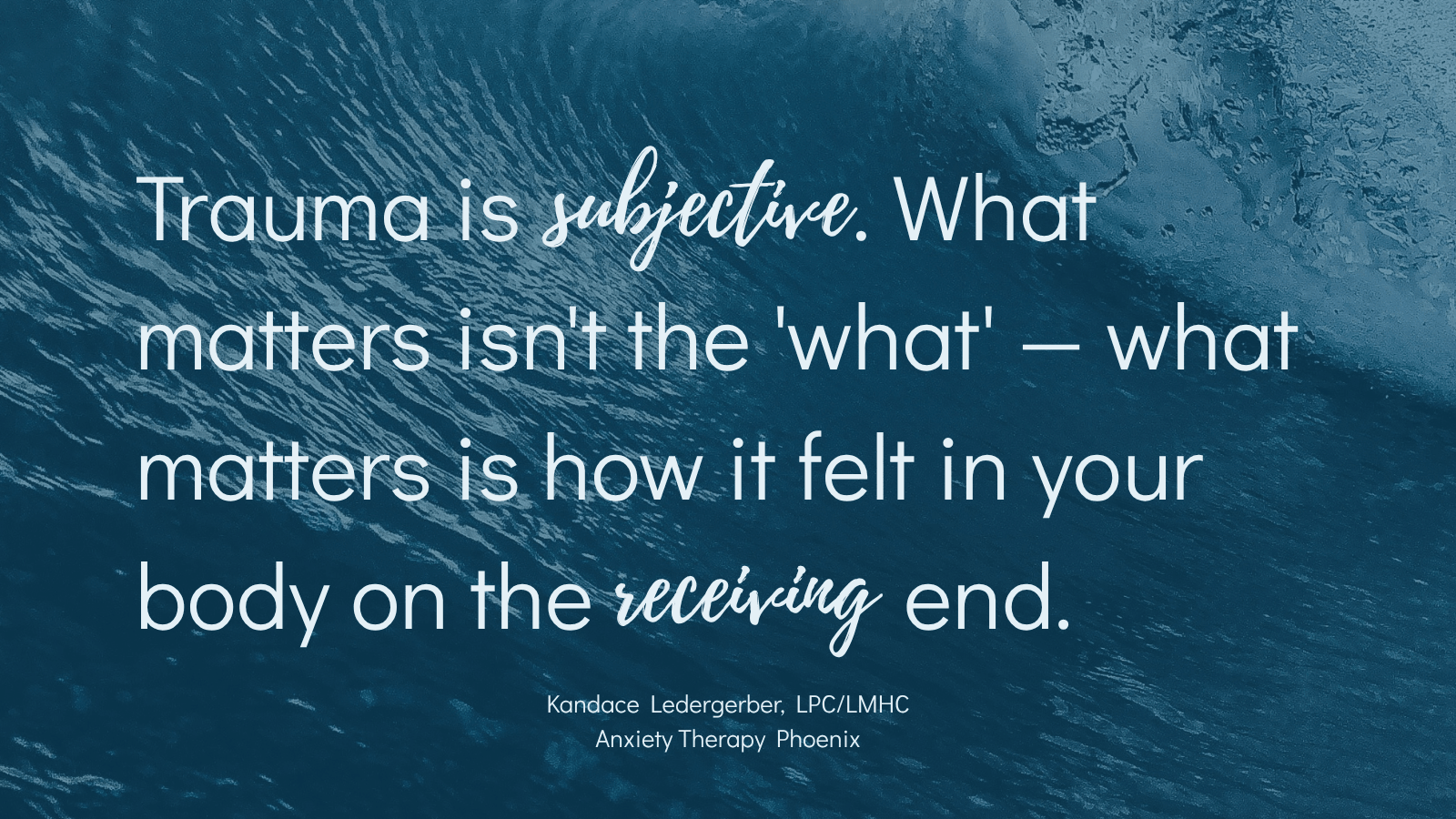
Photo Description: Dark navy ocean wave background with white text reading: "Trauma is subjective. What matters isn't the 'what' — what matters is how it felt in your body on the receiving end." The word "subjective" appears in cursive script for emphasis, as does the word "receiving." Attributed to Kandace Ledergerber, LPC/LMHC, Anxiety Therapy Phoenix.
Photo by Silas Baisch on Unsplash
Trauma doesn't have to be a single catastrophic event. It doesn't have to be something that would make headlines or that anyone else would point to and say, "Yes, clearly, that was terrible." Trauma is subjective. What matters isn't the "what" — what matters is how it felt in your body on the receiving end. If it felt like a slap in the face with a side of steaming rejection, that's how your nervous system is going to treat it. Full stop.
It might have looked like:
A parent whose moods were unpredictable, and you learned to read the room before you could relax in it.
A classroom moment that made you feel humiliated.
Growing up in a home where love felt conditional on performance.
Years of feeling like too much, or not enough, or both at the same time.
Being the one who held everyone else together, long before you were old enough to have to.
These experiences don't always look dramatic from the outside. There's no single moment you can point to and say, "that's where it all started." But they shape the nervous system profoundly and quietly, teaching it that the world isn't entirely safe, that you have to stay ready, that the other shoe is always about to drop.
And here's the part that trips a lot of people up, because these experiences often felt normal at the time (after all, we only know what we know), it can be genuinely hard to connect them to the anxiety you're carrying now. It doesn't feel like cause and effect. It just feels like this is who you are.
What I often see in my work is that the connection between those early experiences and present-day anxiety isn't obvious at first. It tends to emerge over time, through conversation, through patterns, through noticing what triggers the alarm bell and tracing it back to where that alarm was first installed.
And when that connection lands, it usually doesn't feel like a lightbulb moment. It's more like a dead stop accompanied by an "Oh. Yup, I guess that makes sense. Well, at least I know I'm not out of my mind."
That moment of making sense of it is important. But understanding alone isn't what allows us to heal forward.
Why Anxiety Doesn't Just Go Away On Its Own
This is the part that frustrates people most, and understandably so. You've probably already tried to think your way out of this. You know, logically, that the thing you're anxious about probably isn't as catastrophic as it feels. You've identified your triggers. You've read the articles. You might have even tried therapy before.
And the anxiety is still there.
That's not because you're doing it wrong. It's because anxiety doesn't only live in your thoughts; it lives in your nervous system. And the nervous system doesn't respond to logic. You can understand cognitively that you're safe and your body can still respond like you're not, because it's working from a different set of information than your rational mind holds.
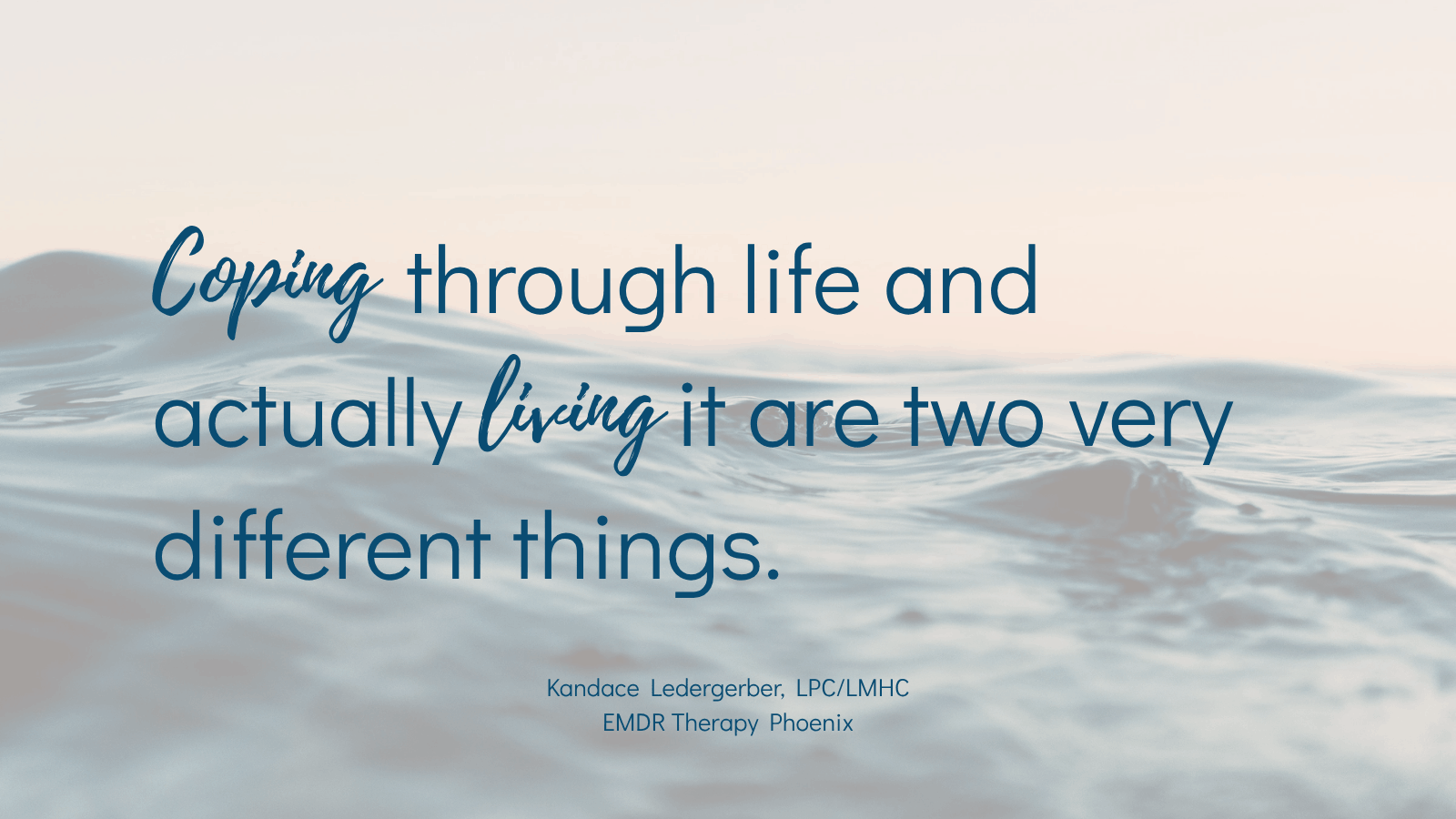
Photo Description: Calm, pale ocean water background with soft warm tones. Dark teal text reads: "Coping through life and actually living it are two very different things." The words "Coping" and "living" appear in cursive script for emphasis. Attributed to Kandace Ledergerber, LPC/LMHC, EMDR Therapy Phoenix.
Photo by Matt Hardy on Unsplash
This is why willpower doesn't fix anxiety, and why coping skills (as genuinely useful as they are) only get you so far. Coping is for the moments when your system is dysregulated, and you need something to get through. That’s important. But coping through life and actually living it are two very different things. Healing means getting to a place where you're not constantly white-knuckling it, where coping skills are tools you reach for when things come up, not the scaffolding holding your entire day together.
If you've ever felt like you've tried everything and nothing sticks, that's worth exploring. 3 Myths About Anxiety Therapy & How EMDR Approaches Anxiety Differently gets into exactly why the usual strategies fall short and what a different approach actually looks like.
Who Tends to Feel This Most
Anxiety doesn't discriminate (and neither does trauma). But access to care does. People of color carry disproportionately higher rates of both anxiety and trauma, and are far less likely to receive support for it, because of systemic barriers, cultural stigma, and a mental health landscape that has historically not made enough space for them. That's worth calling out, and it's something I work to hold space for and lean into in the work I do, for myself and with others.
In my practice, I also see anxiety show up consistently in people who are holding a lot, the achievers, the caretakers, the ones who are somehow always on top of everything while quietly running on an empty tank.
From the outside, these people often look like they have it together. Colleagues marvel. Friends say "I don't know how you do it!" And inside, there's a very different story. Because being "on top of it all" has a cost that isn't visible on the outside looking in. It costs them constantly, internally, in ways that don't show up on a performance review.
But here’s the thing, high-functioning anxiety is still anxiety. It just wears a more socially acceptable disguise. If any of that sounds like you, Why Am I Like This? | Anxiety Therapy for the Inner Critic might resonate, it gets into exactly what that internal experience looks like and where it comes from.
And then there's a specific version of this worth naming, the anxious achiever. The person whose drive and dread are running on the same fuel. Where striving isn't just ambition, it's also the nervous system's way of managing threat. Why Perfectionism Can Feel Safer Than Stillness unpacks what that pattern looks like underneath the surface.
What Actually Helps
If anxiety lives in the nervous system, then healing has to happen at that level too. Not just in your thoughts but also in your body, in your felt sense of safety, in the parts of you that are still running old protective patterns in a world that no longer requires them.
That shift doesn't happen through insight alone. It happens through experience and through actually feeling safe, over time, in the right kind of therapeutic relationship. Through helping the nervous system update its understanding of what's threatening and what isn't.
This is the work I do with clients in anxiety therapy in Phoenix. It's trauma-informed, it's paced, and it's built around the understanding that you are not broken, your nervous system just learned some things that made sense at the time, and needs the conditions to learn something new.
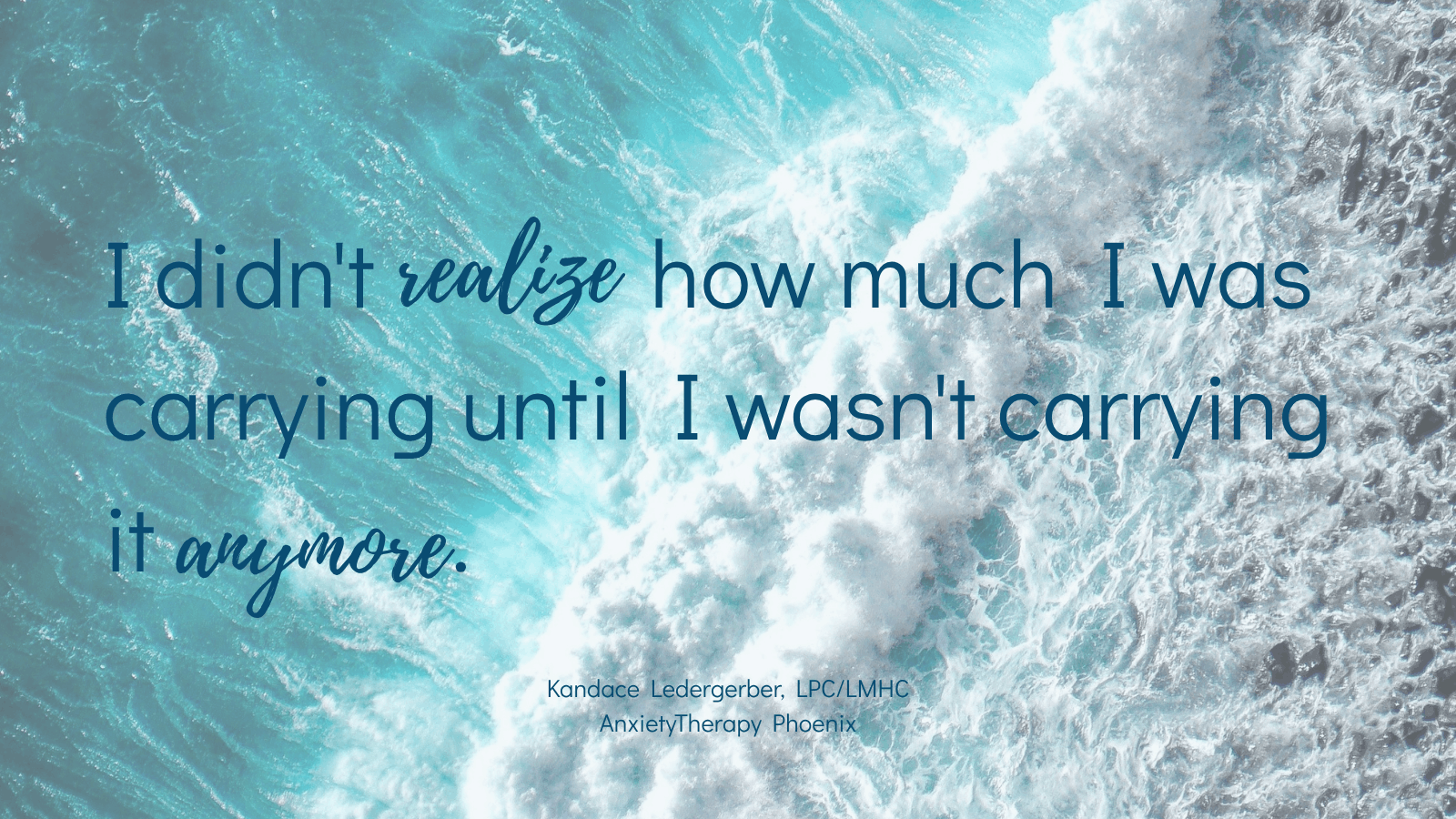
Photo Description: Aerial view of a turquoise ocean wave with white foam. Dark teal text reads: "I didn't realize how much I was carrying until I wasn't carrying it anymore." The words "realize" and "anymore" appear in cursive script for emphasis. Attributed to Kandace Ledergerber, LPC/LMHC, Anxiety Therapy Phoenix.
Photo by Gatis Marcinkevics on Unsplash
For many of my clients, that includes EMDR therapy, a research-backed approach that works at the level of the nervous system rather than asking you to think your way through your history. It helps the brain finish processing experiences it got stuck on, so they stop running in the background, keeping the alarm bell primed. It's not the only path, but for a lot of anxious people, it's the one that finally reaches the level where things actually shift.
What that shift looks like is different for everyone. But what I hear again and again is some version of: I didn't realize how much I was carrying until I wasn't carrying it anymore.
You're Not Out of Your Mind
If anxiety has been a constant force in your life, running the show, keeping you on edge, making you feel like you're one unexpected thing away from falling apart, that makes sense. Your nervous system learned to operate that way for a reason. It was doing its job.
You don't have to keep living at that level of anxiety.
If you're curious about what anxiety therapy in Phoenix could look like for you specifically, I'd love to connect. Reach out to schedule a free consultation — no pressure, just a conversation about where you are and whether working together makes sense.
TL;DR
Anxiety exists on a spectrum — some is normal and useful, some has taken over the controls.
Persistent anxiety usually isn't random — it's rooted in experiences that taught the nervous system to stay on high alert.
Trauma doesn't have to be catastrophic to be real; what matters is how it felt in your body.
Anxiety lives in the nervous system, not just your thoughts — which is why logic and willpower don't fix it.
Coping skills matter, but healing means getting to a place where you're actively living, not constantly coping.
You're not out of your mind. Your anxiety makes sense. And it can change.

About the Author
Kandace Ledergerber, LPC/LMHC, Certified EMDR Therapist
Kandace helps adults who feel stuck in the hamster wheel of anxiety and perfectionism reconnect with a sense of grounding, self-trust, and emotional steadiness. Through EMDR therapy and nervous system-informed work, she supports clients in moving out of survival mode and into a more grounded, meaningful life.
She specializes in trauma recovery, anxiety and perfectionism, and healing the lingering effects of childhood and relational trauma. Her work focuses on helping clients process painful experiences that still feel "stuck" so they can move forward with greater peace, confidence, and emotional freedom.
She offers EMDR therapy in Phoenix, anxiety therapy, and EMDR Intensives in Arizona.
Learn more about Kandace's background, approach, and services on her About page.