Photo by Corina Constantinov on Unsplash
Photo Description: Blog header image with a dark navy ocean wave background. A semi-transparent dark teal overlay panel in the center displays white text reading: "The Hidden Link Between Anxiety & Emotional Safety." Below the title, a subtitle reads "Anxiety Therapy Phoenix" followed by a small coral dividing line and the author credit "By Kandace Ledergerber, LPC/LMHC, Certified EMDR Therapist."
You know that feeling when your phone buzzes and your stomach drops through the floor, before you’ve even looked at the screen? Or when someone says “we need to talk” and your brain has already written twenty-seven disaster scenarios before they finish the sentence?
That’s the alarm bell. And if it’s been going off your whole life (sometimes at full volume, sometimes at a low hum that you’ve just learned to live with), you’ve probably spent a lot of time wondering what’s wrong with you.
Here’s what I want you to know before we go any further: nothing is wrong with you. That alarm bell didn’t malfunction. It was learned.
Key Takeaways
Anxiety is often a protection response, not a personality flaw
For many people, it started as a nervous system adaptation to feeling emotionally unsafe
The inner critic telling you that you "should be over this" usually isn't your voice — it's a borrowed one
People who grew up without emotional safety often become the ones who give it most freely to everyone else
Healing isn't about silencing anxiety forever — it's about the alarm bell learning it doesn't have to run the show
Anxiety Isn’t a Character Flaw — It’s a Protection Response
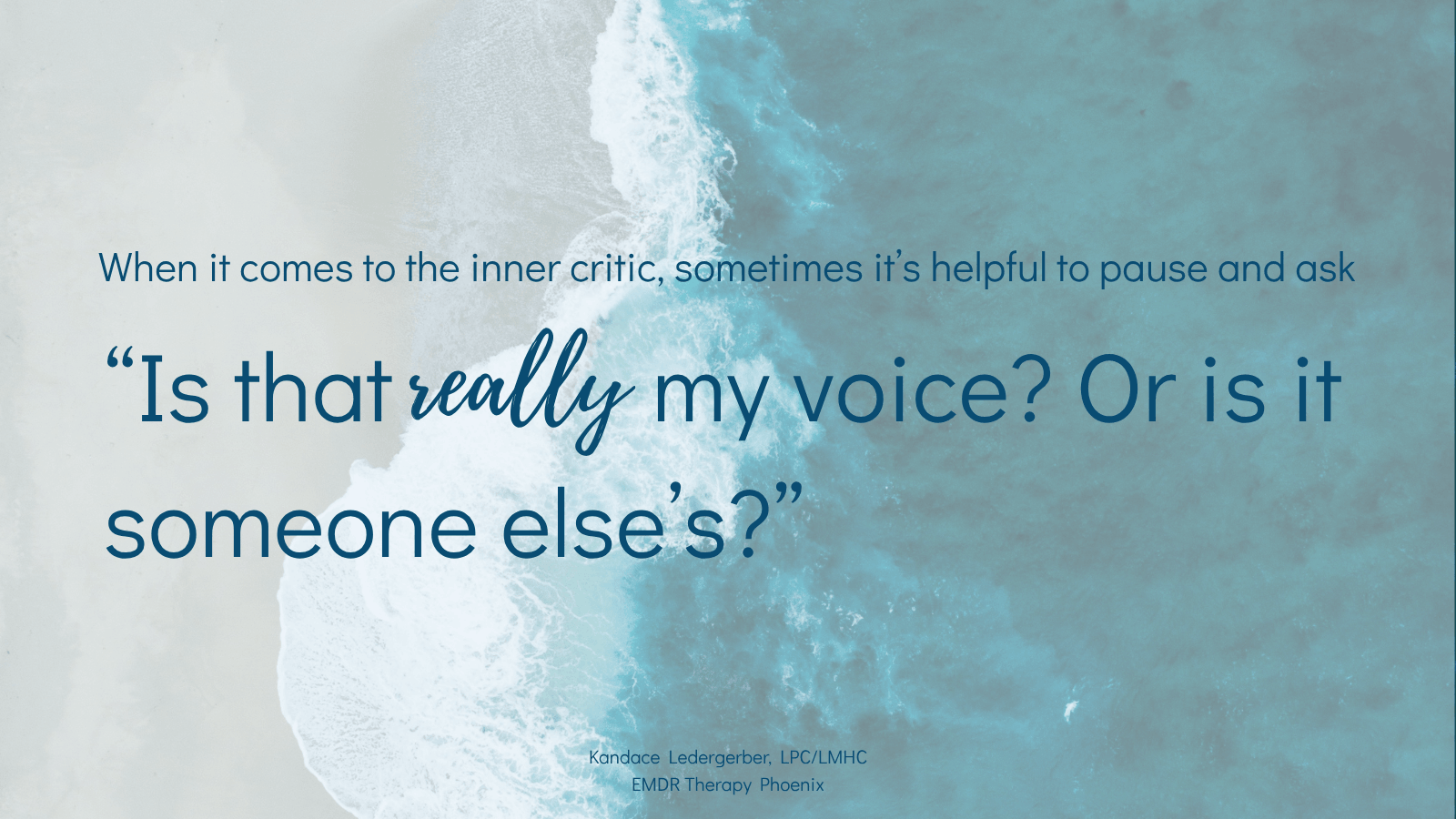
Photo by Shifaaz shamoon on Unsplash
Photo Description: Dark teal text on an aerial ocean shoreline background. Smaller text at the top reads: "When it comes to the inner critic, sometimes it's helpful to pause and ask." Larger text below reads: "Is that really my voice? Or is it someone else's?" The word "really" appears in cursive script for emphasis. Attributed to Kandace Ledergerber, LPC/LMHC, EMDR Therapy Phoenix
Most people who come to therapy for anxiety arrive carrying a specific kind of shame. Not just the anxiety itself, but the judgment layered on top of it. I should be over this by now. Other people handle stress just fine. Why can’t I get my sh*t together?
That inner voice is worth paying attention to, not because it’s right, but because of where it came from.
A lot of anxiety, underneath its surface, is a trauma response. It’s what happens when your nervous system spends years learning that you needed to be on high alert at all times in order to protect yourself from feeling rejected, not enough, or unsafe. Your brain wasn’t broken. It was doing exactly what brains do, adapting to the environment it was in.
So when you hear that voice telling you that you should have figured this out by now, I’d invite you to pause and ask: Is that really your voice? Or is it someone else’s, perhaps someone who said things like that to you when you were young and didn’t know any better? That inner critic has a lot to say, and if you've ever caught yourself wondering why you can't just get out of your own way check out the blog Why Am I Like This? Because a lot of the time, that voice is not yours. And it never was.
Where Did That Alarm Bell Come From?
For some people, the answer is straightforward, even if it’s painful. There were direct messages (spoken or unspoken) that communicated you were too much, not enough, or that your emotions were a problem to be managed. Criticism that came without repair. Rejection that came without explanation. Over time, your nervous system started scanning constantly for the next one.
For others, it’s more complicated. Some people grew up in homes where the you know what really did hit the fan. Where danger wasn’t just a feeling, it was real. And some grew up in homes where nothing overtly “bad” happened, but something always felt off, like walking on eggshells, even when you can’t see the danger. Like the air was charged and you had to read the room before you could take a breath.
Both are valid. The nervous system doesn’t distinguish between actual threat and perceived threat. Your nervous system doesn't make that distinction. If it feels dangerous, it is dangerous.
And then there's a third origin story I see a lot in my work. It doesn't get talked about nearly enough. Growing up as the emotional caretaker.
Maybe it looked something like this.
You wake up to a loud noise and find your parent out in the kitchen, angrily moving pots and pans. They start yelling at you that you didn’t clean up the way you should have. From the other room, you hear your younger sibling stir, and you run to shush them before they make things worse. Your parent slams their bedroom door. And now the quiet feels even more dangerous than the yelling did, because you know what comes next: figuring out how to ease their frustration, their sadness, their whatever-it-is-today.
You were a child. And you were holding the whole house together.
That kind of childhood doesn’t always look like trauma from the outside. But your nervous system knew. And it learned to never, ever stand down.
The Missing Piece Nobody Talks About Is Emotional Safety
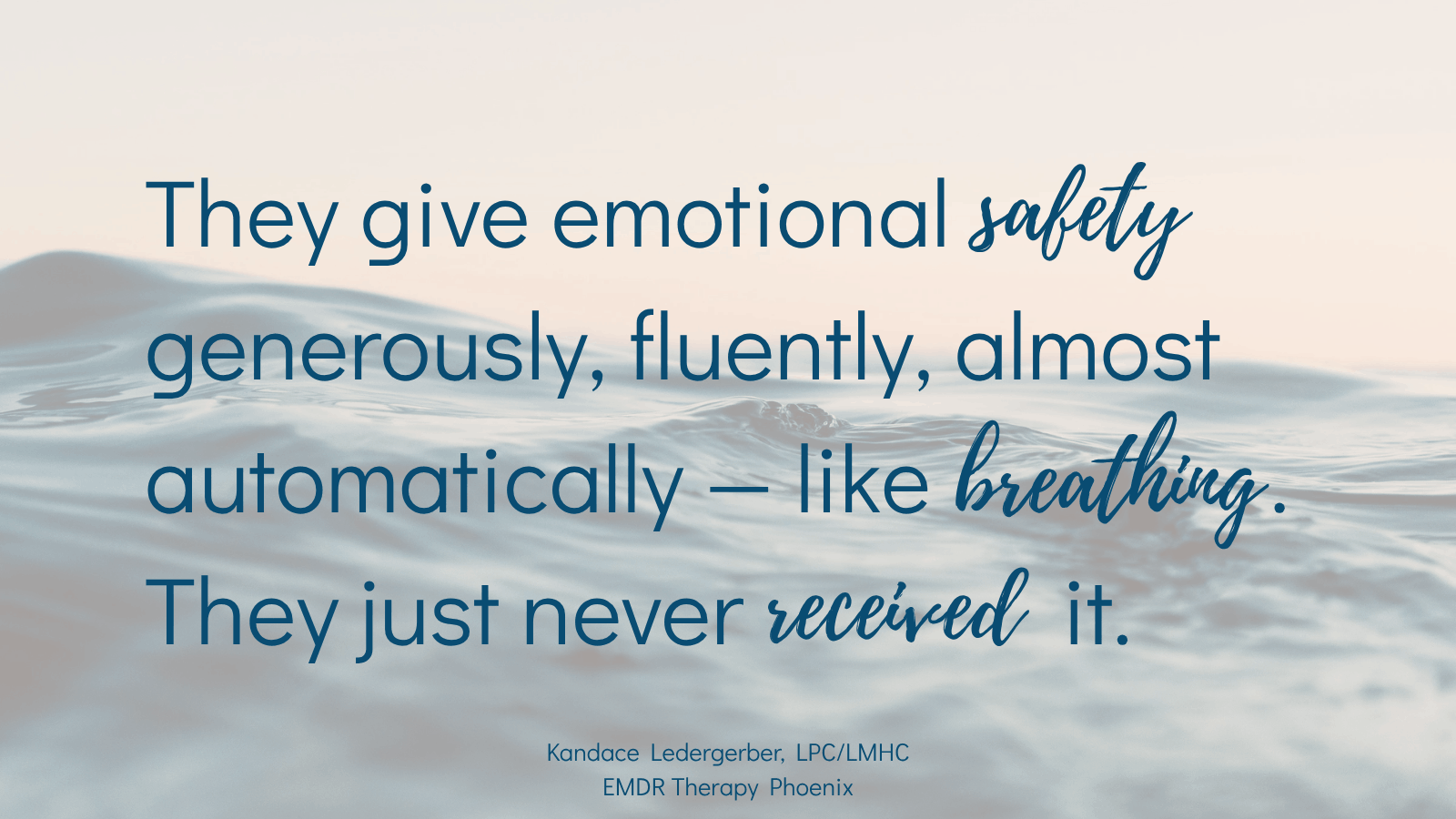
Photo by Matt Hardy on Unsplash
Photo Description: Dark teal text on a calm, pale ocean water background reading: "They give emotional safety generously, fluently, almost automatically — like breathing. They just never received it." The words "safety," "breathing," and "received" appear in cursive script for emphasis. Attributed to Kandace Ledergerber, LPC/LMHC, EMDR Therapy Phoenix.
Here’s something I notice about almost every anxious person I work with: they are exceptional at making other people feel safe.
They’re the friend everyone calls in a crisis. The coworker who somehow always knows when something’s off. The partner who remembers every important date, checks in without being asked, and holds space like it’s second nature (because it is). They give emotional safety generously, fluently, almost automatically, like breathing.
They just never received it.
So when we talk about working through anxiety, I don’t start by asking “how do we make the alarm bell stop?” I start by asking something different: What would it feel like to offer yourself the same safety you give to everyone else?
Most people pause at that question. Some tear up. And some feel completely stumped. Because at the end of the day, they’ve genuinely never considered it as an option.
Emotional safety isn’t a complicated concept. It’s the feeling that you’re allowed to exist as you are. That your emotions won’t get you abandoned or punished. The room won’t change temperature based on your mood. That you are not a problem to be managed. There isn’t a feeling of walking on eggshells; you can breathe and be just as you are.
If you grew up in a home where that wasn’t true, your nervous system may never have learned what safety actually feels like in your body. But here’s the thing, you already know how to create it. You do it for other people all the time. The work is learning to turn that same capacity inward, toward the part of you that’s been on watch since you were small.
What Healing Actually Looks Like
I want to be completely transparent here - the goal of anxiety therapy isn’t to never feel anxious again. It’s to get to a place where the alarm bell isn’t running your life, you are. Where that alarm bell can go off when there’s actually something worth responding to, and quiet down when there isn’t.
That shift doesn’t happen through willpower or positive thinking (although sometimes I wish that’s all it took). The nervous system doesn’t heal by being talked out of things. It heals through experience, through actually feeling safe, over time, in a relationship where that’s possible.
What I see in clients who do this work is hard to capture in a list, but two things come up again and again. A quiet kind of surprise when they realize: I’m not responsible for everyone. And then, sometimes even more surprising: You mean I can actually relax?
That second one tends to land like a revelation. Because for a lot of people, relaxing never felt safe. It meant your guard was down. And with your guard down, anything could happen.
Learning that you can put the guard down, not because the world is suddenly perfect, but because you’re not alone in it anymore, that’s what healing tends to feel like. It’s not dramatic, but it can be… easier, quieter, and feel more like you.
If any of this resonates with you and you’re curious about what anxiety therapy in Phoenix could look like for you specifically, I’d love to connect.
So What Actually Helps? A Note on EMDR
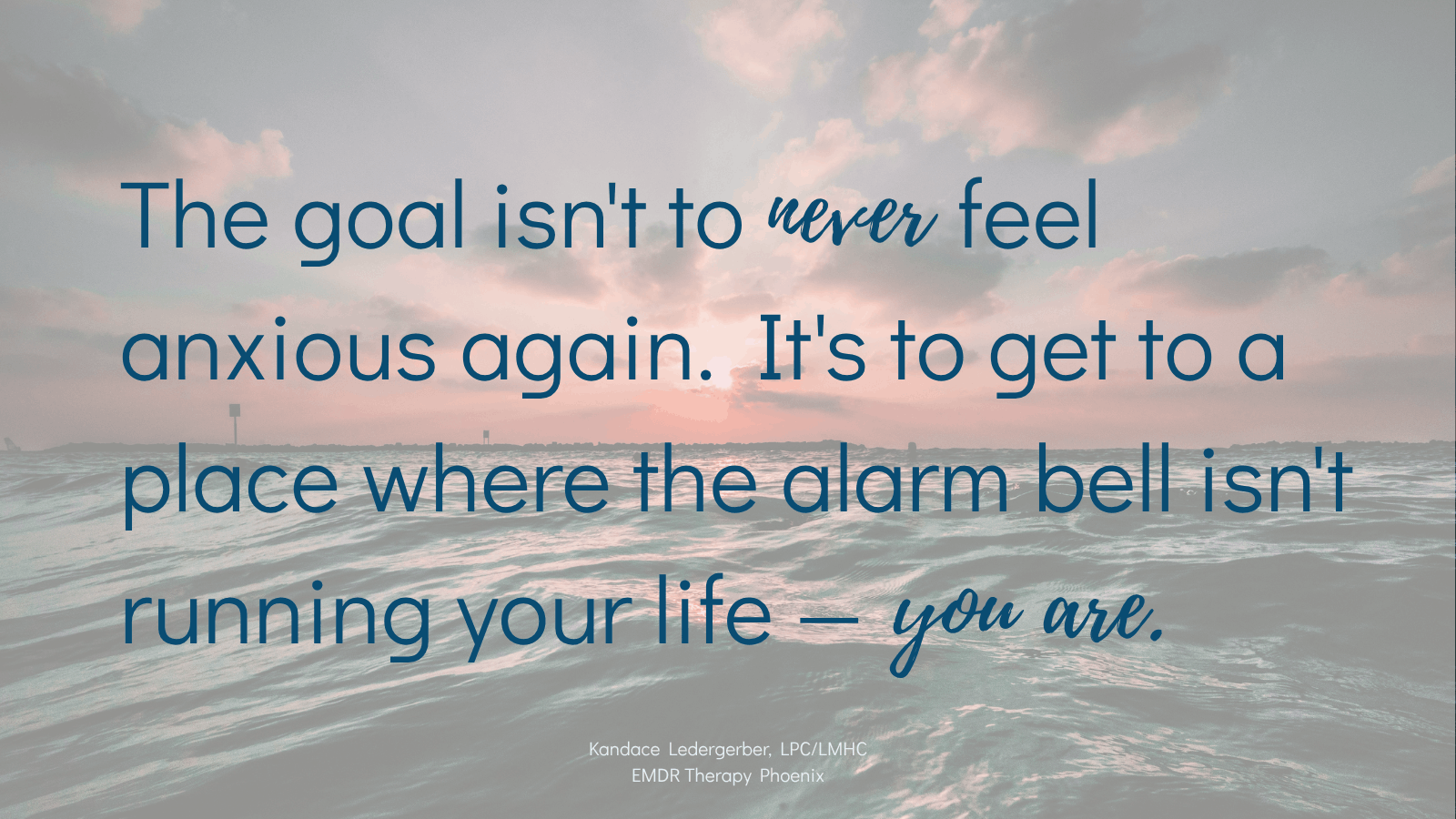
Photo by Silas Baisch on Unsplash
Photo Description: Dark teal text on a soft ocean sunset background reading: "The goal isn't to never feel anxious again. It's to get to a place where the alarm bell isn't running your life — you are." The word "never" and the phrase "you are" appear in a cursive script font for emphasis. Attributed to Kandace Ledergerber, LPC/LMHC, EMDR Therapy Phoenix.
If the nervous system heals through experience and not through understanding, the natural next question is: Well, what kind of experience?
This is where I want to talk about EMDR, because it's the modality I use most often with anxious clients, and it's one of the most misunderstood tools in the therapy world.
EMDR stands for Eye Movement Desensitization and Reprocessing. I know, it’s not exactly a name that rolls off the tongue. But here's the cliff notes - it's a research-backed therapy that helps your brain finish processing experiences it got stuck on. Because that's what trauma does. It doesn't just live in your memories rent-free; it lives in your nervous system, running in the background, keeping that alarm bell primed and ready for action.
You can understand cognitively that your boss isn't your parent. You can know, logically, that you're not a child anymore and that you're safe. And your body can still respond like none of that is true the second something feels familiar from your past. That's not a thinking problem. That's a nervous system problem. And EMDR works at the level of the nervous system.
What I find most meaningful about EMDR for anxious clients specifically is that it doesn't ask you to white-knuckle your way through therapy. It creates the conditions for your nervous system to actually experience safety, sometimes for the first time. And when that happens, the alarm bell doesn't disappear, but it finally starts to re-calibrate.
If you want to go deeper on what EMDR actually looks like and whether it might be right for you, I wrote a complete guide that walks through the whole process in plain language. Find it here.
You Were Never the Problem
If your alarm bell has been going off your whole life, that makes sense. It was doing its job. It kept you safe, or at least, it tried to, in an environment where safety wasn’t guaranteed.
You don’t have to keep living with the alarm going at that volume.
If this resonated with you, I’d love to hear from you. Reach out to schedule a free consultation, or learn more about how I work with anxiety and whether it might be a good fit for where you are right now.
TL;DR
Your anxiety makes sense. It was your nervous system adapting to an environment where safety wasn't guaranteed.
That inner voice telling you to "get it together" probably isn't yours; you learned it from someone else.
Many anxious people are incredible at giving emotional safety to others, and have never learned to receive it themselves.
Healing isn't about eliminating anxiety; it's about the alarm bell learning it doesn't have to run your life
You were never the problem.

About the Author
Kandace Ledergerber, LPC/LMHC, Certified EMDR Therapist
Kandace helps adults who feel stuck in the hamster wheel of anxiety and perfectionism reconnect with a sense of grounding, self-trust, and emotional steadiness. Through EMDR therapy and nervous system-informed work, she supports clients in moving out of survival mode and into a more grounded, meaningful life.
She specializes in trauma recovery, anxiety and perfectionism, and healing the lingering effects of childhood and relational trauma. Her work focuses on helping clients process painful experiences that still feel "stuck" so they can move forward with greater peace, confidence, and emotional freedom.
She offers EMDR therapy in Phoenix, anxiety therapy, and EMDR Intensives in Arizona.
Learn more about Kandace's background, approach, and services on her About page.