Why Your Nervous System Can't 'Just Calm Down'
Photo by Matt Hardyon Unsplash
Photo Description: Blog header graphic reading "Why Your Nervous System Can't Just Calm Down" with subtitle "From an EMDR Therapist in Phoenix" and author credit "By Kandace Ledergerber, LPC/LMHC, Certified EMDR Therapist." Ocean wave background in soft blue tones.
You've tried the apps… Probably more than one if we're honest. You've sat through the guided meditations, followed the breathing prompts, maybe even paid for the premium version with the sleep sounds and the body scans. And still, something in your body and brain just won't settle.
Maybe it feels like trying to force yourself to fall asleep. The harder you try, the more awake (and irritated) you are. The more you tell yourself to relax, the more wired and alert you feel. And underneath all of it is this quiet, exhausting question: What is wrong with me?
Here is my guess, based on working with many trauma survivors with this issue. Nothing. Nothing is wrong with you.
The problem isn't that you're inherently bad at calming down. The problem is that you've been trying to drop yourself into stillness in a nervous system that doesn't yet feel safe enough to receive it. Kind of like attempting to eat your dinner calmly for the evening, but instead of at a table, you're on a roller coaster.
Calm isn't a switch you simply flip. It's something you build. And for a lot of people (especially people who've been through hard things), that building takes a different kind of work than a breathing app can offer. And it's often easier when there is a human being sitting next to you, guiding you through it and problem-solving along the way.
Key Takeaways
Your nervous system isn't broken. It's doing exactly what it learned to do -- staying alert to stay safe.
Calm isn't a switch you flip. It's something you build over time, like a muscle.
The window of tolerance explains why stress sends some people into overdrive and others into shutdown.
Regulation is possible. But it requires working with your body, not against it.
Your Nervous System Is Not Broken -- It's Trained
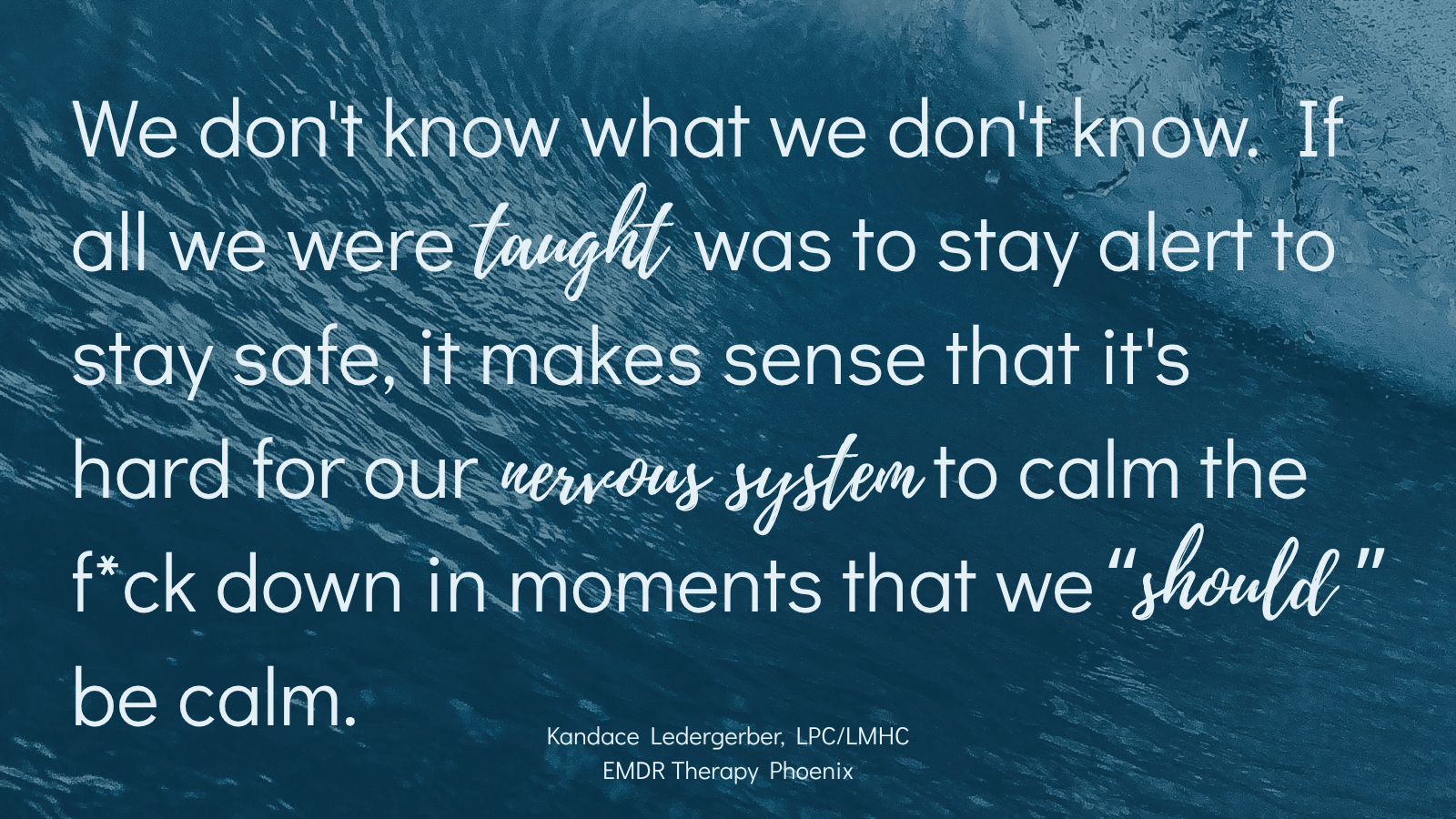
Photo by Silas Baisch on Unsplash
Photo Description:Quote graphic reading "We don't know what we don't know. If all we were taught was to stay alert to stay safe, it makes sense that it's hard for our nervous system to calm the f*ck down in moments that we 'should' be calm." Attributed to Kandace Ledergerber, LPC/LMHC. Dark ocean wave background.
Your nervous system has one job: keep you alive. Not happy. Not calm. Simply alive.
So it stays alert. It scans for threats. And for people who grew up in environments that were unpredictable or unsafe, it learned to stay on high alert long after those environments were gone. That alertness was never a flaw. It was the whole point. And it did its job...sometimes too effectively.
The problem isn't that your nervous system learned this. It's that it doesn't get the memo when things have changed.
I know it can be genuinely frustrating; a) that you had to develop this skill in the first place, and b) that it's still live and in action. I want to speak to both of these.
The first is that we often grow up in environments that have behaviors that are passed on through generations. Often (not always, but often) the caregivers raising you did what they were taught. It doesn't make it okay, AND it's a place of understanding and context.
The second, I say often in sessions, is that "We don't know what we don't know." If all we were taught was to stay alert to stay safe, it makes sense that it's hard for our nervous systems to calm the f*ck down in moments that we should be calm. I would also say that it's not impossible to learn and develop, much like any muscle.
But here's the thing about muscles -- building them requires more than knowing you need to. It requires the right conditions, repeated over time. Your nervous system is no different.
This is why you can know, in your mind, that you're safe and somehow still feel like you're not. The knowing lives in your head. The felt sense of safety has to be built somewhere else. If you want to understand more about how the nervous system holds on to what the mind tries to move past, this post on why your body remembers what your mind tries to forget is a good next read.
What the Window of Tolerance Actually Means
You might have heard this term before, and often it's one of those therapy jargon terms that don't really get broken down. Here's what it actually feels like.
Think of your nervous system as having a zone, a range where you feel like yourself. Present. Able to think. Able to feel things without being swallowed whole by them. That's your window of tolerance.
When something pushes you above that window, you can feel it. Your heart rate speeds up. Thoughts race. You snap at someone, or you can't sit still, or everything feels urgent, even if you can't pin-point the why behind the urgency. That's hyperarousal, where your system is stuck in fight-or-flight.
When something pushes you below the window, you also know it, though it can be harder to name. You feel flat, perhaps disconnected or numb. You're in the room but not really there. Your memory might feel foggy, and you're shut down. That's hypo arousal, which can feel like a kind of collapse.
When we experience a trauma or a repeated stressor, our bodies and brains aren't just affected in the original event. We continue (most of the time) to carry it with us, and it shrinks the window. So things that wouldn't rock someone else's boat send you launching out of yours, not because you're being dramatic, but because your nervous system's threshold has been changed by everything it's been through.
This doesn't mean something is wrong with you; it's your nervous system responding to old information. And it makes complete sense.
Why 'Just Calm Down' Doesn't Work (And Can Even Make You Feel More Activated)
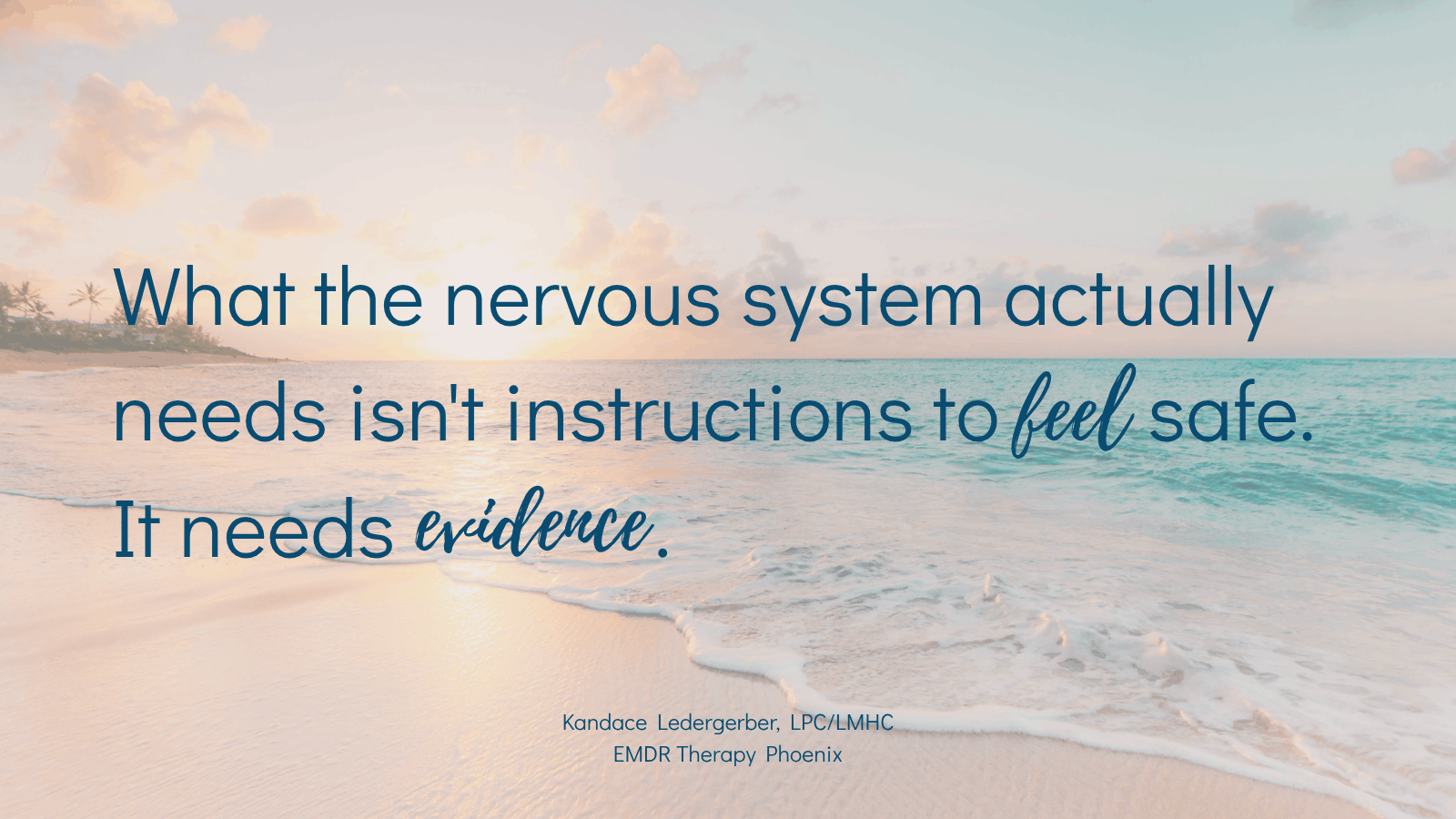
Photo by Sean Oulashinon Unsplash
Photo Description: Quote reading "What the nervous system actually needs isn't instructions to feel safe. It needs evidence." Attributed to Kandace Ledergerber, LPC/LMHC,. Soft beach and ocean background in warm sunrise tones.
Calm isn't the absence of activation. It's a state your nervous system has to learn is safe enough to enter.
When someone tells you to breathe through it, to relax, or let it go, they're asking your nervous system to do something it hasn't been taught to trust yet. The meditation app is doing the same thing. It's asking you to drop into stillness before your system has any evidence that stillness is safe.
For some people, silence is activating. Being still brings up more, not less. And lying there trying to deep-breathe while anxiety is climbing can feel like being told to slow down when every alarm bell in the building is going off. If this resonates, this post on why perfectionism can feel safer than stillness unpacks why your nervous system might actually prefer the busy.
Part of my work with clients is learning what makes those alarm bells feel louder, and what feels like a sense of security. We work with the defenses you've built over time, because those served a function at one point. The goal isn't to turn off all the alarm bells forever -- it's to work with them so they feel less reactive in situations that don't warrant it.
What the nervous system actually needs isn't instructions to feel safe. It needs evidence. Repeated experiences of: I was activated, and then I came back. Something helped, and I was able to land. And, over time, that's what builds a felt sense of safety, not the right playlist, but accumulated proof that you can regulate.
Building Regulation Instead of Forcing It
What I've found over and over again is that as we develop trust in the therapeutic relationship, we can also develop the skills needed to access that sense of security and calm, because the relationship supports it. And that translates to the rest of the week, too.
So what does building that actually look like?
It starts with resources. Not generic ones, not "take a walk" or "light a candle," though those things can be nice. Actual resources that are specific to you. A memory of a place where you felt genuinely at ease. A person, real or imagined, who felt safe to be around. An image, a sensation, a moment your body can return to and recognize as neutral or even a sense of well-being.
The goal isn't to transport yourself somewhere else and disconnect from the rest of the world forever. It's to help your nervous system remember (or perhaps discover for the first time) that a felt sense of calm is something it's capable of.
When we start to build these resources, I like to begin by asking what would feel most helpful in your daily life. These are all imaginal activities; they work a bit like guided meditations or imagery, but they're built around you specifically. The ones I use most often include:
A place in your mind to contain information that's throwing you out of your window of tolerance
A place you can return to for a felt sense of calm and well-being
A grounding exercise that moves through body awareness, breath, physical relaxation, and settling into that place of well-being
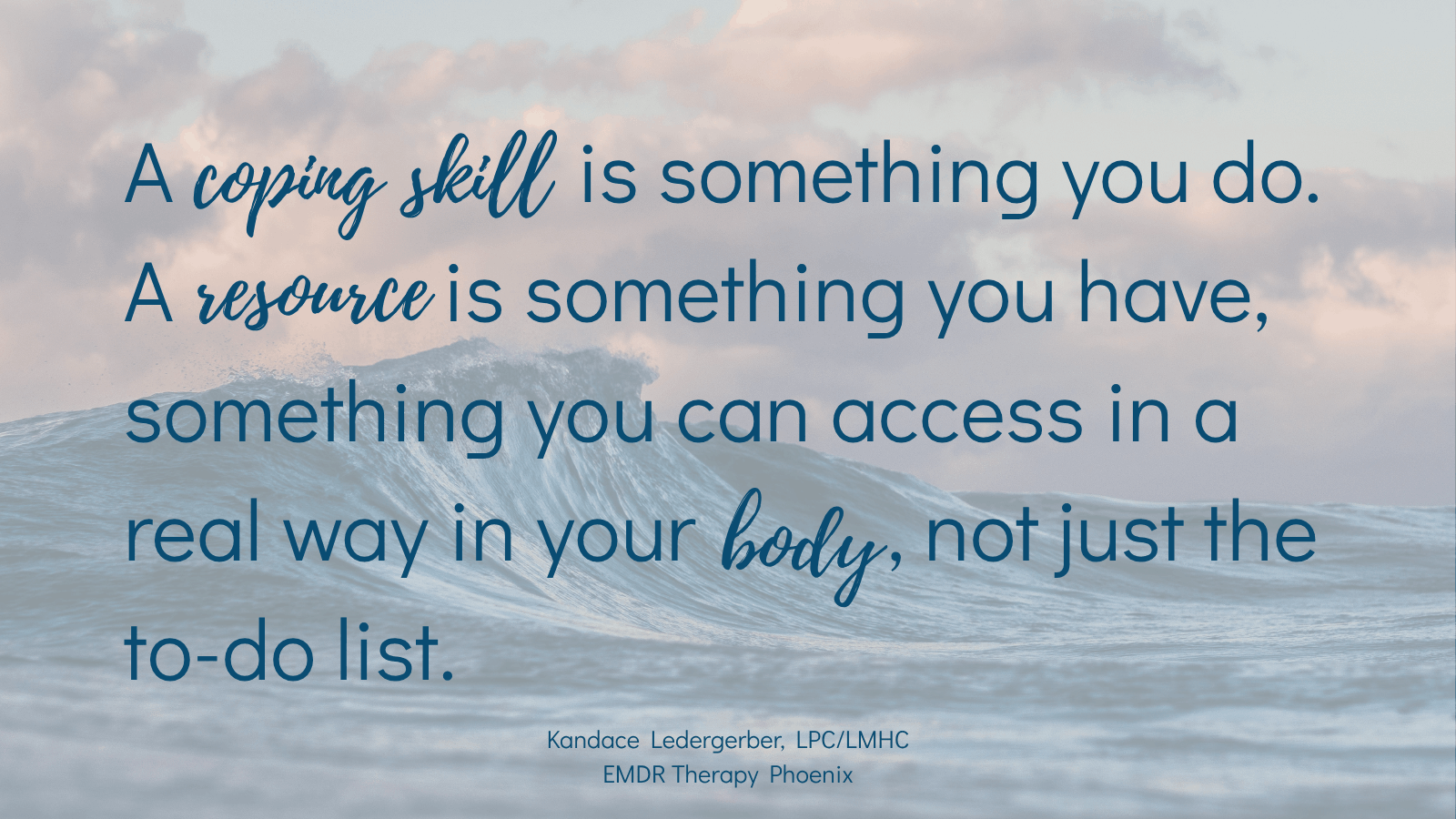
Photo by Silas Baischon Unsplash
Photo Description: Quote graphic reading "A coping skill is something you do. A resource is something you have, something you can access in a real way in your body, not just the to-do list." Attributed to Kandace Ledergerber, LPC/LMHC. Soft ocean wave background in blue and peach tones.
We might use bilateral stimulation to help the brain and body sink into those places more fully. And then I encourage practicing at least once a day, and especially in the moments when you feel yourself starting to leave that window. If you'd like to read more about what building those resources actually looks like, this post on nervous system regulation tools goes deeper into the practice.
What I find is that there's a real difference between a coping skill that you might use and forget about and a resource that's actually wired in. A coping skill is something you do. A resource is something you have and can access in a real way in your body, not just the to-do list. Building those takes time and repetition. But once they're there, they're yours.
The Ebb and Flow - Why We Don't Stay in the Hard Stuff
Here's something that surprises a lot of people about trauma work: we don't just dive in to the deep dark waters and stay there.
Good trauma therapy looks more like wading than swimming. You step into what's difficult and you stay long enough to work with it, but not so long that you're overwhelmed by it and consumed by the waves. And then you come back to something that feels okay, neutral, grounded and hopefully a bit calmer.
Your nervous system needs both. The tension and the return. Both the activation and the landing. Because if we push past what your system can hold, and force into dysregulation and stay there, you're not healing, you're just reexperiencing.
This is sometimes called titration in clinical settings, but the concept is simpler than the word: small doses, with space in between. Like a rep of an exercise with a water break to give your muscles a much-needed break.
In my practice, I treat trauma by re-processing the same way. The goal is for us to tap into the memory while still keeping ourselves present in the room and connected in the moment. And if it gets too overwhelming, if the client feels themself disconnecting, numb, blank, too anxious or on edge, we back off and come back to center. The point is allowing ourselves to process the past in a place that feels accessible, not forcing ourselves into a box of trauma and staying there.
The choice, always, belongs to you. How long you stay with something, and when you touch back down. There's no pushing through in good trauma work. There's only moving at the pace your nervous system can actually use, and ultimately, through it all, you are in charge.
This is what makes the work sustainable instead of retraumatizing.
Where EMDR Comes In
EMDR therapy gets mischaracterized a lot. People imagine it means reliving everything in detail, or that the eye movements are some kind of trick.
What it actually is: a structured way to help your nervous system process what it's been holding. And it starts exactly where this post started -- with safety.
The resourcing phase of EMDR is where we build those guided imagery resources before we approach anything difficult. We're not skipping to the hard part. We spend real time helping your nervous system learn what regulation feels like, so that when we do approach something hard, you have somewhere to return to. That phase isn't a warm-up; it's actually the foundation.
For people who've spent years trying to force calm into a system that doesn't feel safe to do so, it's often the piece that's been missing.
If you're in Phoenix and you've been white-knuckling your way through trying to feel better, this is the kind of work I do at Soul Mission EMDR Therapy. You can learn more about EMDR therapy in Phoenix and what that process looks like, or read the complete guide to EMDR therapy if you want to go deeper before reaching out.
Ready to Stop Forcing It?
If you've been trying to calm a nervous system that doesn't feel safe, you're not failing at self-care. You're running up against something that needs a different kind of support.
The work is slower than a magic app (unfortunately). But it is more specific to you.
If that sounds like what you've been looking for, I'd love to talk. Reach out to schedule a free consultation, where we can have a conversation about where you are and if the type of work I do might help.
TL;DR
Your nervous system isn't defective, it's protective. It learned to stay on guard because, at some point, that kept you safe. Calm isn't something you force; it's something you build through repeated experiences of activation and return. The window of tolerance explains why everyday triggers can feel so big. Real regulation means creating a felt sense of safety first, then gradually expanding what you can hold. EMDR is one way to actually do that work, starting with resources, not the hard stuff.

About the Author
Kandace Ledergerber, LPC/LMHC, Certified EMDR Therapist
Kandace helps adults who feel stuck in the hamster wheel of anxiety and perfectionism reconnect with a sense of grounding, self-trust, and emotional steadiness. Through EMDR therapy and nervous system-informed work, she supports clients in moving out of survival mode and into a more grounded, meaningful life.
She specializes in trauma recovery, anxiety and perfectionism, and healing the lingering effects of childhood and relational trauma. Her work focuses on helping clients process painful experiences that still feel "stuck" so they can move forward with greater peace, confidence, and emotional freedom.
She offers EMDR therapy in Phoenix, anxiety therapy, and EMDR Intensives in Arizona.
Learn more about Kandace's background, approach, and services on her About page.