Photo by Linus Nylund on Unsplash
Photo Description: Blog title graphic reading “The Nervous System Is Not a Mindset” with subtitle “Nervous System Regulation for Adults Living in Fight, Flight, or Freeze.” The background features soft ocean imagery symbolizing emotional regulation and stability.
Nervous System Regulation for Adults Living in Fight, Flight, or Freeze
If you’ve stumbled onto this article, you’re probably an adult who can recall events from your life, some of them painful. You understand the patterns that grew out of those experiences. You can name your triggers. You may even journal with the best of them about the ins and outs of your childhood. I’m guessing you’ve been to therapy, or at the very least, you’re deeply insightful.
Which is why it can feel so damn frustrating when your nervous system completely hijacks you and you’re caught off guard.
If you’ve ever thought, I know I’m safe… why the f** can’t I just relax?* — you’re not failing at self-awareness, a positive mindset, or coping skills.
The nervous system is not a mindset. It is physiology. And physiology does not respond to logic alone.
Many of the adults I work with can explain how their childhoods shaped them. They can recognize when anxiety is disproportionate to the situation. They can tell you exactly why they react the way they do.
And yet their body still braces as if something bad is about to happen.
That disconnect is not a weakness. It’s biology.
What Nervous System Regulation Actually Means
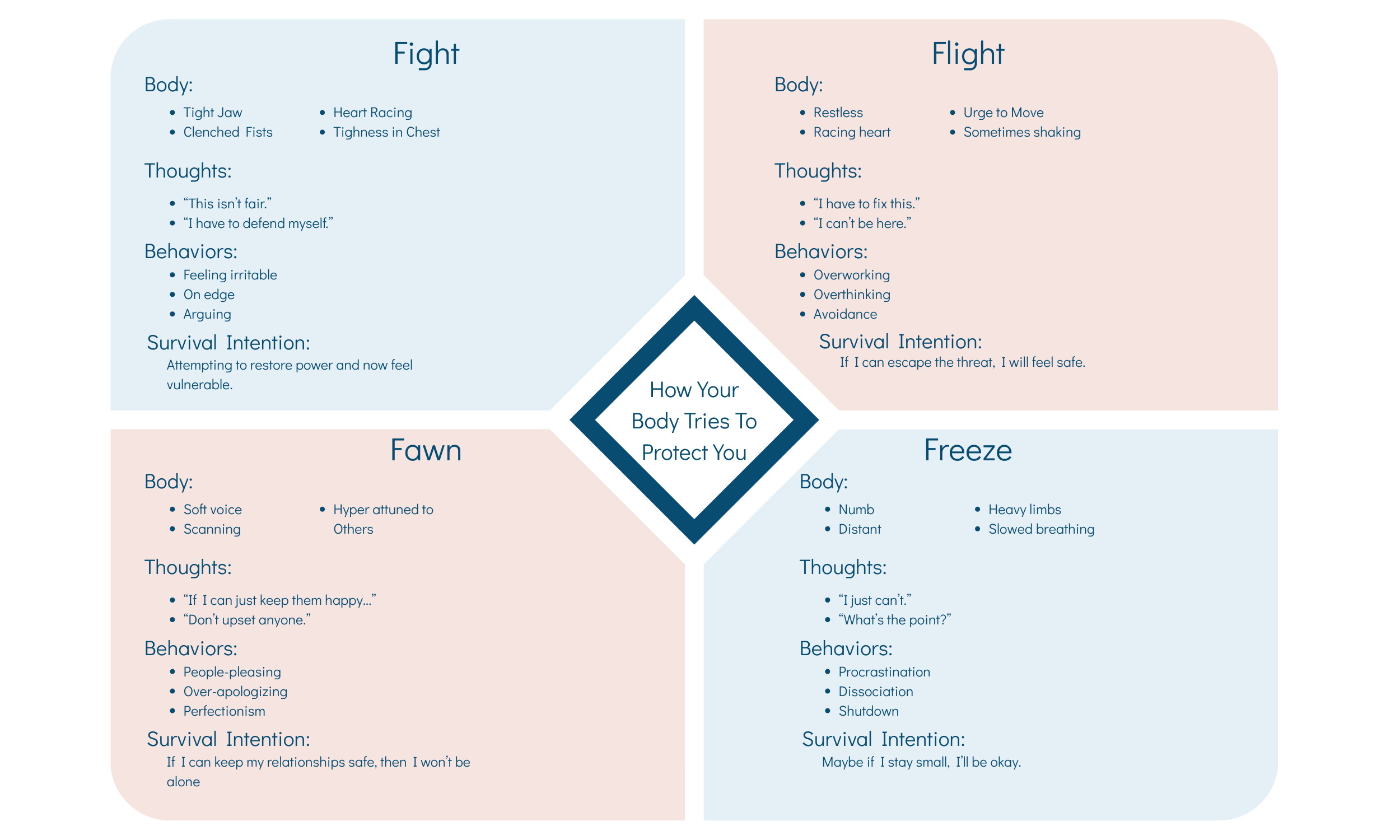
Photo Description: Four-part educational diagram explaining fight, flight, freeze, and fawn responses. Each section lists common body sensations, thoughts, behaviors, and the underlying survival intention associated with each nervous system state.
Your nervous system is constantly scanning for cues of safety or danger. If we think about our ancestors, survival depended on accurately reading the environment. Was there a predator nearby? Was the tribe safe? Missing those cues could be deadly.
So when your system perceives threat, it shifts automatically into survival mode. This happens incredibly fast and completely outside of conscious choice.
That survival activation tends to show up in predictable patterns:
Fight — irritability, anger, control, intensity
Flight — anxiety, overworking, perfectionism, restlessness
Freeze — shutdown, numbness, procrastination that feels paralyzing
Fawn — people-pleasing, over-accommodating, losing your voice
Please hear me when I say: these are not personality flaws. They are adaptive strategies. At some point, your nervous system learned that one of these responses increased your chances of getting through something hard. What a smart system.
The issue isn’t that your nervous system learned this pattern. The issue is that it hasn’t learned that you no longer need to stay on high alert.
When stress becomes chronic or trauma remains unprocessed, the body can stay braced long after the danger has passed. That’s when people begin searching for nervous system regulation or how to regulate your nervous system. What they’re really asking is: Why does my body still feel unsafe?
If you’d like a deeper explanation of how trauma responses get stored in the body and why triggers feel so intense, you can read more in my article on when trauma triggers take over.
You Cannot Journal Your Way Out of Survival Physiology
Journaling is an amazing tool! I actually created an entire workbook around it. But insight lives in the thinking brain. Survival lives in the more primitive parts of the brain that activate the body.
When your nervous system is activated, your brain prioritizes protection over reflection. In that state:
You can know you’re safe and still feel anxious.
You can understand your triggers and still react intensely.
You can explain your trauma and still feel it in your chest, throat, or stomach.
This is why affirmations sometimes feel hollow, or even like a lie. It’s why cognitive tools can feel inaccessible in the exact moments you need them most.
Self-awareness is powerful. But self-awareness without regulation can quietly turn into self-criticism. Cue the voice that says, Why can’t I just do this? (I talk more about that annoying inner voice here.)
If your body is white-knuckling it, no amount of reasoning will convince it to relax. It needs to experience safety and stabilization first.
Regulation Before Reaction (and Reflection)

Photo by Clay Banks on Unsplash
Photo Description: A woman wearing hiking gear stands outdoors in a mountain landscape, looking upward with a calm expression. The image symbolizes grounding, regulation, and nervous system stabilization practices discussed in the article.
This is where many high-functioning adults get stuck. You may have done years of personal growth. You may be incredibly insightful. But when your nervous system is activated, cognitive strategies alone often fall flat.
Nervous system regulation is not about forcing yourself to relax. It is about offering cues your body can register as safe.
That can include simple practices such as:
Lengthening your exhale slightly longer than your inhale
Letting your eyes slowly orient to the room
Pressing your feet into the ground and noticing support
Gentle, slow bilateral movement or rhythmic walking
These are not dramatic interventions. They are small signals that you are not being chased by a bear. And small signals, repeated consistently, begin to shift your baseline.
When the nervous system settles, even slightly, thinking becomes more flexible. Other people’s reactions feel less threatening. Rest feels less dangerous.
Why Self-Care Feels Impossible When Your Body Feels Unsafe
Many adults blame themselves for inconsistency with self-care. They start meditation and abandon it. They tell themselves to rest but feel anxious when they try.
But an activated nervous system interprets stillness as vulnerability.
If your system learned that staying busy meant staying safe, then slowing down can trigger discomfort rather than relief. This is especially true for adults who:
Grew up in unpredictable or emotionally unsafe environments
Became “the responsible one” early in life
Learned that productivity equals value
Live with high-functioning anxiety or perfectionism
Your body adapted beautifully to survive what it had to. It makes sense that it struggles to power down now.
A 3-Minute Practice to Begin Regulating Your Nervous System
This is not about achieving perfect calm. It is about offering your body new information.
Place both feet flat on the floor and gently press them down. Let your eyes slowly scan the room and name three neutral objects. Nothing meaningful. Just neutral.
Take one slow breath in through your nose.
Let your exhale be slightly longer than your inhale.
Allow your shoulders to soften just a fraction.
You are not trying to eliminate anxiety. You are letting your nervous system register that, in this moment, there is no immediate threat.
Small repetitions of safety build new patterns over time.
If you would like more guided practices like this, I created a Nervous System Regulation Workbook inside the Thriving Era Toolkit. It includes structured reflections and gentle exercises designed for adults who are tired of living in fight, flight, or freeze. You can access it here: Thriving Era Toolkit
When the Body Feels Safer, Everything Changes
When the nervous system begins to shift, thoughts follow. Not because you forced them to, but because the body is no longer bracing for impact.
Anxiety softens. Perfectionism loosens its grip. Rest becomes more accessible. Therapy becomes more effective because your system can process rather than defend.
If you are looking for EMDR therapy in Phoenix and want trauma-informed therapy that works with your nervous system instead of arguing with it, you are welcome to book a free 15-minute consultation and learn more about my approach.
TL;DR
The nervous system is physiological, not just psychological.
Fight, flight, freeze, and fawn are protective responses.
Insight alone does not regulate survival activation.
Regulation must come before deeper reflection.
Small, repeated signals of safety can shift your baseline.

About the Author
Kandace Ledergerber, LPC/LMHC, Certified EMDR Therapist
Kandace helps adults who feel stuck in the hamster wheel of anxiety and perfectionism reconnect with a sense of grounding, self-trust, and emotional steadiness. Through EMDR therapy and nervous system-informed work, she supports clients in moving out of survival mode and into a more grounded, meaningful life.
She specializes in trauma recovery, anxiety and perfectionism, and healing the lingering effects of childhood and relational trauma. Her work focuses on helping clients process painful experiences that still feel "stuck" so they can move forward with greater peace, confidence, and emotional freedom.
She offers EMDR therapy in Phoenix, anxiety therapy, and EMDR Intensives in Arizona.
Learn more about Kandace's background, approach, and services on her About page.