Why Family Trauma Can Make Boundaries Feel Impossible

Photo by Silas Baischon Unsplash
Photo Description: A wide landscape image featuring a dramatic stormy ocean wave at sunset with warm orange and pink tones in the sky. A semi-transparent light overlay sits in the center of the image containing the blog title “Why Family Trauma Can Make Boundaries Feel Impossible.” in dark teal text, a small coral horizontal rule, and the author name and credentials in smaller dark teal text below, “Kandace Ledergerber, LPC/LMHC, Certified EMDR Therapist”
You told yourself this time would be different.
Maybe you'd even practiced it. Thought through what you would say, how you would hold the line, what it would feel like to actually mean it. And then the moment came- the request, the guilt trip, the familiar tone that you've known your whole life. And something in you just... collapsed.
Not a dramatic decision. Not even really a choice. More like the fight went out of you before it had a chance to start. Fine. It's just easier this way. You gave in, smiled through it, said yes when every single part of you was screaming no.
And now you're sitting with that familiar feeling afterwards. The one that's equal parts relief, resentment, and perhaps some sadness or shame. The tension and anxiety gone, sure. But something else went with it.
If this sounds familiar, I want to pause before we go any farther and share - You are not bad at boundaries.
You are someone whose system learned, a very long time ago, I'd guess, that having needs was dangerous. And no amount of knowing better logically is going to override that failing in your body, where it lives.
Key Takeaways
Struggling to hold boundaries after family trauma doesn't necessarily mean you have an issue with willpower; it signals that something is stuck in the nervous system.
The body learned that conflict was dangerous, love was conditional, and keeping the peace was the safest option
The collapse you feel in that moment isn't you being weak; it's an old survival mechanism replaying, doing exactly what you needed it to do when it was formed.
Not all boundary attempts feel the same: the relationship context matters enormously
Healing happens through noticing, not perfecting - what happens in your body and in the relationship is the data
You don't need to get it right every time. You just need to start somewhere safe.
This Isn't a Willpower Problem
In my opinion, the mainstream conversation about boundaries has a bit of a script problem.
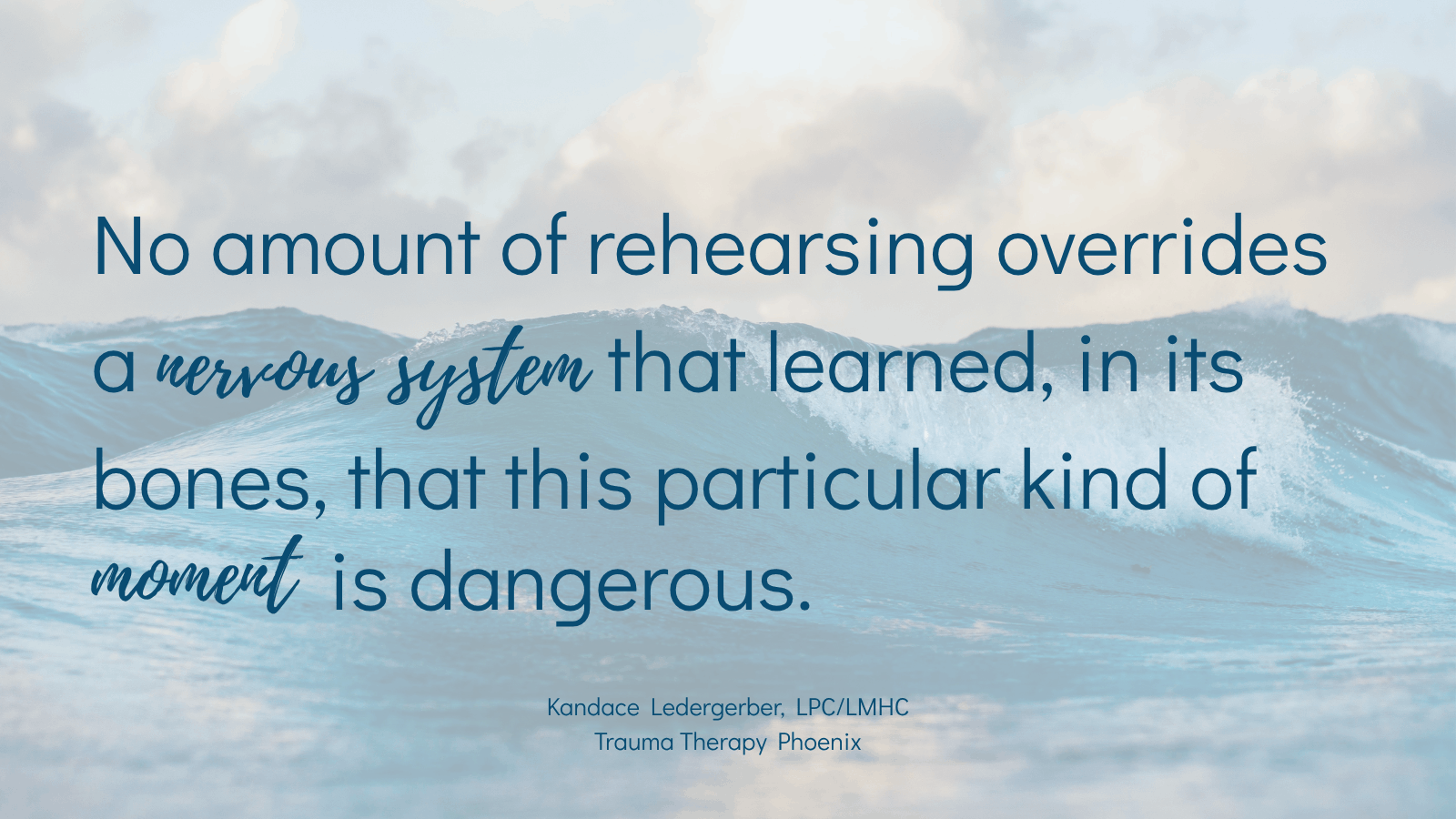
Photo by Silas Baisch on Unsplash
Photo Description: A wide landscape image with a dramatic ocean wave background in cool blue and grey tones. Dark teal text overlays the image with a quote about the nervous system and boundaries. “No amount of rehearsing overrides a nervous system that learned, in its bones, that this particular kind of moment is dangerous.” The words "nervous system" and "moment" appear in a cursive script font for emphasis. Attribution reads Kandace Ledergerber, LPC/LMHC, Trauma Therapy Phoenix in smaller centered text at the bottom right.
It assumes the hard part is knowing what to say. So it offers frameworks, talking points, and specific language designed to be firm but kind. And if the boundary doesn't hold, the implication is that you just didn't say it confidently enough or didn't do it right. Try again, with more conviction this time, louder for the back.
But something important to keep in mind is that for someone who grew up in a home where having needs felt genuinely unsafe, that advice lands somewhere between useless and quietly cruel.
Most people I talk with know what a boundary is. They can describe it on paper, and perhaps could even describe exactly what they might say. But in the moment, something happens in their body. Their voice starts to shake, their hands feel clammy, and they're trying really hard to remember those words they scripted out hours before.
If you've experienced something similar, I'm guessing that the problem is not that you don't know what a boundary is. It's not that you also wouldn't be able to write out exactly what you'd like to say. It's that when the moment arrives, your body is already ten steps ahead of your brain, running a response that was put into motion long before you ever even heard the word boundary.
No boundary-forming script reaches that part. No amount of rehearsing overrides a nervous system that learned, in its bones, that this particular kind of moment is dangerous.
That means that it's not an issue of confidence, but an issue of an outdated belief held in the body.
What Family Trauma Actually Teaches the Body
When we talk about why boundaries feel impossible after family trauma, we're usually talking about three things happening at once, and they don't always show up in equal parts. Different relationships and different family members can activate different layers of what was once built-in protection.
The first is the fact that the body learned there was a danger in conflict. Especially in homes where conflict meant explosive yelling, punishment, withdrawal of love, or emotional chaos, the nervous system logged a very clear message: disagreement is dangerous, and we need to stay safe. And now, even decades later, the adult version of that child can know logically that the conversation isn't actually dangerous, but their body will feel like a bear is chasing them.
The second I find most often is a belief that the person coming into therapy holds about what they must do to keep a relationship going. This belief is often formed when love feels conditional, and they must be something in order to deserve that love. This often sounds like "I have to be perfect to deserve their love or approval" or "I have to take care of everyone and make sure they're okay." And with this old belief in mind, if they hold or draw a boundary, they might not be worthy of love, and somewhere underneath the adult logic is an older fear: if I push back, I might lose them.
And the third is a built identity around these beliefs. If you spent your childhood as the peacemaker, the caretaker, the one who held things together, you may genuinely not know who you are when you're not managing someone else. The role became so woven into your sense of self that stepping outside of it doesn't just feel uncomfortable, it can feel like a threat to something fundamental. If you recognize yourself in that, How Family Roles Follow Us Into Adult Relationships goes deeper on where those roles come from and why they follow us the way they do.
So with all three of these hurdles in front of us, saying a simple "No thank you, I don't want that" can feel like an explosive time bomb.
Why the Collapse Makes Complete Sense
Let's talk about that moment, the one where the fight just goes right out of you.
It doesn't feel like a decision. It feels like a collapse. Your shoulders drop, your resolve dissolves, and before you've fully registered what happened, you've already given in. Fine. It's just easier, I'll just suck it up. Again.
And here's what I'd love to remind you for those moments - your nervous system did exactly what it needed to do to feel safe.
The family system you grew up in (most likely) is one of the most powerful threat-detection contexts your body knows. It doesn't matter that you're an adult now. It doesn't matter that you're not a child in that house anymore. The moment a particular tone lands, a familiar dynamic kicks in, or a specific person makes a specific kind of request, the body responds to the old information. And the old information says: compliance keeps you safe. Collapse before it gets worse.
The fact that this survival response is here isn't a bad thing; it just may be outdated information. A response that no longer has a place but was once necessary for survival. Take a breath and let that sink in for a second. The part of you that collapses in those moments isn't failing you. It's protecting you the only way it knows how. It's just that the protection it's offering is one you built for a version of your life that you no longer live in, even if it doesn't always feel that way yet.
Green Flag Relationships Change Everything
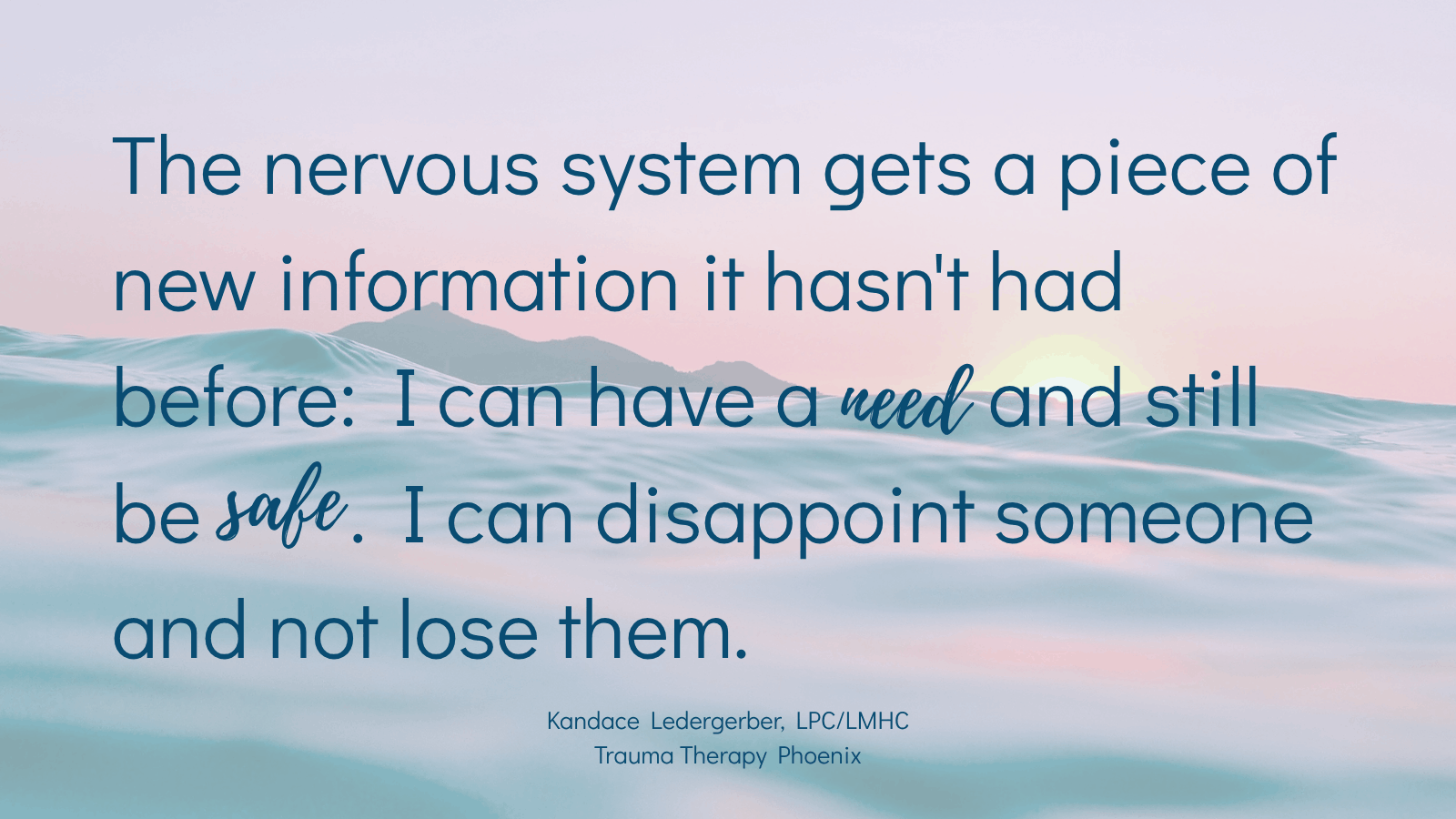
Photo by Linus Nylund on Unsplash
Photo Description: A wide landscape image with a soft pastel ocean background in pink, lavender, and seafoam tones at what appears to be sunrise or sunset. Dark teal text overlays the image with a quote about safety and healing in relationships “The nervous system gets a piece of new information it hasn't had before: I can have a need and still be safe. I can disappoint someone and not lose them.” The words "need" and "safe" appear in a cursive script font for emphasis. Attribution reads Kandace Ledergerber, LPC/LMHC, Trauma Therapy Phoenix in smaller centered text at the bottom right.
Here's something that I find rarely gets talked about in boundary conversations. Not all boundary attempts feel the same, and it's understandable that they don't.
Trying to hold a boundary with someone who has never respected them (a parent whose reactions were unpredictable, a family member whose love has always come with conditions) is a completely different nervous system experience than trying to hold one with someone who is genuinely safe. Comparing those two experiences does a real disservice to anyone trying to understand why boundaries feel impossible in some relationships and manageable in others.
In my work with clients, one of the most meaningful moments is when someone holds even the smallest boundary in a relationship where the other person responds well. Not perfectly. Not with zero discomfort. But where they say something true about what they need, and the relationship survives it. Where the other person says, "okay, that makes sense," or simply adjusts without drama.
Something shifts in those moments. The nervous system gets a piece of new information it hasn't had before: I can have a need and still be safe. I can disappoint someone and not lose them. That information doesn't erase the old programming overnight (unfortunately). But it starts to create something - a new reference point, a small piece of evidence that a different experience is possible.
That's where healing actually begins. Not in getting the script right. In accumulating evidence that safety is a real felt thing.
The Work Isn't About Getting the Words Right
What I've found most useful in this work (both clinically and practically) is shifting the focus away from performance and toward noticing.
When a client works on boundaries in therapy, we don't just practice what to say. We set the boundary, and then we pay attention to what happens afterwards. What happened in your body when you said it? Did the tension stay, did it ease, did something unexpected come up? What did the other person's response tell you about the relationship, about the world around you or even yourself? All of that is data. None of it is failure.
This approach takes the pressure off getting it right and puts it somewhere more useful, by getting curious. Because the nervous system doesn't update through perfect execution. It updates through experience. Through the slow accumulation of moments where something went differently than the old story predicted.
If you're looking for more practical guidance on what that process can look like step by step, Boundaries for Trauma Survivors: A Step-by-Step Guide to Feeling Safe While Setting Limits is a good companion to this post.
And when the nervous system needs more than noticing, when the old programming runs too deep for insight alone to reach, this is where EMDR becomes particularly helpful. Not because it teaches you what to say, but because it works at the level where the old story actually lives. The experiences that taught your body that having needs was dangerous can be processed, not just understood. And when that happens, the collapse doesn't disappear overnight, but it starts to loosen its grip. If you want to understand more about how that process works, EMDR Therapy Phoenix: A Trauma Therapist's Complete Guide to Moving Forward and Hope walks through it in plain language.
You're Not Bad at Boundaries
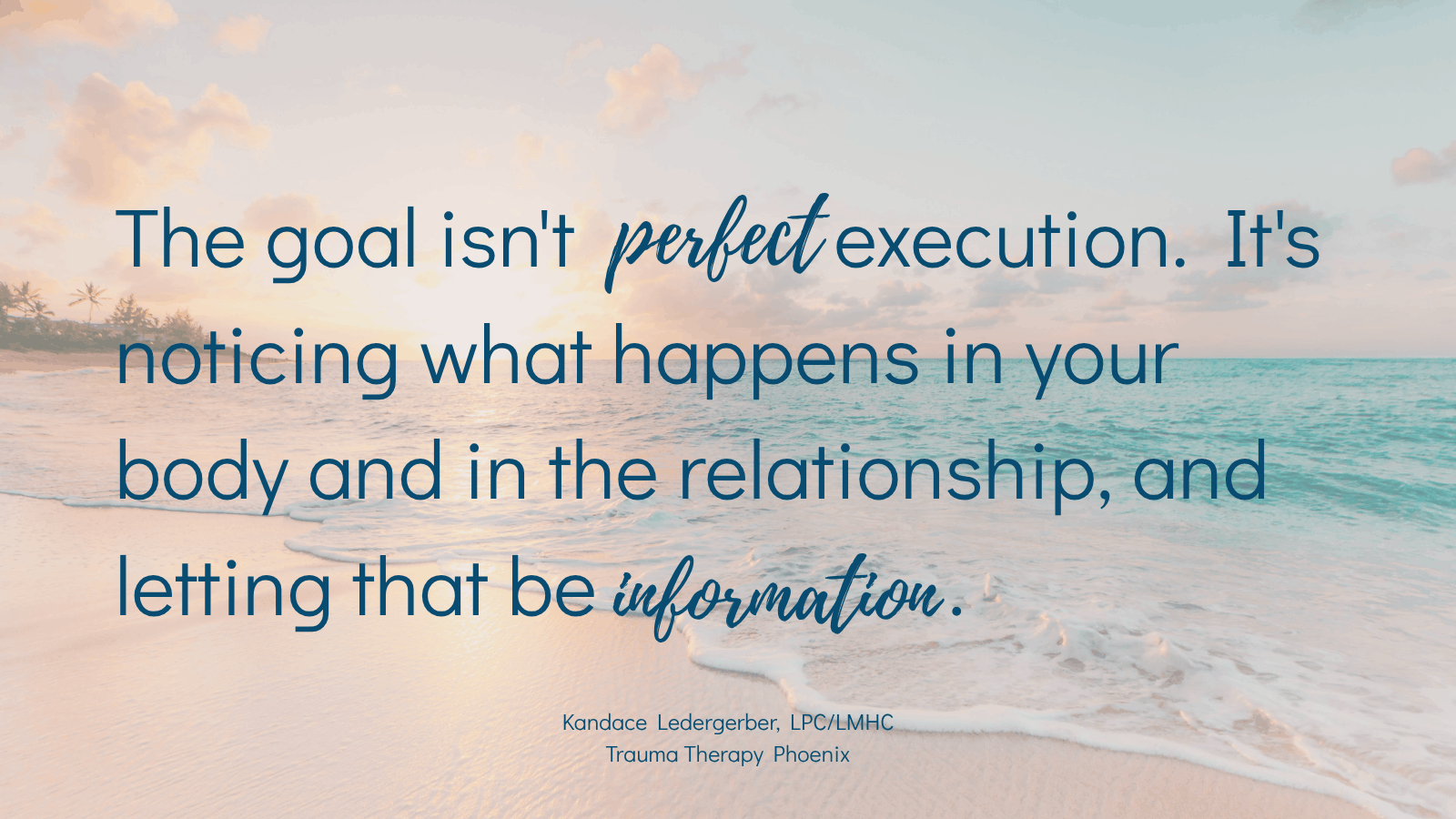
Photo by Sean Oulashin on Unsplash
Photo Description: A wide landscape image with a soft beach background in warm sunrise tones. Dark teal text overlays the image with a quote about boundaries and healing. The words "perfect" and "information" appear in a cursive script font for emphasis with quote “The goal isn’t perfect execution. It’s noticing what happens in your body and in the relationship and letting that be information.” Attribution reads Kandace Ledergerber, LPC/LMHC, Trauma Therapy Phoenix in smaller centered text at the bottom.
I want to come back to where we started, because I think it matters enough to say twice.
You are not bad at boundaries.
You are not weak, conflict-avoidant, or a pushover. You are someone whose nervous system learned, in a home that asked too much of you, that having needs put things at risk. That keeping the peace was safer than telling the truth. That the collapse (as uncomfortable as it feels) was once the smartest move available.
That learning made sense then. It kept things functioning. It kept you connected to the people you needed, even when those people weren't always safe to need.
The work now isn't about becoming someone who never collapses. It's about slowly, gently giving your nervous system enough new experiences that the collapse stops being the only option it knows.
That work is real, and it takes time, and you don't have to do it alone. If you're ready to explore what that support could look like, Trauma Therapy in Phoenix is one place it can begin.
If any of this resonated with you, reach out to schedule a free consultation or learn more about how I work with family trauma and whether it might be a good fit for where you are right now.
TL;DR
Struggling to hold boundaries after family trauma isn't about willpower or knowing the right words, it's about what the nervous system learned.
Family trauma teaches the body that conflict is dangerous, love is conditional, and compliance is the safest option. No script overrides that.
The collapse in those moments isn't weakness. It's a survival response that once made complete sense and was needed.
Not all boundary attempts feel the same. Safe relationships create new evidence that having needs doesn't have to cost you connection.
The goal isn't perfect execution. It's noticing what happens in your body and in the relationship, and letting that be information.
Healing happens slowly, through experience and you don't have to navigate it alone.

About the Author
Kandace Ledergerber, LPC/LMHC, Certified EMDR Therapist
Kandace helps adults who feel stuck in the hamster wheel of anxiety and perfectionism reconnect with a sense of grounding, self-trust, and emotional steadiness. Through EMDR therapy and nervous system-informed work, she supports clients in moving out of survival mode and into a more grounded, meaningful life.
She specializes in trauma recovery, anxiety and perfectionism, and healing the lingering effects of childhood and relational trauma. Her work focuses on helping clients process painful experiences that still feel "stuck" so they can move forward with greater peace, confidence, and emotional freedom.
She offers EMDR therapy in Phoenix, Anxiety Therapy Phoenix, Trauma Therapy Phoenix, and EMDR Intensives.
Learn more about Kandace's background, approach, and services on her About page.