How Family Roles Follow Us Into Adult Relationships

Photo by Christoffer Engström on Unsplash
Photo Description: Blog header graphic with an ocean wave background in shades of bright teal and white. A semi-transparent light blue overlay panel in the center displays dark navy text reading "How Family Roles Follow Us Into Adult Relationships." Below the title, smaller text reads "Trauma Therapy Phoenix" followed by a small coral dividing line and the author credit "By Kandace Ledergerber, LPC/LMHC, Certified EMDR Therapist."
You notice it before you can name it. The way their fork moves a little slower. The quiet that settles in just slightly wrong. Nothing dramatic. Nothing you could even point to if someone asked. But something in the air at the dinner table just changed, and your body already knows it.
Before a single conscious thought forms, you're in motion. Getting up to refill a glass. Asking if they want more food. Running through every conversation from the last 48 hours — what did I say, what did I miss, what do I need to fix before this gets worse? Hands busy. Brain spinning. The urgency and panic already running the show before you've even named what you're feeling.
It ends one of two ways. Maybe the tension builds until something finally breaks, a blowup, a door slam, and now you're either scrambling harder or you've finally had enough and you blow up too. Or maybe your partner surfaces twenty minutes later and says, "Sorry, rough day at work," and you smile and say it's fine, while something under your skin is still itching to claw out, still braced and waiting for the other shoe to drop.
If either of those endings feels familiar, I want to share something with you before we go any further.
That response likely didn't start in this relationship. It started a long time before you ever met this person.
Key Takeaways
The roles we play in adult relationships are often adaptations we learned in childhood, not personality traits.
The caretaker and the peacemaker are two of the most common roles, and they frequently live in the same person.
Growing up in a home where certain dynamics felt normal means we often don't recognize them as patterns until much later.
Following what's familiar isn't a flaw; it's what the nervous system does.
Healing isn't about blaming the people who shaped us; it's about recognizing what we learned and slowly choosing something different.
Someone Had To Do It
The behaviors you were doing in that moment (the scanning, moving, replaying, smoothing over) didn't start with this relationship. Those behaviors started somewhere much earlier. In a home where reading the room wasn't optional, and knowing someone's mood before they spoke was just part of how you stayed safe.
Family roles develop in childhood as adaptations to the emotional environment we grew up in. When a home feels unpredictable, tense, or emotionally chaotic, children become remarkably good at reading the room. They learn what keeps the peace, what prevents the blowup, and what makes the adults around them okay enough so that everyone else can breathe.
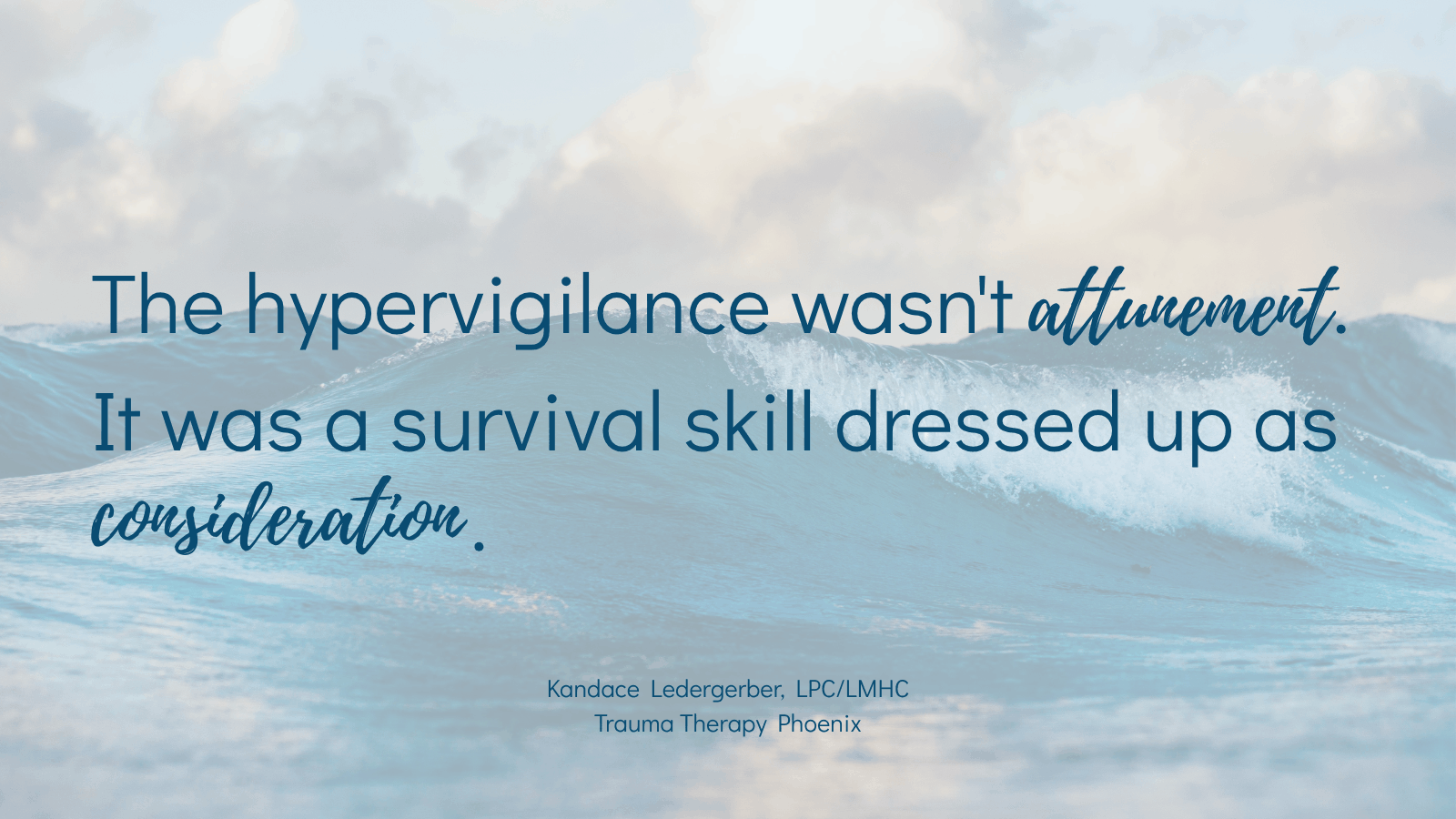
Photo by Silas Baisch on Unsplash
Photo Description: Quote graphic featuring a large ocean wave in soft blue and white tones filling the background. Dark navy text overlaid on the image reads "The hypervigilance wasn't attunement. It was a survival skill dressed up as consideration." The words "attunement" and "consideration" appear in cursive script for emphasis. Attributed to Kandace Ledergerber, LPC/LMHC, Trauma Therapy Phoenix in smaller text at the bottom.
Over time, that reading-the-room becomes a role. And the role becomes so familiar it stops feeling like a role at all. It just feels like you.
The two roles I see most often in my work (and they almost always travel together) are the caretaker and the peacemaker. The caretaker manages, anticipates, and holds things together — if this pattern feels familiar, I wrote about how the fixer role develops and what it costs in I Have to Fix It: The Lie Trauma Taught You Control Equals Safety. The peacemaker smooths, appeases, and keeps the temperature in the room from rising — and if that one lands closer to home, I Have to Keep Everyone Happy: The Lie Trauma Taught You Love Is Earned goes deeper on how that pattern forms and why it's so hard to put down. One handles the logistics of survival. The other handles the emotional weather.
In a lot of families, one child ends up doing both.
If you were that child, you probably got a lot of quiet messages about what you were good at. That you were so responsible. Mature for your age. The one who had it together. What those messages didn't account for was the cost.
We Don't Know What We Don't Know
Here's something I find myself coming back to again and again in my work: we only know what we know.
When you grow up in a home, that home is your entire reference point for what normal is. The mental replay when someone's mood shifts. The urgency to fix something before it becomes bigger or worse. The near constant low-grade hypervigilance to other people's emotional states — these weren't red flags to you. They were a common Tuesday afternoon. They were just how things worked.
So when these same patterns show up in your adult relationships, oftentimes it might not even feel like a trauma response. It might feel like being a good partner. A thoughtful friend. Someone who's just really tuned in to the people in their immediate circle.
The disorienting part, and this is something clients often sit with for a while, is realizing that what felt completely normal was actually your nervous system working incredibly hard to keep you safe. That the hypervigilance wasn't attunement. It was a survival skill dressed up as consideration.
And here's the thing, you couldn't have known what you didn't have a frame of reference for. None of us can.
The People Who Shaped the Roles
I also want to make sure we bring something to the surface here, because I think it matters:
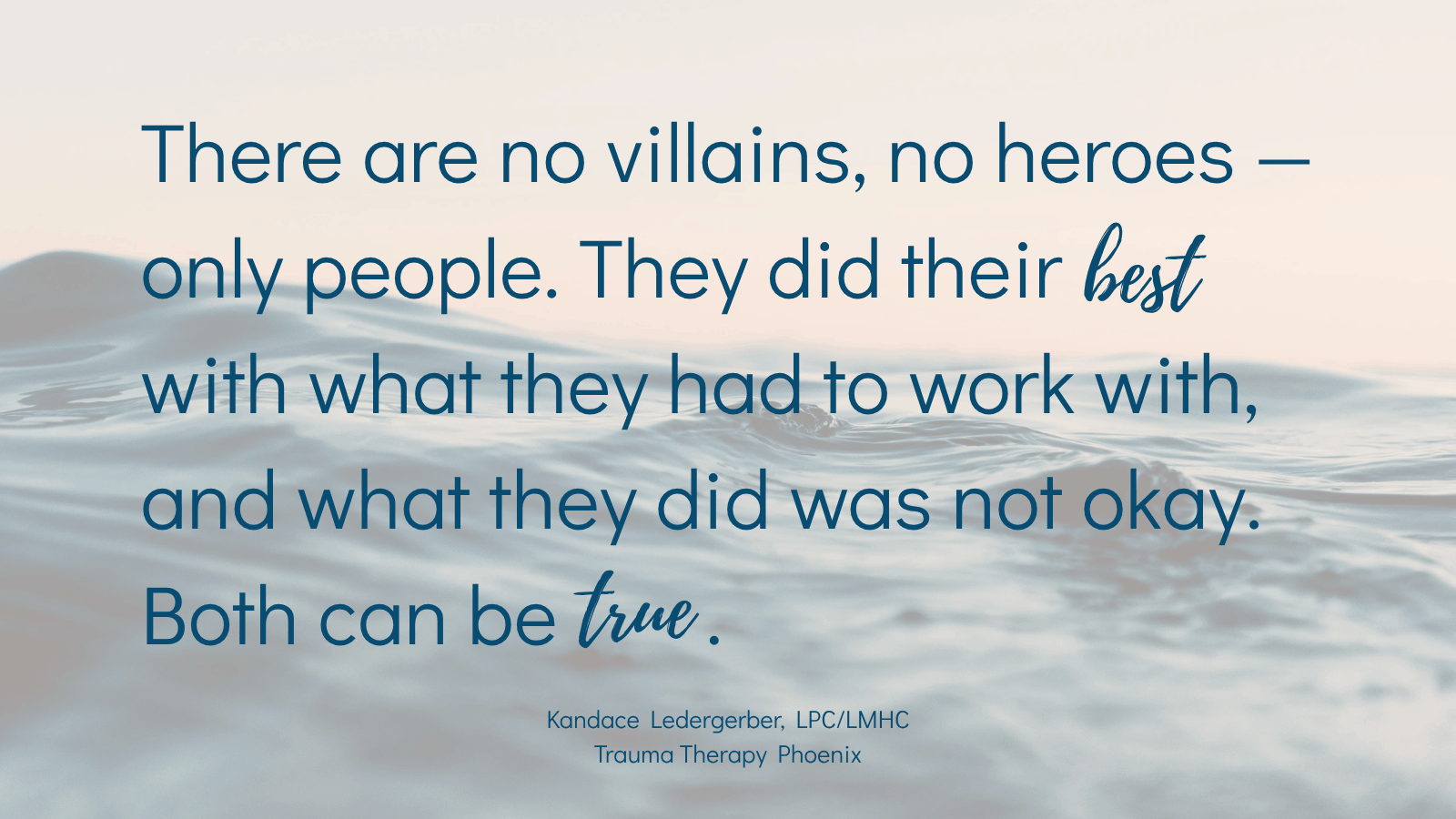
Photo by Matt Hardy on Unsplash
Photo Description: Quote graphic featuring a calm, pale ocean surface in soft blue and beige tones. Dark navy text reads "There are no villains, no heroes — only people. They did their best with what they had to work with, and what they did was not okay. Both can be true." The words "best" and "true" appear in cursive script for emphasis. Attributed to Kandace Ledergerber, LPC/LMHC, Trauma Therapy Phoenix in smaller text at the bottom center.
Understanding where your role came from doesn't require turning your parents into villains.
I heard this framing in an EMDR training years ago, and it's stayed with me: there are no villains, no heroes — only people. So often, I sit with clients whose parents made genuinely harmful choices and were also (most of the time) doing the best they could with what they had. People who were shaped by their own families, their own unprocessed pain and trauma, their own survival roles that nobody ever named with them, either.
This next piece is also important. That framing doesn't excuse the impact. What happened still happened. The way you learned to move through the world still cost you something real, and it's okay — necessary, even — to acknowledge that. Both of those things can be true at the same time.
They did their best with what they had to work with, and what they did was not okay. Both can be true.
What I notice in clients who are healing from family-of-origin patterns is that most of them don't actually want to be angry. They don't want to dole out blame. They just want to understand why they are the way they are, and then they want to feel differently, not just in their immediate world but also in the world with their family of origin. That's not avoidance. That's a completely legitimate goal. And it's certainly worth honoring.
How Those Roles Show Up in Adult Relationships
The nervous system doesn't leave the role at the door when you move out of the house.
It brings it into every relationship that follows. Romantic partnerships, friendships, workplaces, anywhere that another person's emotional state can feel like something that's your job to manage. And often, without realizing it, we gravitate toward dynamics that feel familiar. Not because we're broken or self-destructive, but because familiar is what the nervous system recognizes as known. And the familiar, even when it's hard, can feel safer than the unknown.
This is how the caretaker ends up in relationships where they're doing most of the emotional labor and can't quite figure out how that happened. How the peacemaker ends up with a partner whose moods require constant monitoring. How someone who swore they'd never replicate their family ends up, years later, doing the same mental replay in their kitchen at 9pm.
It's not a coincidence. It's a nervous system following what it learned.
The urgency and panic you feel when a partner goes quiet? That's not overreacting. That's an old alarm system doing exactly what it was built to do. Detect a shift in the emotional temperature and move before things get worse. The fact that things may not actually be worse, that your partner might just be tired, doesn't register until after the urgency has already kicked in.
That's not a sign that something is wrong with you. That's a pattern that runs faster than conscious thought.
What Starts to Shift
I want to talk a bit about what healing actually looks like here, because it's rarely the dramatic moment people hope for or have seen a thousand times in movies.
It's usually quieter than that. A moment where you catch the urgency before you're already running at full speed. A pause where you ask yourself where this feeling is actually coming from. A conversation where you say something true about what you need and the world doesn't end.
The inner child framing gets a lot of circulation, and I think it sometimes gets dismissed as soft or oversimplified. But what I've seen in this work is that it's not a one-time exercise. It's a lifelong evolution of self. The version of you that learned to read the room, to manage, to smooth, to hold, that part doesn't disappear. It gradually learns that it doesn't have to work so hard anymore. That's not a destination. It's a direction.
This is where EMDR can be a particularly meaningful part of this work. Understanding the pattern intellectually is one thing. But the nervous system doesn't update through understanding alone, it updates through experience. EMDR works at the level where these patterns actually live, helping the brain and body process the experiences that made these roles feel necessary in the first place. If you're curious about what that process actually looks like, EMDR Therapy Phoenix: A Trauma Therapist's Complete Guide to Moving Forward and Hope walks through it in plain language.
You Were Doing What Made Sense
The role you played made sense. In the environment you were in, with the information your nervous system had, it was the most logical adaptation available to you and a way for you to have some sense of control. That's no small feat.
The peacekeeper kept things from escalating. The caretaker kept things running. These weren't weaknesses. They were a child's most intelligent response to a situation that asked too much of them.
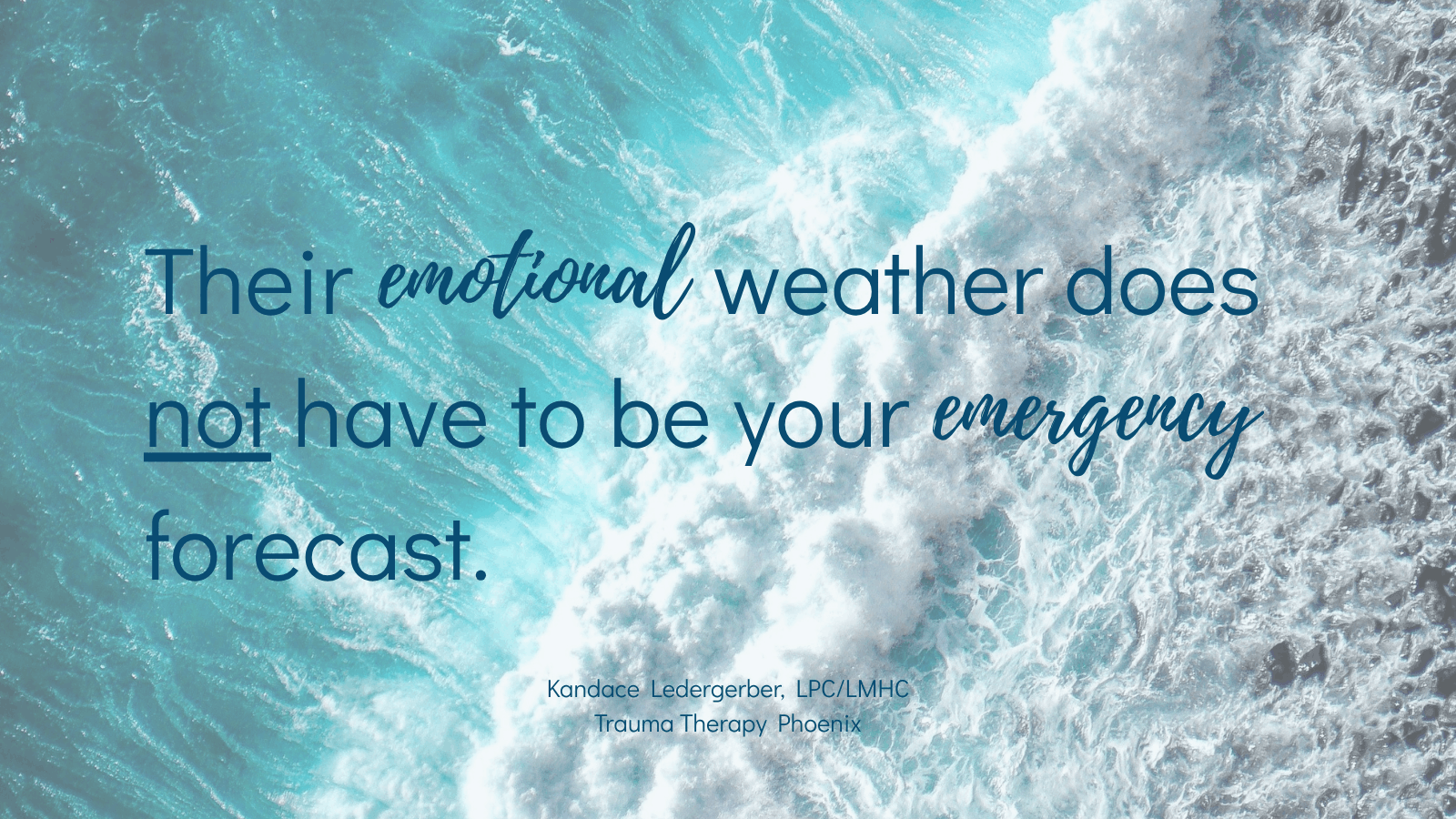
Photo by Gatis Marcinkevics on Unsplash
Photo Description: Quote graphic featuring an aerial view of bright teal ocean waves with white sea foam. Dark navy text reads "Their emotional weather does not have to be your emergency forecast." The words "emotional" and "emergency" appear in cursive script for emphasis, and the word "not" is underlined for additional emphasis. Attributed to Kandace Ledergerber, LPC/LMHC, Trauma Therapy Phoenix in smaller text at the bottom right.
The work (and it is work, real and ongoing) is slowly learning that you don't have to keep performing those roles in every relationship for the rest of your life. That you are allowed to put some things down. That someone else's emotional weather is not your emergency forecast.
That learning doesn't happen all at once, and it doesn't happen through willpower alone. It happens in relationships, over time, when the nervous system finally gets enough evidence that it's safe to try something different.
If you're starting to recognize these patterns in yourself and wondering what support could look like, trauma therapy in Phoenix is one place where work can begin.
If any of this resonated with you, I'd love to hear from you. Reach out to schedule a free consultation, or learn more about how I work with family trauma and whether it might be a good fit.
TL;DR
The roles we play in adult relationships — caretaker, peacemaker, the one who holds it all together — usually started as adaptations to the family we grew up in.
We don't know what we don't know. When those dynamics were our normal, we don't recognize them as patterns until something makes us stop and look.
Understanding where these roles came from doesn't require villainizing the people who shaped them. Most of them were doing the best they could. And the impact was still real.
The nervous system follows what it knows, including in the relationships we choose as adults.
Healing isn't dramatic. It's a slow, ongoing shift toward recognizing the pattern before it's already running the show.
About the Author
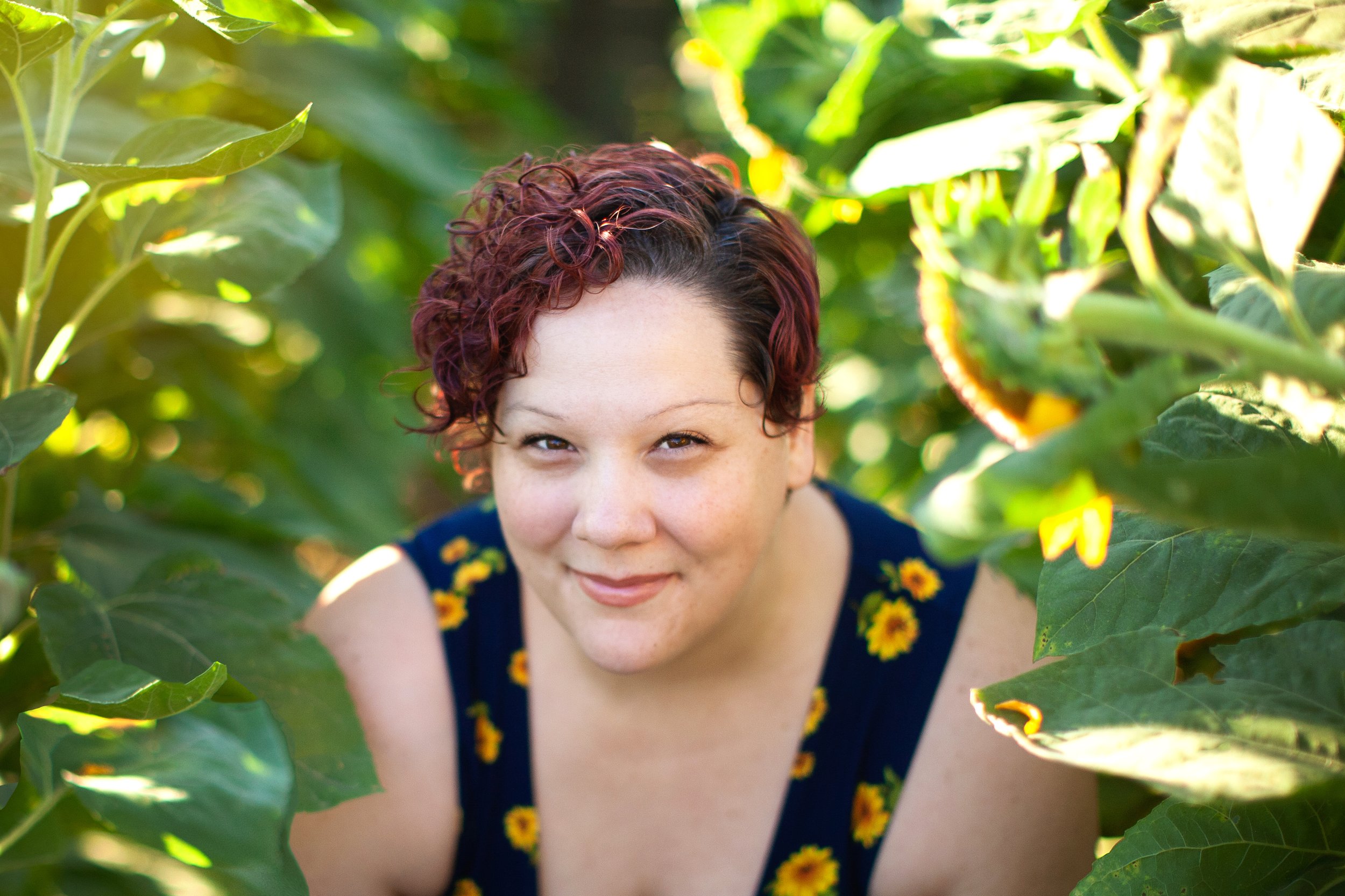
Kandace Ledergerber, LPC/LMHC, Certified EMDR Therapist
Kandace helps adults who feel stuck in the hamster wheel of anxiety and perfectionism reconnect with a sense of grounding, self-trust, and emotional steadiness. Through EMDR therapy and nervous system-informed work, she supports clients in moving out of survival mode and into a more grounded, meaningful life.
She specializes in trauma recovery, anxiety and perfectionism, and healing the lingering effects of childhood and relational trauma. Her work focuses on helping clients process painful experiences that still feel “stuck” so they can move forward with greater peace, confidence, and emotional freedom.
Kandace is the founder of Soul Mission EMDR Therapy , where she provides EMDR Therapy in Phoenix and online across Arizona and Florida.
Learn more about Kandace’s background, approach, and services on her About page.