Photo by Silas Baisch on Unsplash
Photo Description: Title graphic reading “Boundaries for Trauma Survivors: A Step-by-Step Guide to Feeling Safe While Setting Limits,” with “By Kandace Ledergerber, LPC/LMHC, Certified EMDR Therapist” below a short white divider line. White text on a translucent navy panel over an underwater ocean scene with rippling light on a sandy floor and small fish in the upper left.
UPDATED 10/2026
Boundaries... Just reading the word might bring up a whole mix of emotions. Perhaps discomfort, fear, or even guilt. If you’re a trauma survivor, setting boundaries can feel almost impossible. You might know that you should set them, but when the moment comes, panic sets in. Maybe your heart races, your hands turn clammy, or a voice in your head whispers, You’re being too much. You’re going to hurt them. You should just keep quiet. Just suck it up.
Sound familiar?
If so, you’re not alone. Setting boundaries is hard for many people, but for trauma survivors (and for so many of the women I work with through EMDR therapy in Phoenix), it can feel like an emotional minefield. Not only are you challenging old survival mechanisms, but you’re also rewriting the very wiring of your brain. That’s huge. And also? It’s completely possible.
This article is here to help you move through the discomfort, understand why boundaries feel so overwhelming, and offer you a step-by-step approach to setting limits while keeping your nervous system regulated.
Key Takeaways
Boundaries feel so hard because trauma taught your nervous system that speaking up was dangerous. That makes complete sense.
Discomfort doesn’t mean danger. Anxiety while setting a boundary is your brain adjusting to something new, not proof you’re doing it wrong.
Regulating your body before and after a boundary matters as much as the words you choose.
The boundary sandwich (positive, boundary, positive) gives you a simple structure when emotions are running high.
Every boundary you hold builds a new path in your brain that says, I can have needs and still be safe.
Not everyone will love your boundaries. The right people will respect them.
Why Are Boundaries So Freaking Hard for Trauma Survivors?
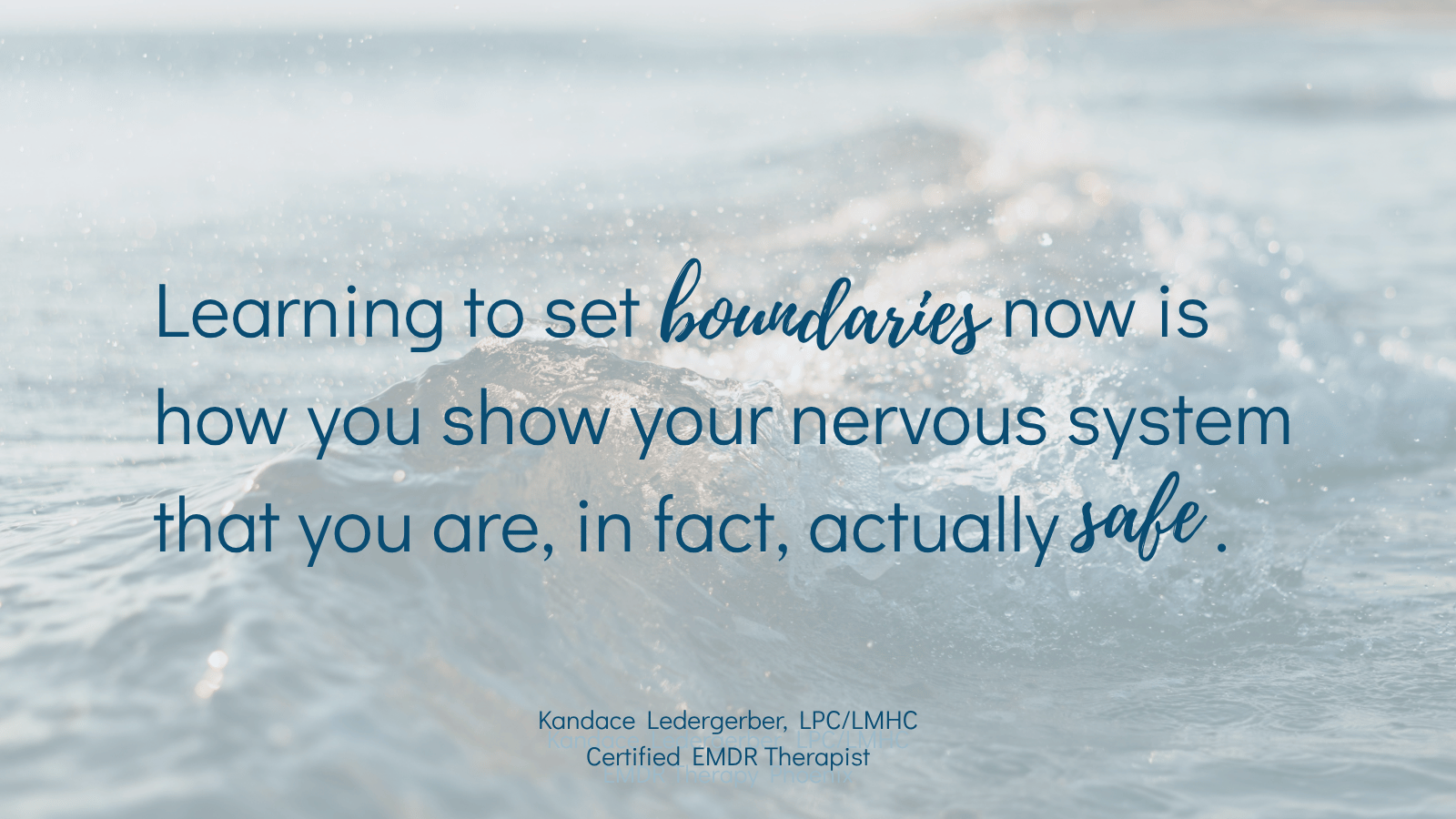
Photo by Mourad Saadi on Unsplash
Photo Description: Quote graphic reading “Learning to set boundaries now is how you show your nervous system that you are, in fact, actually safe.” The words “boundaries” and “safe” are in a navy script font. Attribution reads Kandace Ledergerber, LPC/LMHC, Certified EMDR Therapist. Soft, faded close-up of a small ocean wave splashing in pale blue and silver light.
To put it simply: boundaries go against EVERYTHING trauma may have taught you.
Trauma (especially relational trauma) often conditions survivors to prioritize the needs of others over their own. Whether it was growing up in a household where saying "no" led to punishment, being in relationships where your boundaries were ignored, or experiencing any form of abuse that made you feel powerless, the message was clear: Your needs don’t matter. Keep the peace. Stay small to stay safe.
Over time, this survival strategy gets reinforced. The brain learns that avoiding conflict or people-pleasing is the "safest" option. After all, if we perform just right, maybe it will turn out okay. So, when you start setting boundaries, your nervous system reacts as if you’re doing something dangerous, because in the past, advocating for yourself was unsafe. Your brain sends you a giant flaming red flag, even though nothing is actually on fire.
But here’s the thing: you're not in that past anymore. And learning to set boundaries now is how you show your nervous system that you are in fact actually safe.
Why Boundaries Are Necessary for Healing
Boundaries are not about pushing people away; they’re about creating safe, sustainable relationships. Oftentimes, people don’t know we need a boundary in place until we express it. In other situations, a relationship may be an unsafe space where boundaries are needed. In either case, boundaries are there to help us.
Here’s what boundaries can do for trauma survivors:
✔ Restore a sense of control – Boundaries allow you to reclaim agency over your life, relationships, and energy. Trauma robs us of our sense of control and agency, so this is a huge one to start taking back one bite at a time.
✔ Reduce anxiety and overwhelm – When you stop overextending yourself, your nervous system gets a break. Yes, I know, at first it won’t feel like that as you uphold the boundary your brain might be fighting against holding. But in the long run, you get the chance to rest and listen to your own brain and body, not just the messages you’ve been told by trauma.
✔ Help you feel safer in relationships – The right people will respect your boundaries, which strengthens your sense of emotional security. Let me say that one again a little louder for the people in the back. The RIGHT people will understand and hear you. This can be a hard one to hear and accept.
✔ Support your healing process – Setting and enforcing boundaries rewires your brain, reinforcing new neural pathways that say: I am worthy. My needs matter. I am safe. This is huge, because your brain is literally unlearning old patterns and learning healthier (and more accurate) ones.
And perhaps most importantly: Boundaries teach your nervous system that it is okay to have needs—a fundamental part of healing from trauma. After all - you are a human being with needs (and that’s okay) you are not a robot.
Step-by-Step Guide to Setting Boundaries
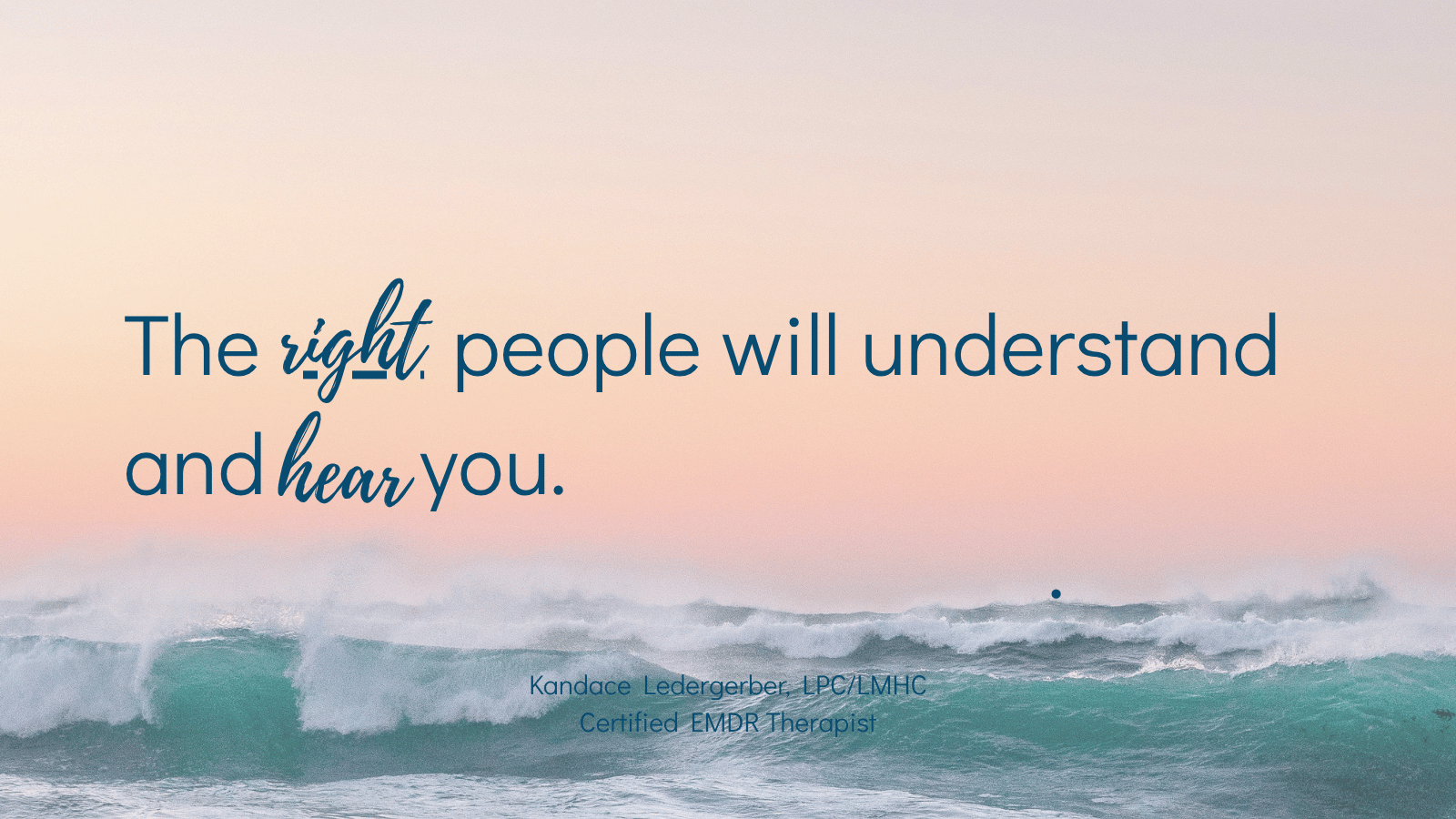
Photo by Laura Barry on Unsplash
Photo Description: Quote graphic reading “The right people will understand and hear you.” The words “right” and “hear” are in a navy script font. Attribution reads Kandace Ledergerber, LPC/LMHC, Certified EMDR Therapist. Soft peach and pink sky over teal ocean waves breaking with white spray.
So how do you actually do this? I know it can be overwhelming, but let’s break it down.
Step 1: Identify Where You Need Boundaries
Start by noticing where you feel drained, resentful, or overwhelmed. These feelings are clues that a boundary might be needed. Some common areas include:
Work (e.g., not answering emails after hours)
Family (e.g., limiting conversations about triggering topics)
Friendships (e.g., saying no to plans when you’re exhausted and tapped out)
Emotional space (e.g., not being the constant "go-to support therapist" for others)
Step 2: Expect Discomfort and Normalize It
If setting a boundary makes you anxious, that doesn’t mean you’re doing something wrong. It just means your brain is adjusting because setting a boundary is something that’s new. Your nervous system is used to old patterns, so stepping outside of them might feel unfamiliar—even threatening.
Remind yourself: Discomfort does not mean danger.
Step 3: Regulate Before and After Setting the Boundary
This is key: setting the boundary is one thing, but soothing your nervous system before and afterwards is another.
Right before setting a boundary, you might feel a lot in your body. It’s important to send the signal “I am safe” and “I am not in danger right now.”
Right after setting a boundary, you might feel a whole range of emotions, including guilt, fear, or even experience a trauma response (heart racing, nausea, dissociation). This is understandable, and it’s your body reacting as if you’ve done something wrong. But you haven’t. Remember that.
Try these regulation techniques after setting a boundary:
🧘♀️ Deep Breathing – Inhale for four seconds, hold for four, exhale for six. If the hold feels too restrictive, skip it, but make sure your exhale is longer than your inhale.
🖐 Grounding Exercises – Notice five things you can see, four you can touch, three you can hear, two you can smell, and one you can taste.
🚶♀️ Movement – A short walk, shaking out your hands, or stretching can release built-up tension.
📖 Journaling – Write about what you’re feeling and remind yourself: I am safe. I am allowed to have needs.
Step 4: Boundary Sandwich
Finding the right words can be tough, especially when emotions are high. I find most clients feel most comfortable with a boundary sandwich. This takes one positive, the boundary, and ends with another positive or something constructive. It can look like this:
Positive: I really appreciate and value you as my friend.
Boundary: I feel like sometimes you talk over me when I’m trying to share about my life and what’s going on.
Positive: I enjoy our visits, and it would mean so much to me if we could both have space to share.
You don’t have to explain yourself endlessly or justify why you’re setting the boundary. You are allowed to keep it simple and just reflect what is happening for you.
Rewriting Your Brain: The Science Behind Boundaries
Each time you set a boundary, you are literally reshaping your brain.
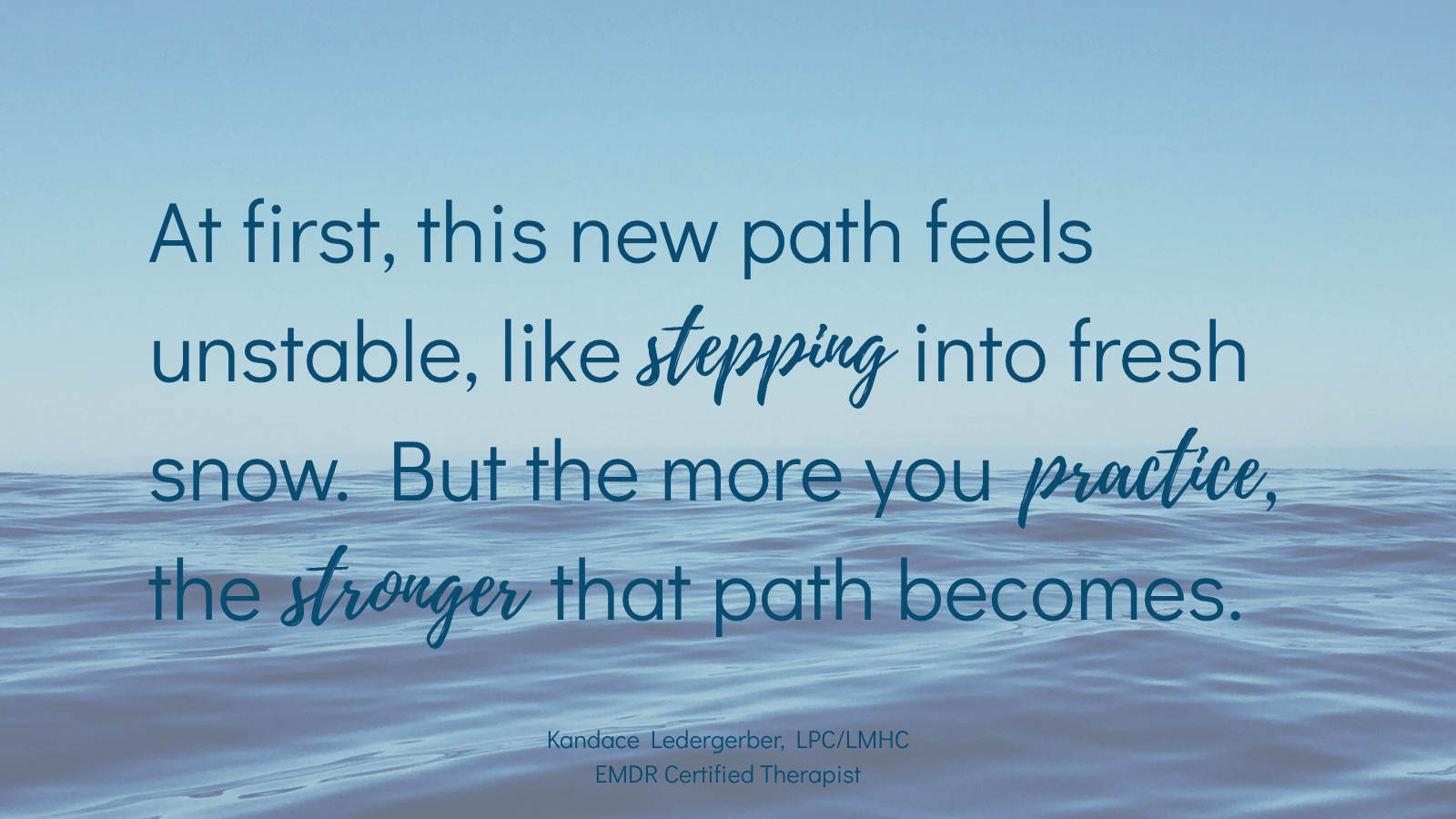
Photo by Greg Becker on Unsplash
Photo Description: Quote graphic reading “At first, this new path feels unstable, like stepping into fresh snow. But the more you practice, the stronger that path becomes.” The words “stepping,” “practice,” and “stronger” are in a navy script font. Attribution reads Kandace Ledergerber, LPC/LMHC, EMDR Therapy Phoenix. Calm ocean background in soft blue tones under a pale sky.
Neuroplasticity, the brain’s ability to rewire itself, means that every new and repeated behavior strengthens certain neural pathways. If you’ve spent years people-pleasing or avoiding conflict, your brain has a well-worn "path" that tells you, keeping others happy keeps me safe.
But when you start setting boundaries, you’re creating new neural pathways that say, I can have needs and still be safe. At first, this new path feels unstable, like stepping into fresh snow. But the more you practice, the stronger that path becomes.
Every time you set and hold a boundary, you reinforce this new reality. Over time, your brain starts to accept it as the norm. And eventually? Setting boundaries won’t feel like walking through fire—it will feel like second nature.
What to Do If Someone Pushes Back
Not everyone will love your boundaries—especially those who benefited from you not having them. If someone reacts negatively, remember:
1️⃣ Their reaction is about them, not you. People who respect you will respect your limits.
2️⃣ You are not responsible for managing their feelings. You’re allowed to set boundaries even if it disappoints someone.
3️⃣ Stay firm. You don’t have to backpedal. Reaffirm and/or repeat your boundary and disengage if needed.
You Are Allowed to Take Up Space.
Setting boundaries isn’t easy, and if your body is still sounding the alarm every time you try, that doesn’t mean you’re failing at this. It means your nervous system learned, at some point, that having needs wasn’t safe. You are not selfish for having needs. You are not hurting others by taking care of yourself. You’re learning how to exist in relationships in a way that feels safe, sustainable, and actually like you. So take a breath. Start small. And every time you hold a boundary, even a wobbly one, know that you’re reclaiming a little more of your voice.
If you’ve done the reading and practiced the scripts and something in you still collapses the moment you try to say no, that’s often a sign the old pattern lives deeper than willpower can reach. That’s the kind of work I do in therapy, and you don’t have to figure it out alone. Reach out for a free consultation whenever you’re ready, and we can talk about what that might look like for you.
TL;DR
Trauma (especially relational trauma) teaches survivors that their needs don’t matter and that staying small keeps them safe.
That’s why setting a boundary can trigger a full-body alarm, even when nothing is actually wrong.
Boundaries restore a sense of control, ease overwhelm, and help you feel safer with the right people.
Start by noticing where you feel drained or resentful, expect discomfort, and regulate before and after.
Keep it simple. You don’t owe anyone an endless explanation.
With repetition, holding boundaries starts to feel less like walking through fire and more like second nature.

About the Author
Kandace Ledergerber, LPC/LMHC, Certified EMDR Therapist
Kandace helps adults who feel stuck in the hamster wheel of anxiety and perfectionism reconnect with a sense of grounding, self-trust, and emotional steadiness. Through EMDR therapy and nervous system-informed work, she supports clients in moving out of survival mode and into a more grounded, meaningful life.
She specializes in trauma recovery, anxiety and perfectionism, and healing the lingering effects of childhood and relational trauma. Her work focuses on helping clients process painful experiences that still feel "stuck" so they can move forward with greater peace, confidence, and emotional freedom.
She offers EMDR therapy in Phoenix, anxiety therapy, and EMDR Intensives.