Photo Description: Header image with text How EMDR Therapy Works and subtitle explaining how EMDR goes beyond talk therapy to heal trauma, By Kandace Ledergerber, LPC/LMHC, Certified EMDR Therapist in light blue writing within dark blue framework and ocean floor background.
Photo by Silas Baisch on Unsplash
If you’ve ever found yourself stuck in a cycle of overthinking, people-pleasing, and burnout despite doing everything right, you’re not alone.
For so many high-achieving perfectionists, trauma isn’t just a chapter of the past—it’s an undercurrent shaping how you move through your day, even when you don’t realize it. Shaping the jobs they end up in, the relationships they stick to, even when they are unhappy, and how they respond in their friend groups.
You’ve read the self-help books. You’ve practiced mindfulness. You’ve gone to therapy. And yet… something still feels stuck, off, or just out of reach.
For many high-achievers, anxiety isn’t just about overthinking—it’s about survival patterns that once kept you safe but now keep you stuck. If this feels familiar, EMDR Therapy Phoenix can help you learn skills to re-ground when those patterns strike and unearth them altogether.
That’s because healing requires more than understanding your story through your mind—it involves helping your body feel safe again.
Why Talk Therapy Is Powerful (But Sometimes Not Enough on Its Own)

Photo Description: A person wearing an orange helmet crosses a suspension bridge in a lush green forest, symbolizing the journey of trauma healing, courage, and moving forward with support.
Photo by Maher El Aridi on Unsplash
Let’s start here: talk therapy is incredibly valuable.
It offers insight, validation, and connection—three essential ingredients for healing, especially in a world where most are not taught how to listen or validate the feelings of others actively. Talk therapy can help you name your patterns, understand your emotions, and make meaning out of your experiences.
But when trauma lives in the body—in the nervous system that fires before your logical brain even catches up—healing may also need to include the body’s natural processing mechanisms.
That’s where EMDR therapy can be an extremely powerful tool.
For a deeper dive into how EMDR works, check out our full guide here.
1. Trauma Isn’t Just a Story—It’s a Body Response
Trauma lives in your body, not just your mind. You might logically know you’re safe now, or that what happened in your past wasn’t your fault, but your nervous system might still be on high alert, scanning for danger or feeling intense shame at every turn. Talk therapy helps you understand why this happens—EMDR helps your brain reprocess those stored experiences so your body can finally relax.
Talk therapy helps you understand why this happens, EMDR helps your brain reprocess those stored experiences so your body can finally relax. This is part of how EMDR helps the brain move out of survival mode.
2. Trauma Gets Stuck in the Nervous System
Normally, the brain knows how to process stressful experiences. It files them away and moves on. But trauma—especially repeated or chronic stress—gets “stuck.” It’s like leaving too many browser tabs open that never close, draining your emotional and mental energy in the background.
That’s why even years later, a smell, tone of voice, or facial expression can trigger a flood of emotions that feel completely out of proportion to the moment. These moments are often called “implicit triggers,” and they can surface long after the original trauma.
3. Some Trauma Is Beyond Words
Many trauma memories are pre-verbal—they happened before we had language. Others are simply too overwhelming to describe. This is why sometimes you might shut down when trying to talk about them.
EMDR therapy offers a way through that doesn’t rely only on words—it helps the brain reprocess what’s been stored as unhealed pain. Because talking about an experience and processing it are two very different things.
How EMDR Therapy Works with the Brain and Body
EMDR, or Eye Movement Desensitization and Reprocessing, is an evidence-based therapy that helps the brain naturally heal from trauma.
During EMDR sessions, your therapist guides you through bilateral stimulation, eye movements, gentle taps, or tones that activate both sides of the brain. It's also why this process needs guided support rather than a DIY approach. This process mimics the way the brain integrates experiences during REM sleep, allowing it to "unstick" memories that have been frozen in distress.
Think of it as updating old software on your phone.
The memory doesn’t disappear—it just stops running outdated, fear-based programming in the background.
Over time, the emotional charge fades. You still remember what happened, but it no longer controls your emotions, choices, or sense of self.
The Three-Pronged Approach to Healing
One of the reasons EMDR therapy is so effective is that it doesn’t just focus on the past—it looks at the whole picture of your healing.
The Three-Pronged Protocol addresses:
The Past: Reprocessing memories that created painful, limiting beliefs.
The Present: Working through current triggers that reinforce those beliefs.
The Future: Building new, adaptive responses and beliefs for a grounded, confident self.
Imagine holding a string of yarn with three knots—past, present, and future (it’s all connected!) EMDR gently helps you untie each one, allowing your nervous system to finally relax and integrate the story in a new, healthy way. The three-pronged approach is one of the reasons EMDR is so effective—it helps your past, present, and future selves reconnect.
What EMDR Looks Like in Practice
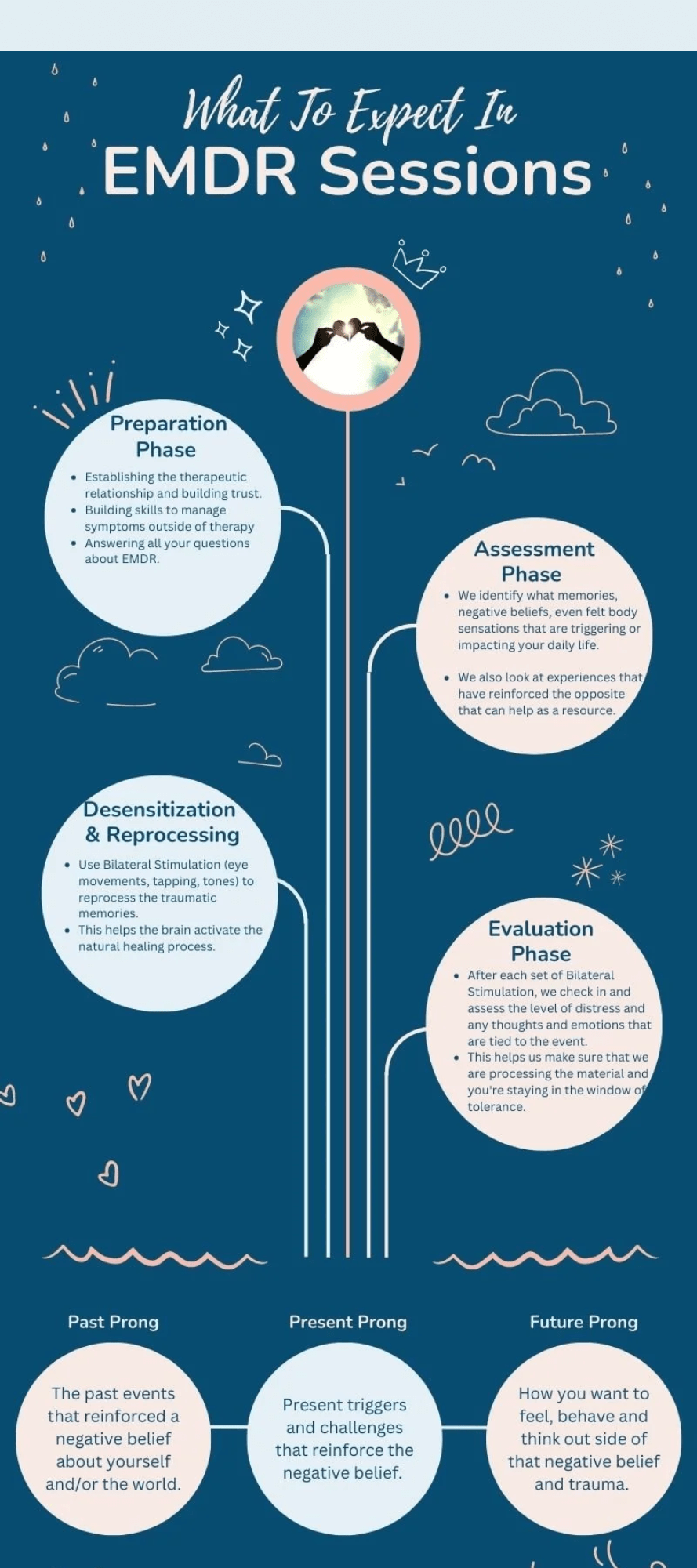
Photo Description: What to expect during EMDR therapy sessions, including the preparation, assessment, desensitization, and evaluation phases.
If you’re new to EMDR therapy, it’s completely normal to wonder what actually happens in a session. Here’s a simple, real-world sense of what the process looks like.
Preparation
The first step is all about safety and connection. We spend time building trust, helping you understand how EMDR works, and developing grounding skills you can use both in and out of session. I’m also learning about you—your story, your strengths, and the places that still feel “stuck.”
The difference between EMDR and talk therapy isn’t about better or worse—it’s about integration. Talk therapy helps you make sense of what’s happened; EMDR helps your body and brain finish the processing, so what you know in your mind finally starts to feel true in your body. Many people weave EMDR into their ongoing therapy, or turn to it when insight alone hasn’t been enough to create real change.
Assessment & Reprocessing
Once you feel steady and supported, we begin identifying the memories, beliefs, or triggers most connected to your current symptoms. These become our targets. During reprocessing, you’ll focus briefly on one target while using bilateral stimulation—gentle eye movements, taps, or tones that help both sides of your brain communicate.
As we move through this, your nervous system begins to release what’s been stuck. Memories may lose their intensity, and new beliefs—like “I’m safe now” or “I’m enough”—begin to take root.
Evaluation & Ongoing Work
After each round, we pause to notice what’s shifting. Healing unfolds gradually and at your pace. EMDR isn’t about erasing what happened—it’s about helping your system finally believe: it’s over, and I’m safe now.
Healing Beyond the Phoenix Skyline
Here in Phoenix, surrounded by our fiery sunsets and desert landscapes, it’s easy to think healing should come just as fast and bright.
But trauma healing is often gentler and slower. It asks us to come home to ourselves—to the body we’ve spent years running from.
EMDR therapy offers that bridge. It allows the nervous system to finally exhale, to trust safety again, and to open space for joy, connection, and presence.
Healing doesn’t mean forgetting your story—it means your story stops controlling how you live it.
Take the Next Step
Healing from trauma doesn’t have to take years—and it doesn’t mean reliving the pain at every turn. EMDR therapy helps you heal on a deeper level, one that brings your mind, body, and nervous system into alignment.
If talk therapy has helped you gain insight but you’re still struggling to feel the change in your body, EMDR therapy might be the next step.
I offer EMDR therapy in Phoenix, both in-person and online throughout Arizona and Florida, as well as EMDR Intensives in Arizona for those ready for a more focused, immersive healing experience.
TL;DR
How EMDR Therapy Works:
Talk therapy helps you understand your trauma. EMDR therapy helps your brain and body reprocess it so it no longer controls you. By addressing the nervous system directly, EMDR creates lasting change that’s both emotional and physical.
Key takeaway: You don’t have to stay stuck in survival mode. EMDR therapy can help you finally feel grounded, balanced, and free.

About the Author
Kandace Ledergerber, LPC/LMHC, Certified EMDR Therapist
Kandace helps adults who feel stuck in the hamster wheel of anxiety and perfectionism reconnect with a sense of grounding, self-trust, and emotional steadiness. Through EMDR therapy and nervous system-informed work, she supports clients in moving out of survival mode and into a more grounded, meaningful life.
She specializes in trauma recovery, anxiety and perfectionism, and healing the lingering effects of childhood and relational trauma. Her work focuses on helping clients process painful experiences that still feel "stuck" so they can move forward with greater peace, confidence, and emotional freedom.
She offers EMDR therapy in Phoenix, anxiety therapy, and EMDR Intensives in Arizona.
Learn more about Kandace's background, approach, and services on her About page.