Photo Description: Blog title graphic reading “You’re Not Going Backwards: What’s Really Happening When Going Home for the Holidays Throws You Into Survival Mode,” followed by a short coral line and “By Kandace Ledergerber, LPC/LMHC, Certified EMDR Therapist.” Dark blue text sits on a pale, frosted center panel framed on both sides by deep teal ocean water with white spray.
Photo by Silas Baisch on Unsplash
You pull up to your childhood home, and before the engine is even off, you feel your shoulders creeping up to your ears. You walk through the door, recognize all the familiar fixtures in the room, and feel your entire body go a fraction tighter. By the time you hit the kitchen, you somehow feel smaller than the space you took up an hour ago in your own home. You hold your breath as you say hi to everyone, bracing for the first comment that will throw your body even further back to feeling 12 again instead of 38.
The holidays can be a special kind of difficult for trauma survivors, especially depending on how much work you've done around your past trauma. I provide EMDR therapy in Phoenix, and every year I hear the same themes creeping into the therapy room. Just thinking about the upcoming plans sends people's bodies into an unregulated space. They worry about shrinking themselves for the sake of everyone else's happiness. And they're unsure they can draw a line in the sand without feeling like they're blowing up the entire structure.
So in this blog, I want to break down why it's normal to feel this way (from a trauma therapist's point of view), what you might recognize in yourself as survival mode strategies show up during the holidays, and ways you can actually regulate when it feels like sh*t is hitting the fan.
Key Takeaways
Feeling thrown back doesn't mean you've gone back. Feeling 12 again is not the same as being 12 again.
Your body remembers the house and cues you into your old role before you even sit down. That's your nervous system trying to keep you safe, not a sign you're doing something wrong.
Fight, flight, freeze, and fawn at the holiday table are responses your body learned years ago to survive a place that didn't feel safe.
Regulate first, then set the boundary. A boundary can be as simple as a leave time or a one-line topic stopper.
Why Going Home Hits Different (What I See As a Trauma Therapist Each Year)
So first off, I want to recognize and honor the fact that the holidays are hard for many, many people. Not just because they can be so busy, but also because of the trauma reminders that seem to be hiding in plain sight.
It makes sense that going back home for the holidays can be an unconscious reminder to your nervous system that the past doesn't feel as far back as it actually is. It's a lot like going back to your old elementary school, which can feel like stepping through a time portal. Your brain recognizes the space and the memories that happened there, but it doesn't always communicate that all of that happened years ago. This is especially true if you're still in the middle of processing your trauma.
So with this frame in mind, it makes sense that as you walk into your old house, your body remembers and cues you into the old role you played before you even take a seat at the table. I want to point out that this isn't because you're doing something wrong. It's your nervous system slipping back into a survival pattern that once kept you safe.
If you're curious to learn more about this pattern, my blog Why Your Nervous System Can't 'Just Calm Down' goes into more detail.
Holiday Regression Doesn't Mean You're Going Backwards (or Starting Over)
Here's the most common misconception I hear around this time of year. It sounds a bit like this: "I can't believe I'm feeling like this. I've done so much work. Doesn't that mean anything!?"
But here's the amazing news: feeling activated or returning to old strategies does not mean you're starting back at square one. Feeling like you're 12 years old again is not the same as being 12 years old again. I want you to really stop and think about all of the changes you've made between that 12-year-old (or however old you picture yourself) and now, all the things you've learned and everything you've accomplished. Walking back into that space and feeling that way doesn't automatically mean you're back in that situation, even if your body is communicating otherwise.
You know things now that your younger self couldn't even begin to grapple with. Your younger self is running on old information, the only information you had at the time. But you (adult you) have access to newer, more updated information. It can just be hard to remember in the middle of a trigger. If you want to learn more about this, read Moving Out of Survival Mode.
What Survival Mode Can Look Like at the Holiday Table
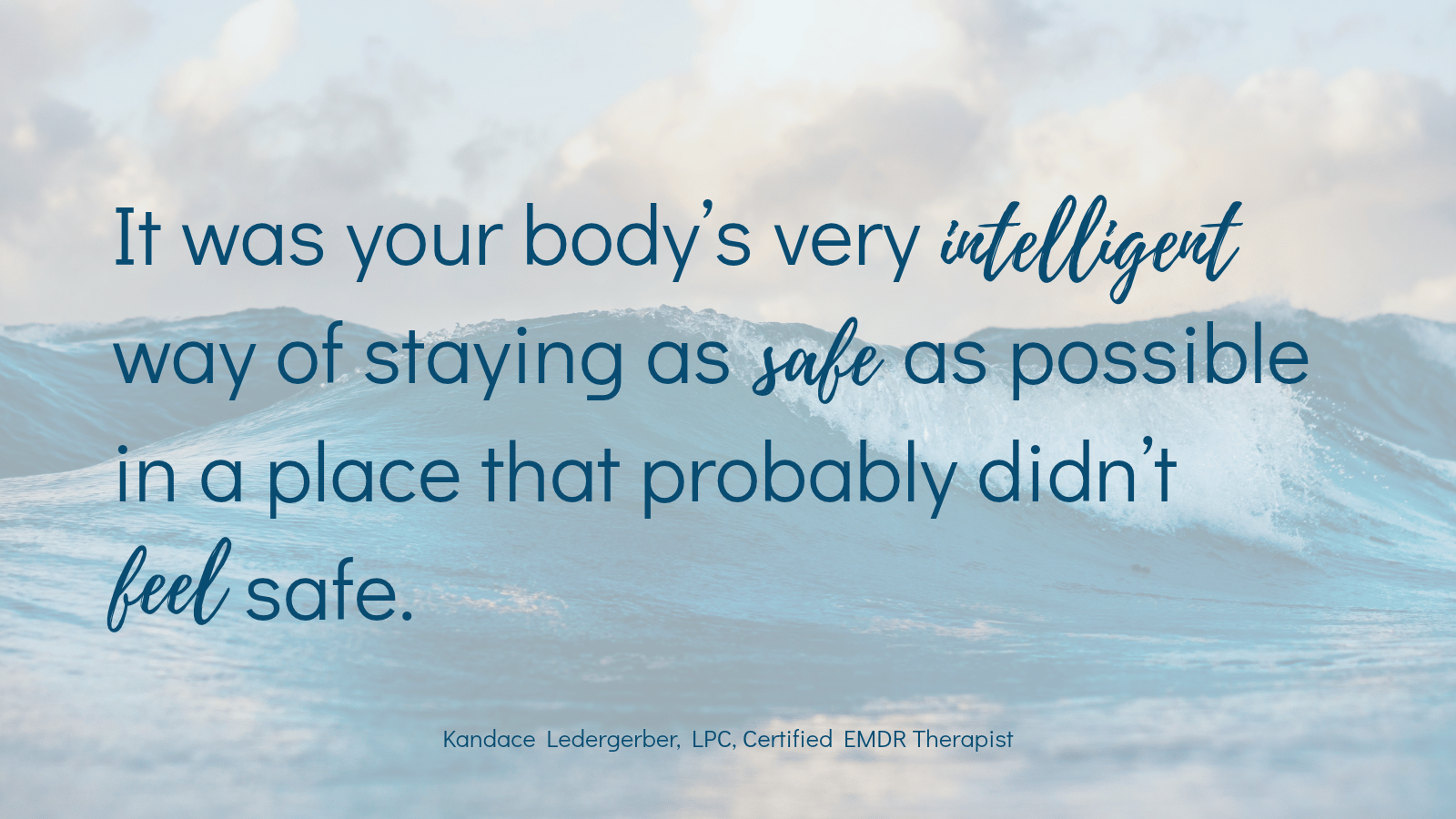
Photo Description: Quote graphic reading “It was your body’s very intelligent way of staying as safe as possible in a place that probably didn’t feel safe.” The words “intelligent,” “safe,” and “feel” appear in script lettering. Attributed to Kandace Ledergerber, LPC, Certified EMDR Therapist. Dark blue text over a faded turquoise ocean wave beneath a soft cloudy sky.
Photo by Silas Baisch on Unsplash
This is everyone's favorite topic (just kidding, most people hate this one). Even when you can feel yourself bracing for impact, reading about survival mode and acknowledging it can feel difficult, especially heading into a season that might send you there. It's like naming where the dread is coming from instead of letting it hum uncomfortably in the background. But here's the powerful thing: if we can acknowledge what's happening and normalize it, it takes away some of the power of the survival mode response.
Here's how I see it show up most often in the high achievers I work with.
Flight: A tensing in your body, maybe in your stomach, your shoulders, or your jaw, and the urge to get the f*ck out of there and keep running until you hit the highway.
Fight: Mentally rehearsing arguments for when that certain family member makes a racist or sexist "joke."
Freeze: Holding your breath (literally) while trying to pretend everything is fine.
Fawn: Your shoulders are up to your ears, but you still jump in to help wherever you can, whether that's chopping veggies or mediating a tense living room exchange.
And here's what I'll say about each of these: every one of these reactions is a response your body learned years ago. It was your body's very intelligent way of staying as safe as possible in a place that probably didn't feel safe.
Regulating While You're In It
Here are a few regulating tools you can use this holiday season to remind yourself that you are, in fact, in control, even when your body doesn't feel that way.
Orient to the present. Name what's different now versus when you were 12. You drove yourself here, and you can leave whenever you need to. You bought your own groceries this week. You have a job you didn't have when you were 12.
Take a breather in the bathroom. Literally. Excuse yourself to the restroom and take 30 seconds to focus on your inhale and exhale. Feel your feet on the floor, place your hands on the cool sink, inhale fully, and exhale steady and long.
Check in with your younger self before you go. Ask yourself what you'd tell the kid who used to sit at that table. Maybe something like "It wasn't your job to keep everyone happy," or "It's going to get better. You'll have a choice."
Text a safe person. Reach out to a friend who gets what you're going through, just to have someone outside the situation to vent to.
Advocating for Yourself Without Giving a Speech
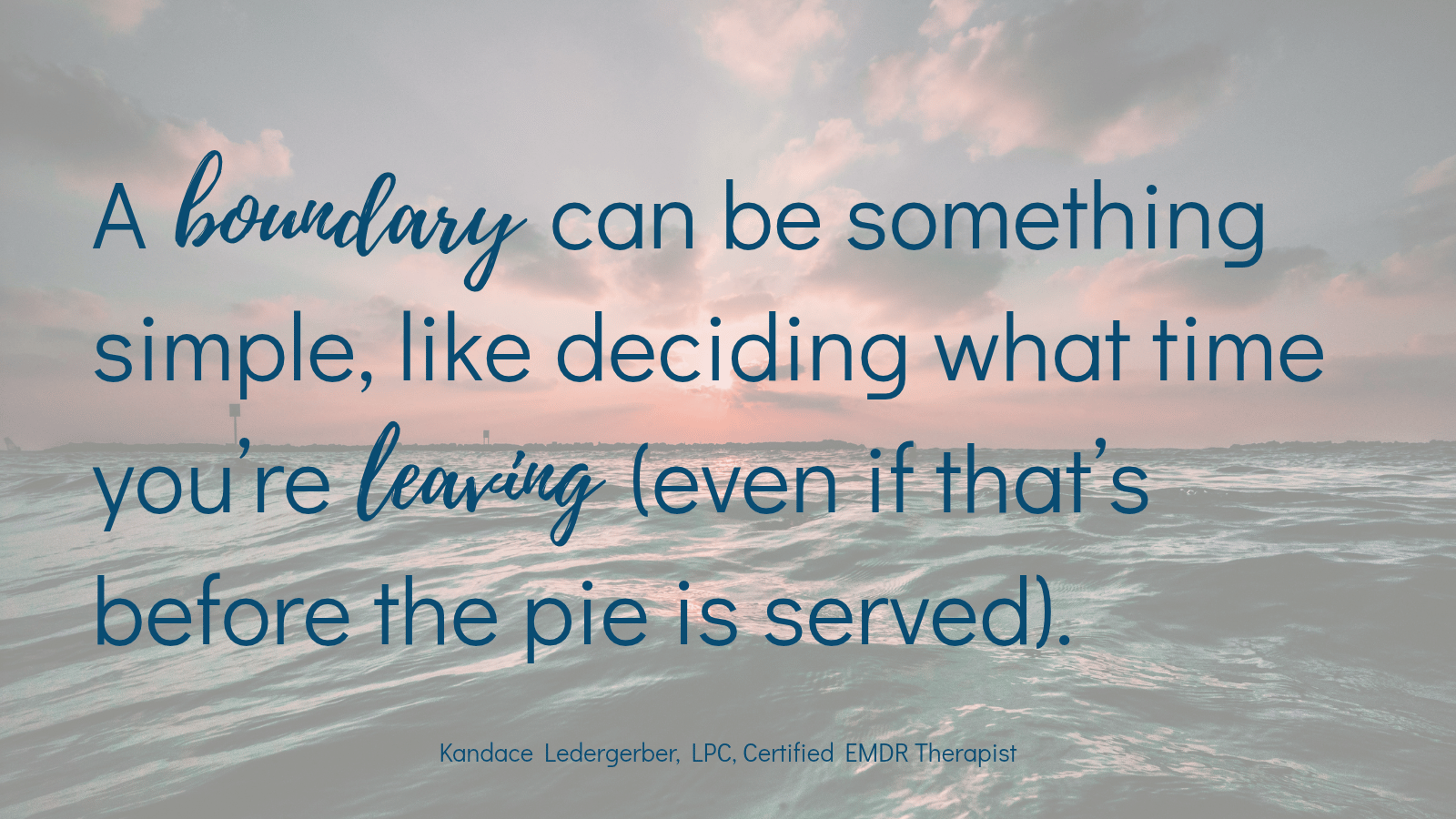
Photo Description: Quote graphic reading “A boundary can be something simple, like deciding what time you’re leaving (even if that’s before the pie is served).” The words “boundary” and “leaving” appear in script lettering. Attributed to Kandace Ledergerber, LPC, Certified EMDR Therapist. Dark blue text over a soft, faded ocean at sunset with pink and gray clouds.
Photo by Silas Baisch on Unsplash
I hear a lot of people talk about their fear of drawing boundaries, so here's the frame I'd like to offer you. A boundary can be something simple, like deciding what time you're leaving (even if that's before the pie is served). It can also be a one-line topic stopper: "I'm not willing to talk about that right now." If they push back and you keep repeating it, they'll usually get the hint eventually.
And if you're in a place where you want to set some firmer boundaries, here's what I'd encourage you to do:
First, and always first, regulate your body. Excuse yourself outside or to the bathroom and take a few full inhales and steady, long exhales.
Remind yourself you're a grown-up, not a child anymore.
Use the boundary sandwich. Say something positive, then the boundary, then end with something positive. It can sound something like: "I'm really enjoying spending time with everyone, so let's not spoil it with this topic. I love the dressing on this salad. What did you put in it this year?" If you want the step-by-step version, I walk through it in my guide to setting boundaries as a trauma survivor.
One heads up: when you start advocating for yourself, not everyone is going to love the updated version of you, at least not right away. That doesn't mean you're doing it wrong. I dig into this more in Go to Therapy, They Said: How Healing Changes Your Relationships (And Why Not Everyone Will Love It).
When You Leave but Your Body Hasn't Yet
And after it's all over, I also want to acknowledge that it's understandable if you feel drained, a bit more on edge, or notice your self-critical voice dialed up a notch louder than normal.
The story you might be tempted to tell yourself is that you're back at square one, but I'm here to tell you that's just not true. You are light-years (okay, maybe not actual light-years, but it can feel like it) away from the child version of you. You are not starting over.
So as you move through the post-holiday crash, remind yourself of everything you've accomplished since you were that younger version of yourself. And notice what was different this year, even if it was just having the awareness of your reactions before they automatically took hold. That counts.
A few things that can help your body catch up:
Regulate and rest. Give your nervous system time to come back down without rushing it.
Drink lots of water. Travel and holiday days take more out of your body than you'd expect.
Remind yourself you're not back in that space. You're in your own home, on your own schedule, making your own choices.
Spend more time with people who help you feel seen and heard.
Do activities that replenish and restore you, whatever those look like for you.
What EMDR Does With the Old Wave
The weeks after the holidays tend to be some of the most meaningful sessions of the year. Not because everything went perfectly (it rarely does), but because the visit just handed us a pretty clear map of what's already shifted and what's still asking for attention.
First, we look at what was different. Maybe you advocated for yourself in a way you never could have as a kid, caught yourself mid-fawn and sat back down, or simply took a breath you wouldn't have taken a few years ago. Those moments count, and we name them.
Then we look at what got stirred up. The familiar patterns that came roaring back aren't failures. They show us exactly where your nervous system is still running on old information. In EMDR, we reprocess those memories so your brain and body can finally take in the update: you're no longer in that role, you don't have to be perfect, and who you are is more than enough.
That's really the heart of it. Reprocessing helps the younger part of you finally get the update, so the house can just be a house instead of a house of mirrors.
One Question to Take Home With You
So before you pack the car or board the plane, I'd invite you to sit with one question: if you could pull up a chair next to your younger self at that table, what would you tell them that you know now? Maybe it's that keeping the peace was never their job. Maybe it's that they'd grow up, build a life of their own, and get to decide when it's time to leave. Whatever comes up, that's the adult you talking, and that voice has been there the whole time.
And if this season stirs up more than you want to carry on your own, that's not a sign your healing didn't work. It's often a sign that something is ready to be processed. If you're curious whether EMDR could help, I'd love to connect before the new year. You can schedule a consultation, and we can talk through what this season brought up and what support could look like heading into 2027.
TL;DR
Feeling like a kid again when you go home is your nervous system recognizing old cues, not proof that your healing didn't work.
Fight, flight, freeze, and fawn at the holiday table were smart survival strategies once, and they make sense now.
Orient to the present: you drove yourself, you can leave, and you're not 12 anymore.
Regulate first, then set the boundary. Simple counts.
After the visit, rest, notice what was different, and remember you're not starting over.
EMDR helps your younger self get the update, so the house can just be a house.
If the holidays are bringing up thoughts of suicide or you're in crisis, please call or text 988 to reach the 988 Suicide & Crisis Lifeline, available 24/7. You can also chat at 988lifeline.org. You don't have to wait until things get worse to reach out.

About the Author
Kandace Ledergerber, LPC/LMHC, Certified EMDR Therapist
Kandace helps adults who feel stuck in the hamster wheel of anxiety and perfectionism reconnect with a sense of grounding, self-trust, and emotional steadiness. Through EMDR therapy and nervous system-informed work, she supports clients in moving out of survival mode and into a more grounded, meaningful life.
She specializes in trauma recovery, anxiety and perfectionism, and healing the lingering effects of childhood and relational trauma. Her work focuses on helping clients process painful experiences that still feel "stuck" so they can move forward with greater peace, confidence, and emotional freedom.
She offers EMDR therapy in Phoenix, anxiety therapy, and EMDR Intensives.