Ways to Ease the Perfectionist Mind | Anxiety Therapy Phoenix

Photo Description: Underwater ocean scene with bright blue water and light filtering through the surface. A semi-transparent white overlay panel in the center displays dark teal text reading "Ways to Ease the Perfectionist Mind" with the subtitle "Anxiety Therapy in Phoenix" below, followed by a coral dividing line and the author credit "By Kandace Ledergerber, LPC/LMHC, Certified EMDR Therapist."
Photo by Cristian Palmer on Unsplash
Updated March 2026
You’re always going. Your head hardly ever stops spinning. There’s always another thing to finish, another standard to meet, another version of yourself to live up to, and the moment you think you might actually get there, the bar moves (or maybe you move it), but either way, there is yet again another task in front of you.
And saying no? That’s its own kind of battleground. Because even when you manage it, the guilt quickly follows right behind it, insistent...sometimes quiet and sometimes yelling, but always telling you that you should have just said yes.
If that sounds familiar, you’re not alone. And more importantly, it makes sense that you’re exhausted.
Perfectionism has a way of feeling like a personality trait, like it’s just who you are. People might recognize you, or you might recognize yourself as a “Type A” individual, or a “high achiever”, but descriptions like “People Pleaser” and “Perfectionist” have also been applied.
But underneath all that striving and self-monitoring is usually something much more specific: a nervous system that learned, somewhere along the way, that getting things right was the price of feeling safe. That rest was not safe but carried risk. And that being human (imperfect, inconsistent, and yes, occasionally messy) wasn’t acceptable.
This post is for anyone whose mind won’t quiet down. Not a list of tips to force your way through it, but a gentler look at what’s actually happening, and what it can feel like to start loosening perfectionism’s grip.
Key Takeaways
Perfectionism isn't a personality flaw; it's a nervous system pattern that developed for a reason.
Saying your expectations out loud is one of the simplest ways to start hearing how unreasonable they actually are.
Getting curious about where perfectionism came from matters more than trying to logic your way out of it.
Perfectionism lives in your body too, in the tension, the held breath, the guilt that follows a simple no.
Easing perfectionism isn't about caring less - it's about feeling safe enough to finally put the guard down.
You are allowed to just be. Imperfect, human, and worthy of rest exactly as you are.
Perfectionism Isn’t a Flaw, It’s a Pattern
Before we talk about easing the perfectionist mind, it helps to understand what we’re actually dealing with.
Perfectionism isn’t about vanity or high standards, although yes, sometimes that can have an impact. It’s usually about safety. At some point, often early on and often without conscious awareness, your nervous system made a connection between performing well and being okay. Between getting it right and being loved, accepted, or at least not criticized.
That connection made sense in the environment it was formed in. The problem is that the nervous system keeps applying it long after the original environment is gone. So now you’re an adult, running a life, holding everything together, and your nervous system is running itself ragged, operating like the stakes are exactly as high as they were when you were small.
That’s not a character flaw. That’s a pattern. And patterns (thankfully) can shift.
If you want to understand more about where that pattern tends to come from, How Childhood Pressure Can Turn Into Adult Perfectionismgets into exactly how early experiences wire the nervous system for striving, and why insight alone doesn’t always change it.
Question the Perfectionism ... Out Loud
Here’s something worth trying the next time the perfectionist mind kicks in: say it out loud.
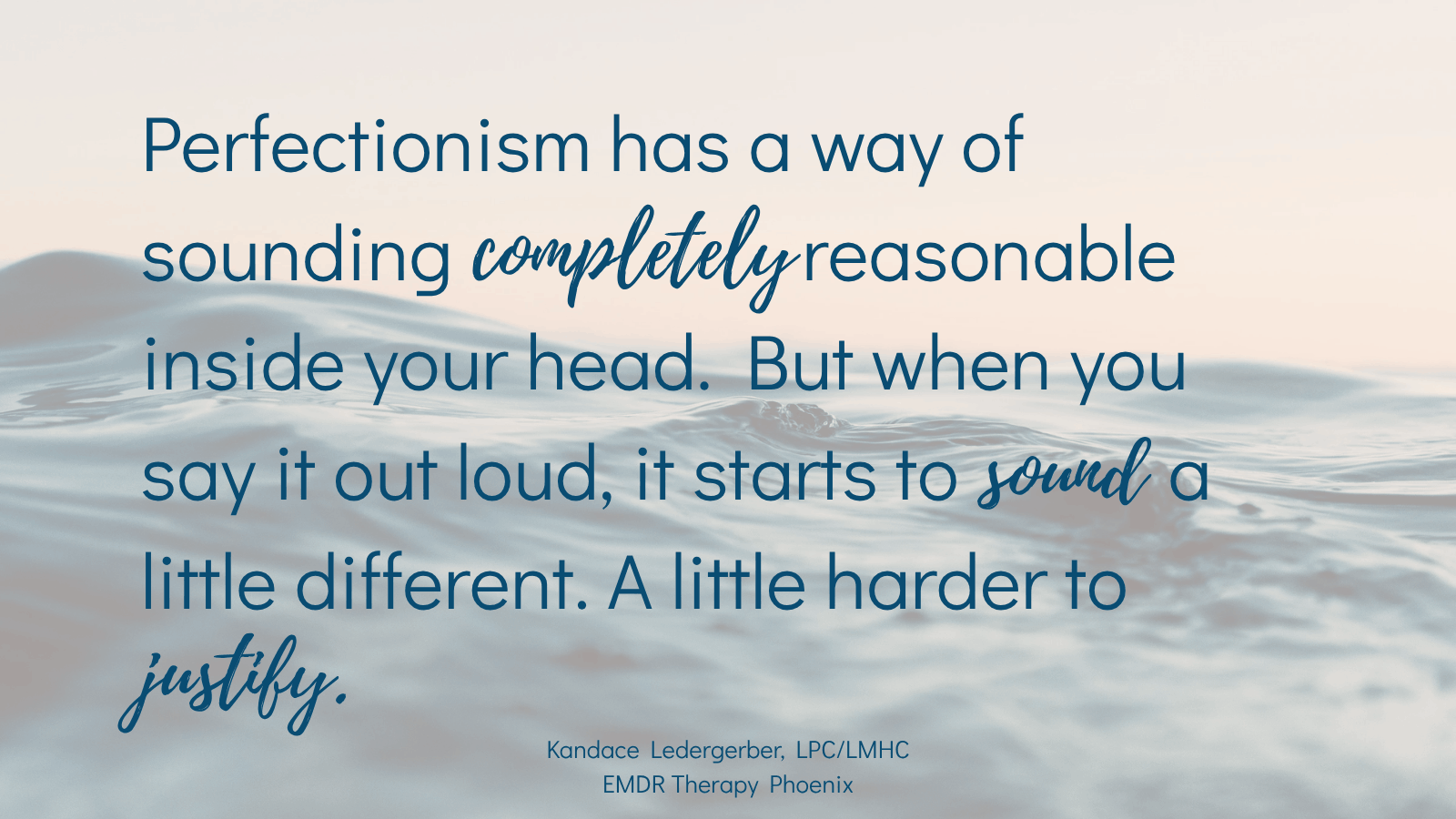
Photo Description: Calm pale ocean water background with soft warm tones. Dark teal text reads: "Perfectionism has a way of sounding completely reasonable inside your head. But when you say it out loud, it starts to sound a little different. A little harder to justify." The words "completely" and "sound" appear in cursive script for emphasis. Attributed to Kandace Ledergerber, LPC/LHMC, EMDR Therapy Phoenix
Photo by Matt Hardy on Unsplash
Not to analyze it or argue with it. Just to hear it.
Because perfectionism has a way of sounding completely reasonable inside your head. Logical, even. But when you actually speak the expectation out loud, when you hear yourself say what you’re demanding of yourself, something can shift. It starts to sound a little different than it did in your head. A little harder to justify.
From there, you can ask yourself a few gentle questions:
Is this a realistic expectation?
Would I ask this of someone I loved?
What would I say to them if they were holding themselves to this standard?
That last one tends to land hardest. Because most perfectionists are extraordinarily generous with the people they love, and extraordinarily harsh with themselves. Holding both of those things at once, noticing the gap between them, can be one of the first cracks in the armor.
This isn’t about talking yourself out of caring. It’s about starting to notice when the standard you’re holding yourself to stopped being yours.
Get Curious About Where It Came From
Perfectionism rarely appears out of nowhere. It has a history, and getting curious about that history, without judgment, can be one of the most grounding things you do.
Not in a “let’s excavate every painful memory” kind of way. More like a gentle noticing. When does perfectionism show up most? At work? Around family? Around your body? In relationships where you feel like you have to earn your place?
From there, you can ask yourself a few gentle questions:
Is this a realistic expectation?
Would I ask this of someone I loved?
What would I say to them if they were holding themselves to this standard?
And if you want to go one layer deeper, try asking the perfectionism itself directly. Not to argue with it — but to get genuinely curious about what it's actually trying to do:
Are you trying to protect me from criticism or rejection?
Are you keeping everything in order so it feels safe to breathe?
Are you trying to prove I'm worthy of being loved?
You might be surprised by what comes up. Because perfectionism usually isn't trying to make your life harder. Many times, it’s trying to keep you safe. Understanding what it's protecting you from is often where the real work begins.

Photo Description: Ocean wave with a soft pastel purple and pink sky in the background. Dark teal text reads: "Most perfectionists are extraordinarily generous with the people they love, and extraordinarily harsh with themselves." The words "generous," "love," and "themselves" appear in cursive script for emphasis. Attributed to Kandace Ledergerber, LPC/LMHC, Anxiety Therapy Phoenix.
Photo by Silas Baisch on Unsplash
Sometimes, perfectionism grew out of direct criticism or high expectations. Sometimes it grew in homes where love felt inconsistent, where you learned to stay small and good and easy to manage. Sometimes it was the environment itself, the pressure in the air, rather than anything anyone explicitly said.
Whatever the origin, the nervous system absorbed the lesson: performing keeps me safe. Stopping is dangerous.
That’s worth knowing. Not so you can assign blame, but so you can start to understand that the perfectionist mind wasn’t irrational. It was adaptive. It was doing exactly what it needed to do, in a context that no longer exists.
Why Perfectionism Can Feel Safer Than Stillnessexplores this more deeply if you find yourself recognizing your own history in any of this.
Notice What It Feels Like in Your Body
This is the piece that gets skipped most often, and it is a critical part.
Perfectionism doesn’t just live in your thoughts. It lives in your body. In the tension that never fully releases. In the breath you are holding. In the guilt that shows up in your shoulders when you say no. And in the exhaustion that a weekend away can barely touch, because it isn’t the kind of tired that rest fixes.
Start noticing what perfectionism actually feels like when it’s running the show. Not just what you’re thinking, but what you’re feeling physically.
Where do you hold tension when something goes wrong?
What happens in your chest or your stomach when you make a mistake?
What does your body do when you finally stop moving? Does it settle, or does it brace?
This isn’t about fixing anything right away. It’s about building a different kind of awareness, one that includes your body in the conversation, not just your mind. Because the nervous system speaks in sensation. And learning to listen to it is often the beginning of something shifting.
What Easing Perfectionism Actually Looks Like
Here’s the thing - easing the perfectionist mind isn’t about becoming someone who doesn’t care. It’s not about lowering your standards or stopping yourself from doing good work.
It’s about safety. Specifically, it’s about your nervous system finally feeling safe enough to put the guard down. To stop performing. To exist without the thousand pounds of armor on.
That shift (when it happens) is quieter than people expect. It doesn’t usually arrive as a dramatic moment of transformation. It shows up in smaller ways. Saying no and noticing that the guilt, while present, doesn’t swallow you whole. Making a mistake at work and catching yourself not spiraling. Sitting still for five minutes without your brain running threat assessments.

Photo Description: Bright turquoise ocean shoreline with white sea foam and soft cloudy sky in the background. Dark teal text reads: "You are allowed to just be. Imperfect, human, and worthy of rest exactly as you are." The words "allowed," "Imperfect," and "worthy" appear in cursive script for emphasis. Attributed to Kandace Ledergerber, LPC/LMHC, Anxiety Therapy Phoenix.
And underneath all of it, something that can feel almost radical: the sense that you are allowed to just be. To be human. To be imperfect. To be exactly who you are, not the polished, performing version, but the real one. The one who gets tired, makes mistakes, and deserves rest and to be seen just as much as anyone else.
That’s not a small thing. That’s the whole thing.
Getting there usually means working at the level of the nervous system, not just the mind. Understanding the roots of perfectionism intellectually is a start, but it rarely reaches deep enough on its own. This is where anxiety therapy in Phoenix can help, particularly approaches that work with the body and the nervous system rather than just the thoughts sitting on top of it.
If you’re curious about what that kind of support looks like, What Is Anxiety, Really? is a good place to start, it breaks down how the nervous system learns these patterns and what it actually takes to help it learn something new.
You Don’t Have to Keep Running at This Pace
If your mind is always spinning, if rest never quite reaches you, if saying no feels like a moral failure, I get it. Your nervous system learned to operate that way for a reason. It’s an adaptive, wonderful thing, that also needs some updating.
You don’t have to keep living at that pace.
If you’re curious about what anxiety therapy in Phoenix could look like for you, I’d love to connect. Book a free consultation, no pressure, just a conversation about where you are and what support could look like.
TL;DR
Perfectionism isn’t a personality flaw — it’s a nervous system pattern that developed for a reason.
Saying your expectations out loud — and asking if you’d hold someone you love to the same standard — can be the first crack in the armor.
Getting curious about where perfectionism came from, without judgment, matters more than trying to logic your way out of it.
Perfectionism lives in the body too — tension, guilt, exhaustion that rest doesn’t fix.
Easing perfectionism isn’t about caring less — it’s about feeling safe enough to put the guard down.
You are allowed to just be. Imperfect, human, and worthy of rest exactly as you are.

About the Author
Kandace Ledergerber, LPC/LMHC, Certified EMDR Therapist
Kandace helps adults who feel stuck in the hamster wheel of anxiety and perfectionism reconnect with a sense of grounding, self-trust, and emotional steadiness. Through EMDR therapy and nervous system-informed work, she supports clients in moving out of survival mode and into a more grounded, meaningful life.
She specializes in trauma recovery, anxiety and perfectionism, and healing the lingering effects of childhood and relational trauma. Her work focuses on helping clients process painful experiences that still feel “stuck” so they can move forward with greater peace, confidence, and emotional freedom.
Kandace is the founder of Soul Mission EMDR Therapy , where she provides EMDR Therapy in Phoenix and online across Arizona and Florida.
Learn more about Kandace’s background, approach, and services on her About page.