How to Know if an EMDR Intensive Is Right for You

Photo Description: A title graphic with an aerial ocean photo split into two vertical strips of teal and dark water on either side, framing a light blue center panel. Navy text in the center reads: "How to Know if an EMDR Intensive Is Right for You," with a small coral divider line below it, followed by "By Kandace Ledergerber, LPC/LMHC, Certified EMDR Therapist."
Photo by Gatis Marcinkevics on Unsplash
Another really hard moment hits. One where your past is haunting you right in your face even though you left that relationship, that house, those people years ago. You are a different person now. In fact, you have worked your ass off to become a different person. You have learned regulation techniques, coping skills, probably gone to therapy, worked on your communication skills and put good boundaries in place. But somehow, in the moments you least expect it, a trigger from the past comes slamming to the surface.
Perhaps you're even currently in talk therapy or working with a life coach, but you just keep feeling stuck and patterns from your past continue to edge their way into your current life.
You're probably thinking, Why is this still happening! I've done so much work to get past this. Why can't I just be done with this?
A friend might have recommended EMDR and you start wondering if that's the right path for you. But you don't want results in weeks and weeks. You want to start feeling the difference, like, yesterday. This is where an EMDR Intensive format could be helpful.
What an EMDR Intensive Actually Is (In Plain Terms)
An EMDR Intensive is longer than your typical hour-long EMDR session. It is dependent on you and your needs, but most EMDR Intensives range in time from 90 minutes, to 3-4 hours, to even 6-8 hours. Now, this does not mean that we are doing deep processing work for every minute of those intensives. Here's how it differs from a typical EMDR session, and the difference is really important. In a typical EMDR session, you come in, talk about the last week or few weeks for 10-20 minutes and then dive into either building resources to actively help you deal with life demands, or move into reprocessing past trauma and actively working through old patterns that are holding you back. For safety's sake, in an hour-long session, we can do the second portion for about 30 minutes if we are really lucky. And then for the last 10 minutes or so, we want to make sure we contain whatever we were working on, re-regulate, and work to close the session. Then, next week we do it again.
So we spend about half the session both opening up and closing down the space so you can feel safe and regulated in your body. The other half of the session is spent on the deep work that you are trying to move through so things actually change.
For some people, this is really effective and is exactly what they need to feel supported and move through the past in a way that feels good to their nervous system.
But if you have ever felt frustrated by the fact that you are just getting to the "meat and potatoes" of the session when it's time to start wrapping up, you are not alone.
An EMDR Intensive extends that time so you have a longer window to work within. Think of it this way: if you sign up for a 3-hour EMDR Intensive, that is 3 weeks of 1-hour therapy sessions that you are attending in one block, where you are only opening the session (10-20 minutes) and closing the session (10-15 minutes) one time. The rest of that time is meant for deep work that can be done at a pace that feels intentional, where we can sit with the hard stuff and make actual movement because we can give it time and attention.
I've been honored to work with individuals in the intensive format (and in the non-intensive format), and if you'd like to learn more about the options I provide, you can visit my EMDR Intensives page.
Who Actually Reaches Out About This
In my experience, one of two types of clients reach out for an intensive. The first is a person who has been doing the weekly therapy or working with a life coach. They are actively unearthing old patterns and doing the work in their life that creates change.

Photo Description: An aerial view of ocean waves in teal and white, with foam splitting the frame diagonally. Blue text reads: "We're not steeped in the trauma the entire time. That's actually what's wonderful about the intensive format." Attributed to Kandace Ledergerber, LPC, Certified EMDR Therapist.
Photo by Shifaaz shamoon on Unsplash
And then, they hit a wall. They keep running into the same pattern, and for the life of them, they cannot get out of it.
The second person is similar in that they have done the work. They have learned and put in hard time setting boundaries, developing healthier communication patterns, and coping skills, but at the end of the day, their past still creeps up on them.
Both of these clients have something in common: they are done waiting. They have put in a lot of hard work and effort. They have read the books, they listen to the podcasts, they go to breathwork classes and yoga. They spend time in nature and use amazing skills to live the best life they can. But something continues to hold them back. This something shows up in their body every time a trigger slams into them. This something shows up in the everyday patterns that continue to hold them back. And they are freaking done with it, and they are ready for change.
The Biggest Misconception About EMDR Intensives
Here is the biggest fear I hear repeatedly from people who are thinking about this format.
It sounds a lot like, 3 whole hours! Digging up my past and sitting in my trauma for 3 entire hours. I don't know if I can handle that.
And here's the thing, during those three hours, or six or eight, we are not steeped in the trauma the entire time. That's actually what's wonderful about the intensive format: we have space to titrate, which just happens to be another one of my favorite things in EMDR.
Because we have more time and we are not pressed into a small window, we can slow down. We can take more frequent steps back, incorporate movement, and allow ourselves to work with the defense patterns that come up that you never seem to be able to break through in your normal therapy hour.
Here is the comparison I find myself using. When you have a stiff muscle from a good workout, and you need to find a good stretch, you don't want to just lean into that stretch for 2-3 seconds. You want to give it time. Maybe stretch that muscle in several different ways. Allow that stiffness to release a bit, and then maybe walk around for a few minutes, and then maybe stretch again, maybe get some water and find what your body needs next.
Why More Time Actually Means More Room, Not More Intensity
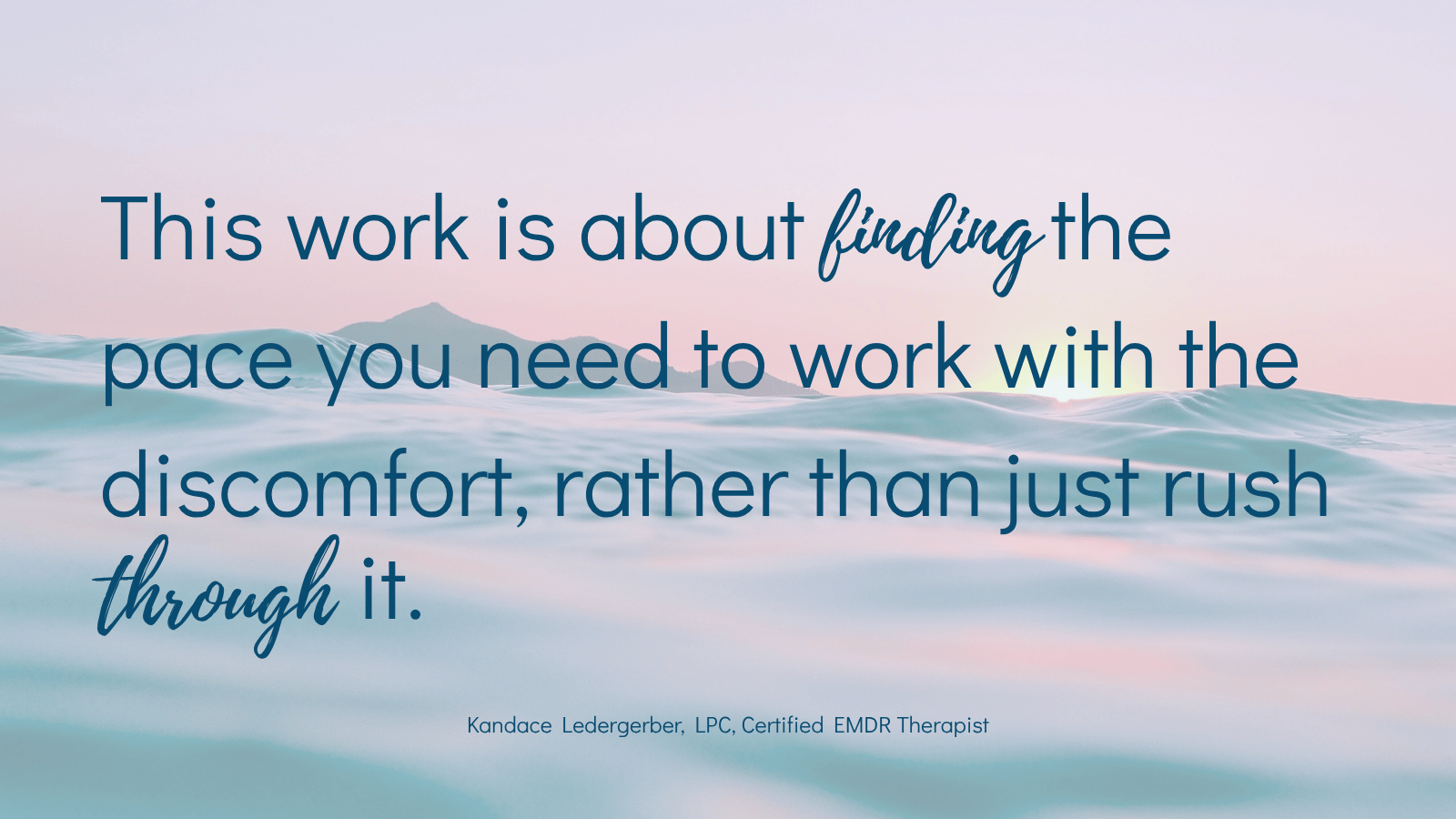
Photo Description: A soft pastel sunrise over gentle ocean waves, with mountains faintly visible on the horizon. Blue script and sans-serif text reads: "This work is about finding the pace you need to work with the discomfort, rather than just rush through it." Attributed to Kandace Ledergerber, LPC, Certified EMDR Therapist.
Photo by Linus Nylund on Unsplash
So what does all this mean? This means that there is more space, not just for more processing and trauma work, but more room to pace what you actually need, both to feel safe and to do the deep work you are craving to get past the stuff that keeps holding you back. This space gives extra time for resourcing as you need it, and time and space to feel seen and heard before you dive deeper. Or perhaps, even extra time to sit with the discomfort of feeling seen and heard so you can dive deeper.
So often this work is about finding the pace you need to allow yourself to work with the discomfort and with the pain, rather than just rush through it.
I know it's not all comfortable. I know it's hard work. I know this, because I have been in the client's seat too. Sitting with that discomfort and working with it instead of trying to move through it can be hard. Listening to ourselves and our needs can be even harder.
But what a wonder it is when we allow ourselves the time and space to sit with what's there rather than rushing into the next thing. In my opinion, both in and out of the therapy room, that is where the growth shows up.
The Real Question: Are You a Fit for an EMDR Intensive?
This is the part that matters most, because an intensive isn't the right fit for everyone, and for good reason. We are all wired a bit differently, but here's what I've noticed about who tends to do well in this format, and who doesn't, and neither one says anything about your capacity to heal.
When Sitting With Discomfort for Long Stretches Isn't for You
Some people genuinely don't do well sitting with something uncomfortable for an extended period of time. They don't like feeling it and then titrating back, they need the extra extended space to process internally and don't want to do that with another person present. There's nothing wrong with that. That's just information about how your brain and body work, which might mean that weekly sessions with built-in breaks are a better fit for you.
When You Like to Dive In, Surface, and Dive Back Down
Other people are wired almost the opposite way. You can focus on one thing for a long stretch, come up for air, check in with yourself, and go back down again. If that sounds like you, the extended format of an intensive might actually match your natural rhythm better than an hour a week ever could. And when you have the support of someone who can sit with you in it and offer tools along the way, it can allow the process to flourish that much more.
When Your Defenses Get Loud Under Sustained Focus

Photo Description: Ocean scene under a cloudy sky with a pink sunset glow on the horizon. Blue text reads: "Your defenses show up for a reason. They just never got the message that the danger has passed." Attributed to Kandace Ledergerber, LPC, Certified EMDR Therapist.
Photo by Silas Baisch on Unsplash
And then there's a third group, maybe the one nobody talks about enough. In sessions, your defenses show up for a reason. At one point in life, they kept you functioning, safe, and alive through something really hard or even unsafe. The issue is that they never got the message that the danger has passed. This extended time gives us space to sit with those defenses, appreciate why they were present in the first place, and also work with what they need (I know this part sounds a little woo-woo). With more time in the room, we're not rushing past that response to get to the "real" work. We slow down with it, figure out what it's actually protecting, and work with it as a part of the work.
What an Intensive Actually Looks Like, Hour by Hour
So what does an intensive actually look like? Well honestly, it does depend on where you are at and where you're trying to get. But overall, here is how I structure intensives.
We start by getting to know each other, figuring out how the past is showing up in your present, and what success would even look like for you by the end of the day. From there, we build at least one or two resources together, so we have a shared, common language to come back to if reprocessing gets hard and you feel anxious, on edge, numb, or disconnected. Then we get specific about which memories are connected to the themes you are wanting to work on, the ones that keep looping back to that stuck place that shows up in your present. And then we do the work. We process, we work with whatever defenses show up in the room, and we take breaks, snacks, stretching, breathing, whatever you need. All of it is welcome. And we do it at the pace that actually works for your nervous system and what feels good to you.
If You're Still Deciding
If you've read all of this and you're still not sure, that's a completely reasonable place to be. An EMDR Intensive means you are putting a lot of time, effort, and energy into one space, and it's natural to have questions or want to know more. And here's the great thing: you don't have to self-diagnose if this is a good fit for you from a blog post alone. That's exactly what a consultation is for, a conversation where we can talk through what you're carrying and figure out whether this format, or the weekly rhythm of EMDR therapy in Phoenix, may be a better fit for you.
TL;DR
An EMDR Intensive is the same EMDR work, just given a longer, single block of time instead of an hour spread across weeks.
Most people who reach out for one aren't in crisis. They've done the work already and they're just done waiting for the next piece to shift.
More time doesn't mean more trauma crammed in. It means more room to titrate, pace, and take breaks when you need them.
Whether an intensive fits you depends on how you handle sustained focus, not on how healed or ready you already are.
Even your defenses showing up mid-session aren't a red flag. With enough time, we can actually work with them instead of rushing past them.
If you're still unsure, that's normal. A consultation is where we figure out fit together, not something you have to decide alone from a blog post.

About the Author
Kandace Ledergerber, LPC/LMHC, Certified EMDR Therapist
Kandace helps adults who feel stuck in the hamster wheel of anxiety and perfectionism reconnect with a sense of grounding, self-trust, and emotional steadiness. Through EMDR therapy and nervous system-informed work, she supports clients in moving out of survival mode and into a more grounded, meaningful life.
She specializes in trauma recovery, anxiety and perfectionism, and healing the lingering effects of childhood and relational trauma. Her work focuses on helping clients process painful experiences that still feel "stuck" so they can move forward with greater peace, confidence, and emotional freedom.
She offers EMDR therapy in Phoenix, anxiety therapy, and EMDR Intensives.