Misconceptions About Trauma: Why You're Still Stuck With It

Photo Description: Blog header graphic with an ocean wave background in cool blue tones, framed by a lighter blue center panel. Dark teal text reads "Misconceptions About Trauma" with the subtitle "Why You're Still Stuck With It," followed by a coral dividing line and the author credit "By Kandace Ledergerber, LPC/LMHC, Certified EMDR Therapist."
Photo by Christoffer Engström on Unsplash
Updated July 2026
You've probably journaled about it. You've talked to your therapist, your best friend, probably three other friends just for good measure, so you could triangulate the truth of what happened to you. You've read every book you can get your hands on. Maybe you've even done yoga or breath work, trying to move it out of your body. You have, by any reasonable measure, done “the work”.
And it's still there. You might hear a name, pick up on a smell, or get a vague text from your mother, and you feel yourself go into survival - cut off from yourself, right back in something you thought you'd already handled.
So the question shows up, quiet and exhausting: why the f*ck is this still here?
In this blog, I want to clear up a few misconceptions that keep smart, capable, high-achieving people stuck longer than they need to be. None of them are your fault, and all of them are worth unlearning.
Key Takeaways
Trauma isn't defined by how big or objectively bad an event was. It's defined by how your nervous system perceived it.
Doing "the work" on your own (journaling, research, self-reflection) is real work, but it's not the same as processing, and that's not a failure on your part.
Healing doesn't mean you'll never react to something again. A setback isn't proof you're back at square one.
Trauma Isn't About How Bad It Looked From the Outside
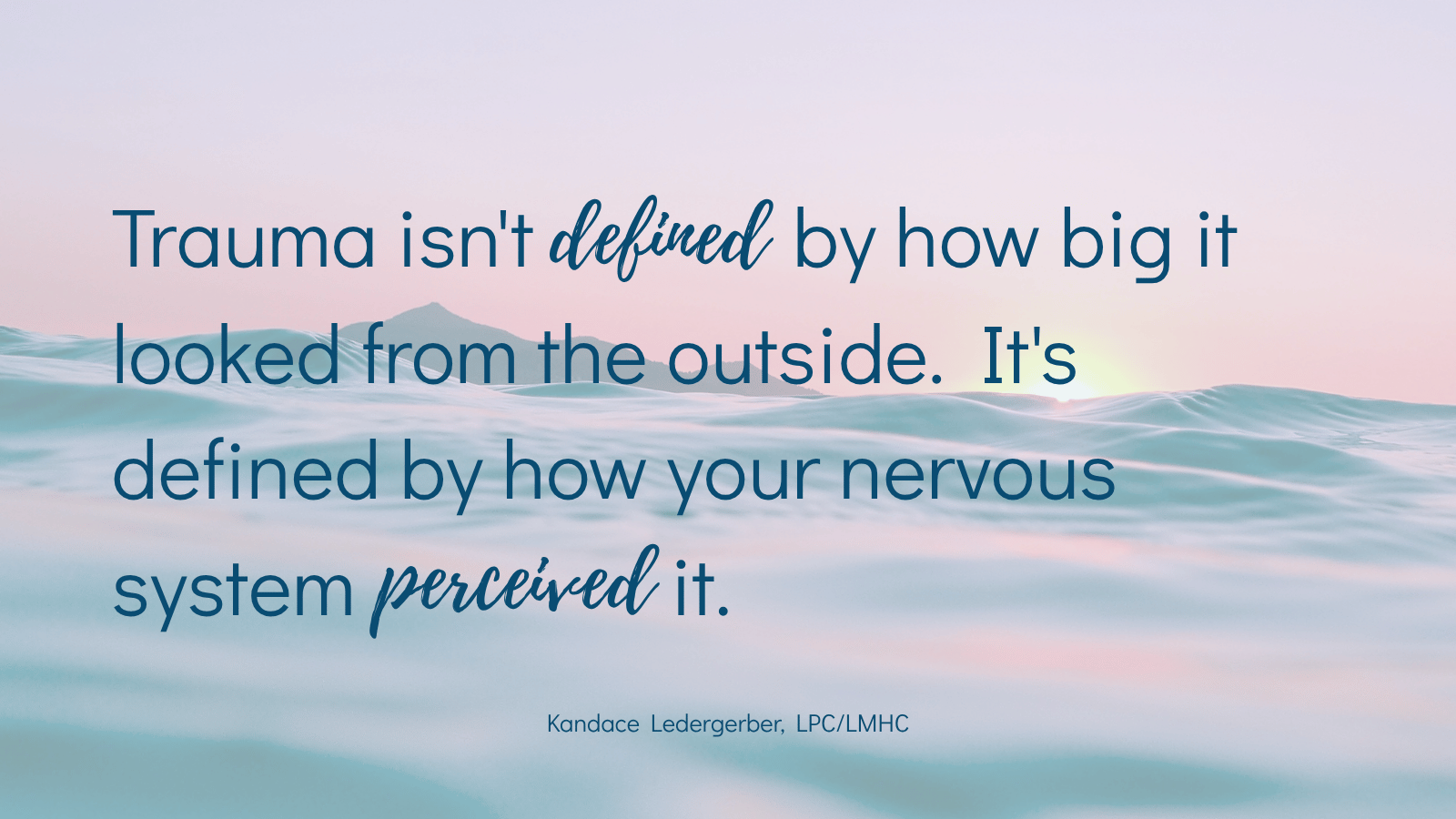
Photo by Linus Nylund on Unsplash
Photo Description: Quote graphic reading "Trauma isn't defined by how big it looked from the outside. It's defined by how your nervous system perceived it." Attributed to Kandace Ledergerber, LPC/LMHC. Ocean wave background at sunset with soft pink, peach, and blue tones, with "defined" and "perceived" rendered in script emphasis typography.
For a long time, the cultural script around trauma was pretty narrow, unfortunately. It had to be a car accident, a shooting, or combat to qualify. Something big enough that nobody would question it. If what you went through didn't clear that bar, the going logic was that it probably wasn't trauma, and you probably needed to get over it (after all, if you’re not bleeding, are you really hurt?).
I've watched that shift in recent years, and honestly, it's about time. Because trauma was never really about the size of the event. It's about your nervous system's perception of it.
Here's what I mean. If you're being chased by a tiger, your only concern is the tiger. You’re not worried about your partner's birthday tomorrow. Or the fact that you're out of milk. Just: survive this. It just tries to keep you alive through whatever it's facing, and it files the experience away accordingly.
And here’s the thing: your nervous system doesn't rank threats by how they'd look to an outside observer. So if something felt like a tiger to you, your body responded like it was a tiger. That's not you being dramatic, or "making it a bigger deal than it was." That's a nervous system doing exactly what it's built to do.
I use the phrase “After all, if you’re not bleeding, are you really hurt?” as a bit of tongue-in-cheek, because who didn’t hear this at some point growing up? It was the idea that unless there is bone sticking out of your leg, you’re probably fine, and even if there is bone that’s visible, you’re still probably fine. The same goes (if not more so) for our emotional experiences.
You've Done the Work. So Why Hasn't It Moved?
Here's the misconception I think does the most quiet damage: that if you've already worked hard on something, and you're still triggered by it, something must be wrong with you.
I want to be direct about this, because I don't think it gets said enough. The clients I work with are rarely people who haven't tried. They are, almost without exception, high-achieving perfectionists who have tried harder than most people ever will. They've journaled. They've read the peer-reviewed articles, not the Instagram infographics, the actual research. They've talked it through with multiple friends to get multiple angles. They've moved it through their body with yoga or breath work. These are not people who are avoiding the problem.
So when it's still showing up, the assumption is often "I must be doing this wrong." or “Something is wrong with me.” And that's where I want to push back.
Here's the piece that's frequently missing: somebody sitting across from you, actually tracking the pattern, not just hearing the story.
A good friend on the couch next to you is doing something wonderful. They're listening and validating in a way that only a good friend can. But that's not the same as therapy, and if you're expecting your own self-work to function like therapy, you're going to keep feeling like you're failing at something you're actually not equipped to see from the outside.
In session, I'm not just hearing your pain in the moment you bring it to me. I'm tracking how the pattern you're describing today connects to what you brought up three weeks ago, and to what you mentioned about your childhood, and to what's currently reinforcing it in your life right now.
That's an aerial view.
You, understandably, are down in the trees. You've been down in the trees your whole life. That's not a flaw in your effort. It's just not a vantage point you can get to on your own, no matter how many books you read.
One of my favorite things is when I can track a specific belief a client has brought in time and time again and when I spot a subtle shift. It could be a conversation they had, the way they held a boundary, or even just taking care of themselves for the first time in forever. And almost without fail, they brush over it like, “yeah, I did this thing,” completely missing how big it is that they’ve started to shift the belief they’ve been holding for years! It’s in those moments that I get the privilege to point it out and revel in it with them.
Healing Doesn't Mean You'll Never React Again
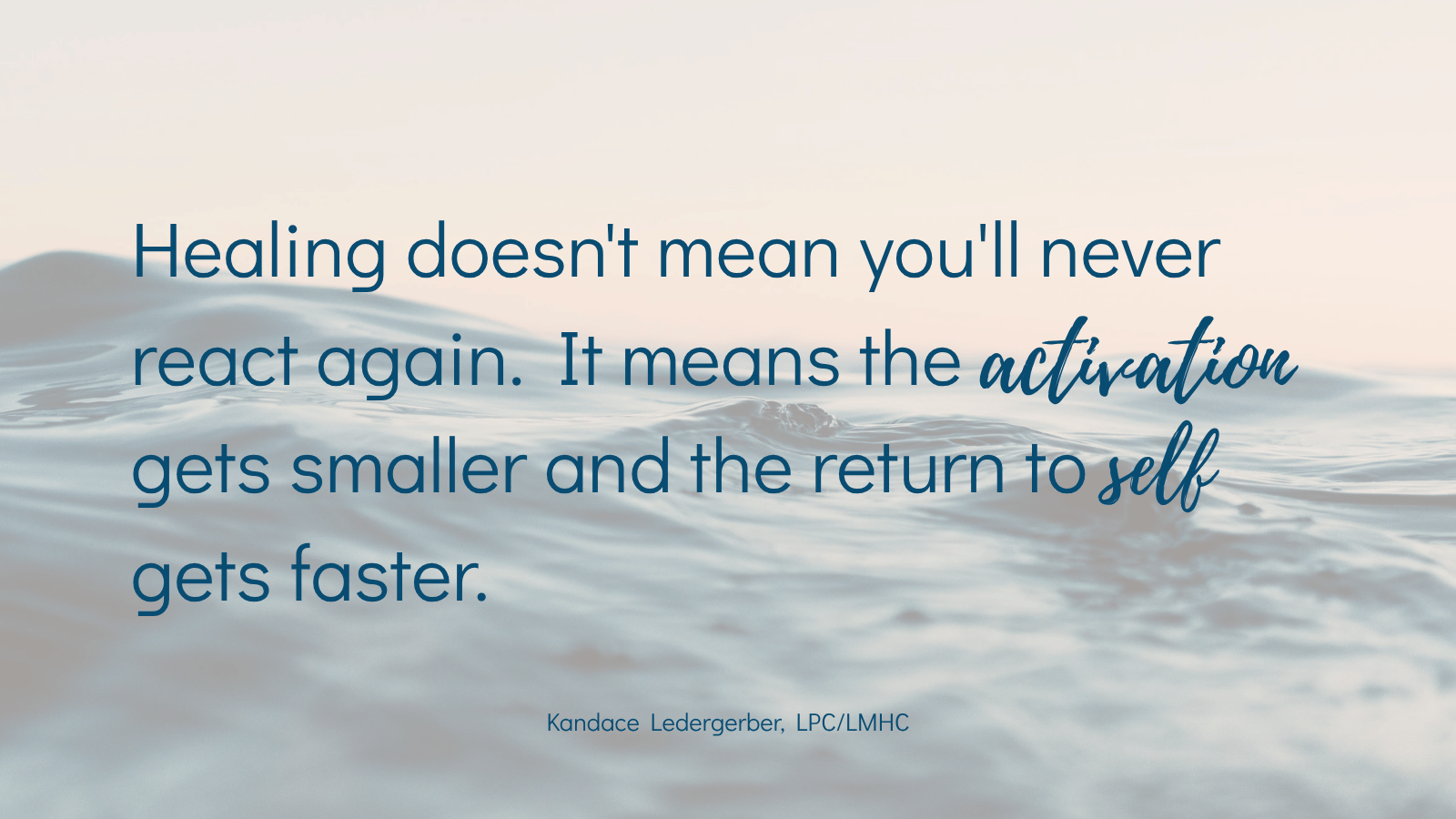
Photo Description: Quote graphic reading "Healing doesn't mean you'll never react again. It means the activation gets smaller and the return to self gets faster." Attributed to Kandace Ledergerber, LPC/LMHC. Soft ocean wave background in muted blue and peach tones, with "activation" and "self" rendered in script emphasis typography.
Photo by Matt Hardy on Unsplash
The third misconception is the one I think sets people up to feel like healing and forms of therapy have failed them, when really, they misunderstood what healing was supposed to look like.
Somewhere along the way, a lot of people picked up the idea that healing means arriving at a place where the old thing never touches you again. No flinch. No fog. Done, forever.
That's not how it tends to work, in my experience. Healing usually looks like the activation getting smaller, and the return to self getting faster. You still notice the moment something stings. You just don't stay gone as long. You come back to yourself quicker than you used to.
If you have a hard day after months of feeling steady, that's not evidence the work didn't take or that something is wrong with you. It's evidence you're a person with a nervous system, living a life that still occasionally serves up a hard day.
Where EMDR Comes In
This is part of why I lean on EMDR therapy Phoenix instead of only talking things through. Talking can help you understand why something happened. It doesn't always help your body stop responding to it like it's still happening. EMDR works with the nervous system directly, so the memory can settle instead of staying primed. If you want the full picture of how that process actually works, the complete guide to EMDR therapy walks through it from the beginning.
If you've been trying to talk your way to the other side of something and it hasn't quite landed, this post on why talking about trauma isn't the same as processing it might be a good next read.
You're Not Behind or Failing
If any of this describes you, you're not doing it wrong. You've been working with the information you had. Some of it just wasn't going to get you all the way there on your own, and that was never a fair thing to expect of yourself.
If you're ready to work with someone who can see the whole pattern, not just today's piece of it, I'd love to talk. Reach out to schedule a free consultation.
TL;DR
Trauma isn't measured by how the event looked from the outside. It's measured by how your nervous system perceived it.
Doing the work alone (journaling, research, talking to friends) is real, and it's still not the same as having someone track your patterns and reflect them back to you.
Healing doesn't mean you'll never react again. It means the charge gets smaller and the return gets faster.
None of this means something is wrong with you. It means you were missing a piece that wasn't yours to provide by yourself.

About the Author
Kandace Ledergerber, LPC/LMHC, Certified EMDR Therapist
Kandace helps adults who feel stuck in the hamster wheel of anxiety and perfectionism reconnect with a sense of grounding, self-trust, and emotional steadiness. Through EMDR therapy and nervous system-informed work, she supports clients in moving out of survival mode and into a more grounded, meaningful life.
She specializes in trauma recovery, anxiety and perfectionism, and healing the lingering effects of childhood and relational trauma. Her work focuses on helping clients process painful experiences that still feel "stuck" so they can move forward with greater peace, confidence, and emotional freedom.
She offers EMDR therapy in Phoenix, anxiety therapy, and EMDR Intensives.