
Photo by Matt Hardyon Unsplash
Photo Description: Blog header graphic featuring soft layered ocean water in shades of blue and teal with a light frosted overlay panel. Title reads "Why Triggers After Sexual Trauma Can Feel So Intense." with a coral accent line beneath it. Byline reads "By Kandace Ledergerber, LPC/LMHC."
A song comes on unexpectedly. Someone's hand lands on your shoulder. A smell drifts through a room you thought was safe. And suddenly something shifts, often fast and without warning, and you don't feel like you're actually in the room anymore. Your heartbeat is going wild, and some part of you is asking the question that feels equal parts desperate and exhausted:
Why does something so small send me so far?
If you've ever found yourself reeling backwards from something that, on paper, shouldn't have done that much, this post was written with you in mind. The goal of this post is not to hand you a list of your triggers to memorize and manage, but to explain what's actually happening in your body when that happens, and why it makes complete sense.
Key Takeaways
Triggers after sexual trauma can feel disproportionately intense because your nervous system is responding to then, not now
The body doesn't experience a trigger as a memory. It experiences it as something happening in the present
Knowing your triggers doesn't make them stop firing, and that's not because you're doing the homework wrong
Resources that are actually wired in for you can help shift your body from then back into now
Giving the brain processing opportunities, not just awareness, is what changes how triggers land over time
Your Body Isn't Overreacting. It's Pattern-Matching
Your nervous system has one job: keep you alive. And it is very, very good at it.
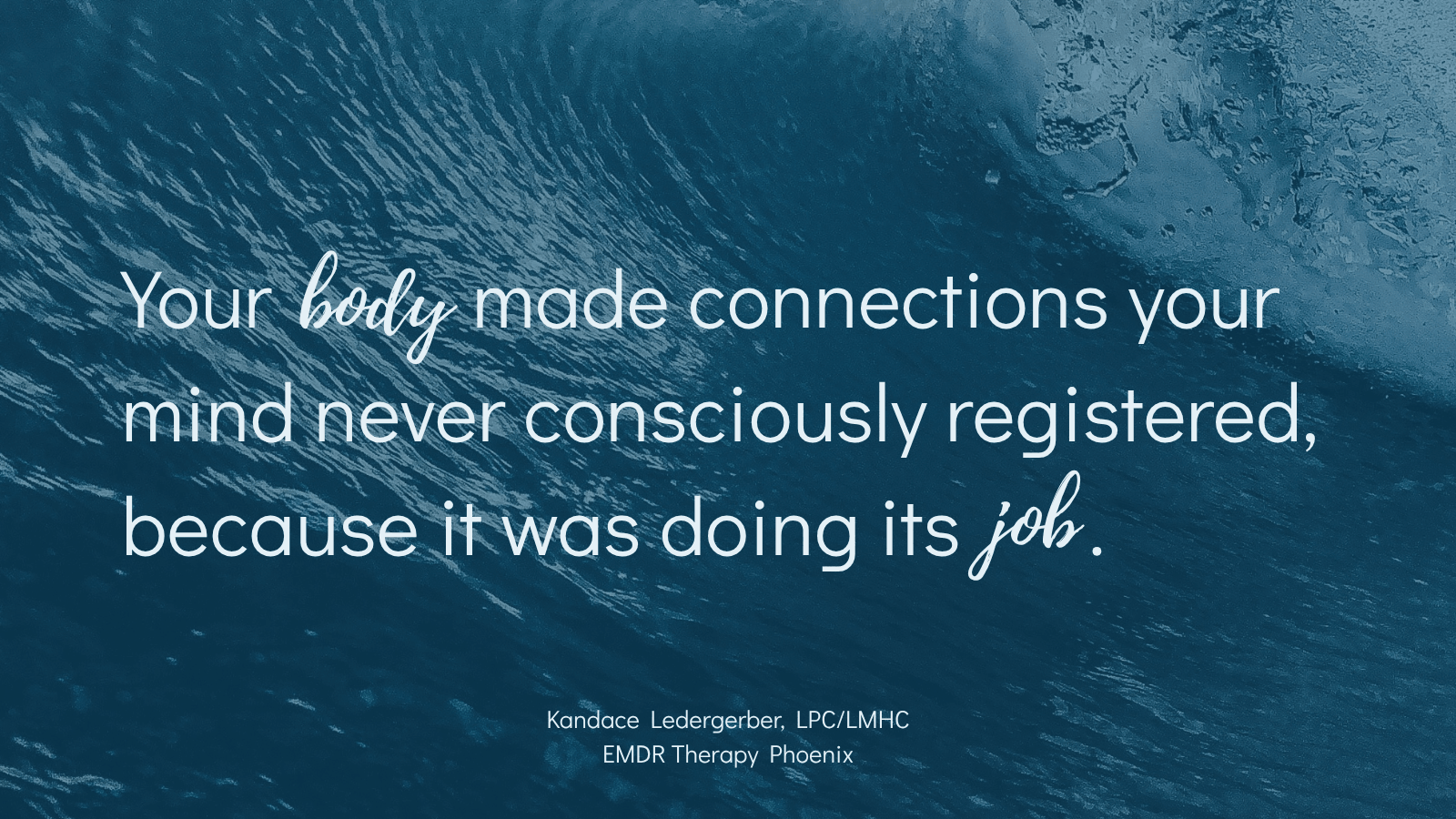
Photo by Silas Baisch on Unsplash
Photo Description: Quote graphic reading "Your body made connections your mind never consciously registered, because it was doing its job." Attributed to Kandace Ledergerber, LPC/LMHC. Deep blue ocean wave background.
Part of how it does that job is by learning to recognize danger very quickly. Not after careful analysis, not after debating the pros and cons, but fast. So it encodes experiences, especially overwhelming ones that are a threat to our safety, in extraordinary sensory detail. The sounds, the smells, the quality of light, the feeling of fabric, the tone of a voice. All of it gets filed, because any piece of it might be relevant later, and it could save us.
After sexual trauma, that filing system becomes especially sensitive. Because what happened was body-based, boundary-violating, and in many cases, something your system had no framework to process in the moment. So it stored the details. All of them.
Which means that later, when your nervous system picks up something that matches even a fragment of what it stored, or even resembles it, it responds. Not because you're fragile. Not because something is wrong with you. Because that is exactly what survival wiring does. It pattern-matches, and it moves faster than your thinking mind can catch up.
It makes sense that our brains need to do this because our brains are wired to try to keep us alive.
Why Sexual Trauma Leaves Such a Detailed Imprint
Most trauma leaves a mark on the nervous system. Sexual trauma tends to leave a particularly detailed one, because it happens to the body, often involves a profound loss of agency, and frequently occurs in the context of a relationship or space that was supposed to feel safe.
The nervous system encodes not just what happened, but everything surrounding it. Which is why the thing that triggers you can sometimes seem completely unrelated to the actual event. A specific kind of touch. A song that was playing or a smell that feels forgotten until it's not. Your body made connections your mind never consciously registered, because it was doing its job.
That's not an irrational reaction. That's a nervous system that was paying very close attention.
The Trigger Isn't the Memory. It's the Experience, Happening Now.
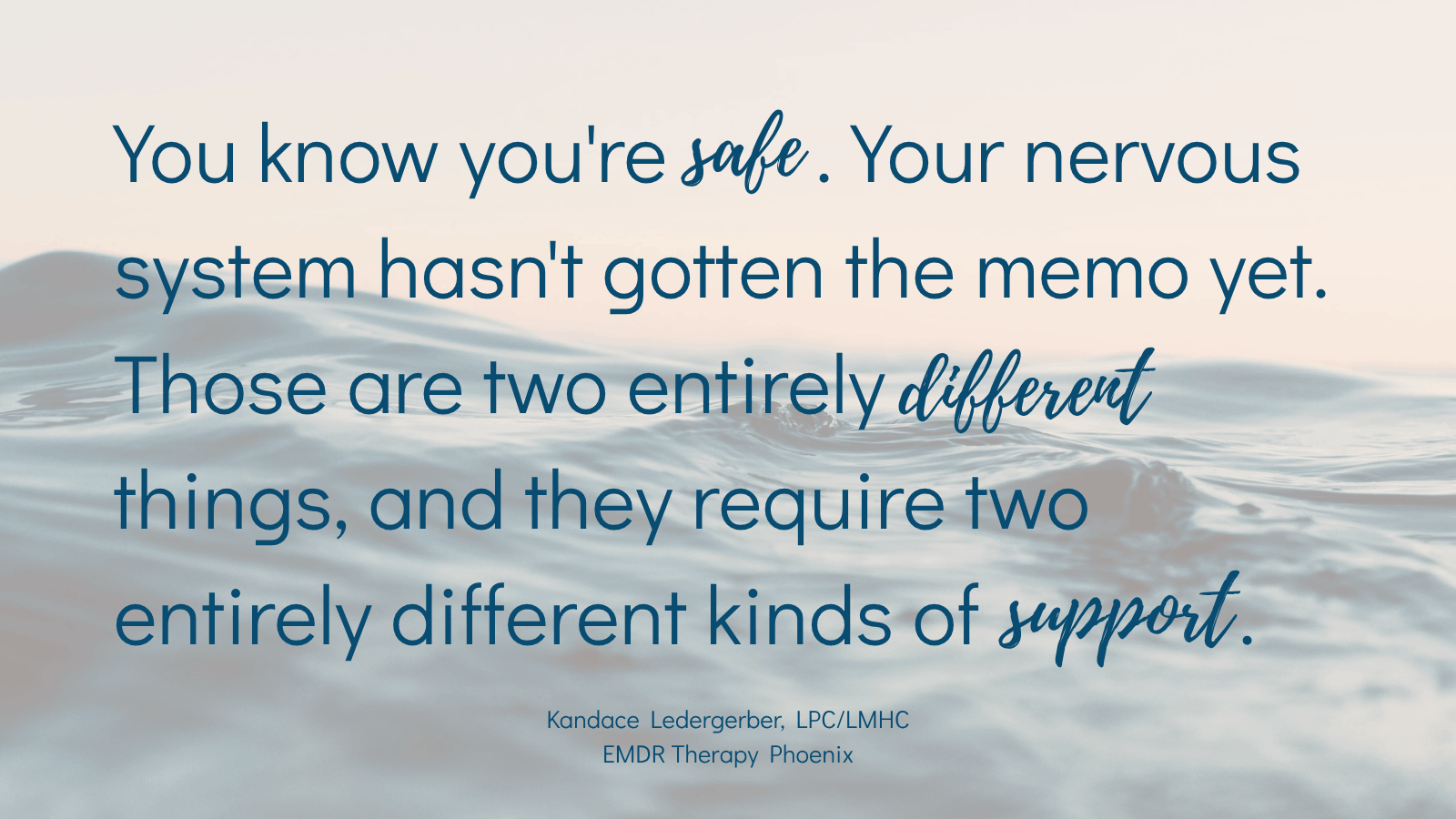
Photo by Matt Hardyon Unsplash
Photo Description: Quote graphic reading "You know you're safe. Your nervous system hasn't gotten the memo yet. Those are two entirely different things, and they require two entirely different kinds of support." Attributed to Kandace Ledergerber, LPC/LMHC. Soft ocean wave background in warm peach and blue tones.
Here's the piece that most "understand your triggers" content skips over completely.
When a trigger fires, your body isn't recalling something from the past the way you might recall what you had for lunch last Tuesday. It's reliving it, in a vivid visceral type of way. The emotional and physiological response is happening in the present, in your body, right now. Your heart rate, your breath, the tension in your chest, the sudden urge to disappear, shut down, or run, those aren't reactions to a memory. They're responses to something your nervous system believes is currently happening.
This is why a trigger can knock you completely sideways even when your logical mind knows, with total certainty, that you are safe. The knowing lives in your head. The felt sense of danger lives somewhere else. And in that moment, the somewhere else wins.
This is also why being told to "just remember you're safe" in the middle of a trigger can feel so frustrating, or even completely useless. You know you're safe. Your nervous system hasn't gotten the memo yet. Those are two entirely different things, and they require two entirely different kinds of support.
If you want to understand more about why the body holds on to what the mind has tried to move past, the post on why your nervous system can't just calm down goes deeper into this.
I often hear clients relate the feeling that they know it in their brain but their body and their heart do not feel it yet. It's often not a matter of poor coping skills or not enough self-awareness. Society has a long history of telling survivors that even how they cope is wrong, in addition to the actual trauma happening in the first place. That the way their body responded during the event was wrong. That the way they're healing is wrong. At some point, the message becomes: everything about how you survived this was a problem. That's not insight. That's just more harm dressed up in different language. How you survived made sense. How your body is responding now makes sense. And finding your way through this, at whatever pace that takes, makes sense too.
Knowing Your Triggers Doesn't Make Them Stop
Let's talk about the advice you've probably already received.
Just learn your triggers. Try tracking them and anticipating them. Build awareness so you can see them coming and respond differently.
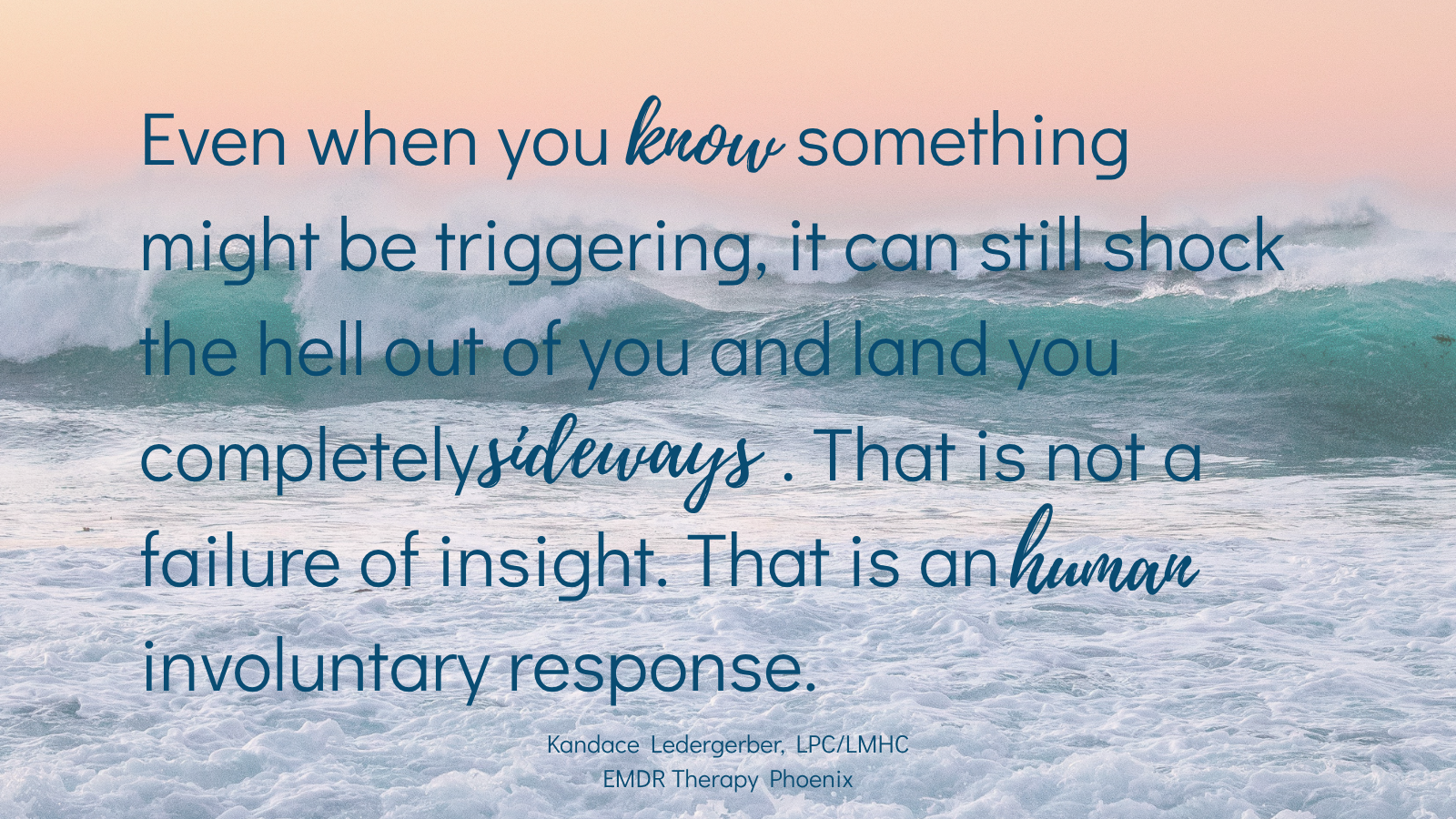
Photo by Laura Barryon Unsplash
Photo Description: Quote graphic reading "Even when you know something might be triggering, it can still shock the hell out of you and land you completely sideways. That is not a failure of insight. That is an involuntary human response." Attributed to Kandace Ledergerber, LPC/LMHC Soft teal and peach ocean wave background.
Here's what I'd like to say to that. While yes, tracking and learning your triggers can help give you useful conscious information, your unconscious self is probably already deeply aware of your triggers, and it's staying on high alert to try to avoid said triggers and alert you at the faintest resemblance (hello fatigue and exhaustion for "no reason".)
This advice isn't wrong, exactly. Awareness is real, and it's useful. But there's something it leaves out, something I think is important to say clearly:
Even when you know something might be triggering, it can still shock the hell out of you and land you completely sideways. That is not a failure of insight or a lack of awareness. That is an involuntary human response. Your body is doing what it learned to do, and knowing about it doesn't help your brain automatically override the wiring.
Awareness can change the aftermath. It might help you come back faster. It might help you understand what just happened and have a little more compassion for yourself in the middle of it. But the jolt and the reeling that come from a trigger? That's still there until there's been real processing. Until your nervous system has actually had the chance to update its understanding that the past is not happening right now.
That's not a flaw in you. That's often just how this works.
What Actually Helps in the Moment
When a trigger fires and you're reeling, the goal isn't to reason your way out of it, because your thinking mind isn't running the show right now. What helps is giving your body enough evidence that right now is not then.
That's what resources are for. Not a generic list of coping skills someone handed you in a worksheet. Actual resources that are specific to you, ones that your nervous system recognizes and responds to, ones that can shift the felt sense in your body from then back toward now.
This might look like a specific memory of a place where you felt genuinely safe. A person, real or imagined, whose presence your body remembers as calm. A grounding practice that moves through sensation slowly enough for your system to actually follow it. Something that doesn't just distract you, but genuinely helps you land back on the ground. If you want to go deeper on what building those resources actually looks like, this post on grounding tools and EMDR resourcing walks through it.
Triggers are real, and they are a real pain. But here's the cool thing about our brains: every time you use a resource after encountering a trigger that communicates to your body you are actually safe, your body is more likely to remember that in the face of the trigger. It takes time, patience, and a lot of work, but in essence, that is you re-patterning your brain. Think about it kind of like walking through a field of tall grass. As you make and take one path, the grass lies flat, but what if one day you decided to take another path? It would take some time for the grass on the second path to form, but after taking the path over and over again the grass in the second path also lies flat, whereas the first one, if not taken, would become overgrown again over time. The same is true for the patterns our brain has learned.
What Changes Over Time, And What Doesn't Until It Does
Triggers don't go away through awareness alone.
They change through processing, the active re-patterning of the brain. Through your nervous system actually having the chance, in a safe and supported way, to update its understanding that what happened then is not happening right now. That the information it stored so carefully no longer needs to be treated as an active emergency.
The frustrating part is that the work can be slow, and typically is not linear. Some weeks things feel like they're shifting, and some weeks a trigger you thought you'd moved past finds you again and reminds you it's still there. This does not mean you are back where you started. It's the nature of the work.
In those moments, try to acknowledge the strides you have made. Take stock of where you were with this issue three months ago or even a year ago and how that felt completely different to the now.
What I've found, over and over again, is that the change tends to be less about triggers disappearing and more about how long you stay sideways after they fire. The jolt might still come. But the time it takes to come back, to find your footing, to remember where you actually are, that gets shorter. And eventually, for many people, what was once a full-body emergency becomes something smaller. Something manageable. Sometimes something that barely registers at all.
That's what processing does. It doesn't erase, but allows the whole self to update.
This is exactly the kind of work I do in my practice. If you're curious about what that process actually looks like, you can learn more about EMDR therapy in Phoenix and how I work, or read my complete guide to EMDR which walks through it in detail, including why we start with resources and safety before we approach anything hard.
If Something Small Just Sent You Somewhere Far
If you found this post because something happened today that knocked you backwards, and you're still trying to understand why, I want to say this directly: that response makes sense. Your nervous system was doing its job with the information it has. The fact that it's still running that pattern doesn't mean you're broken or stuck or too far gone. It means you haven't yet had the support to help your body update what it learned.
That support exists. And it doesn't require you to white-knuckle your way through your triggers or build a spreadsheet of everything that sets you off. It requires working with your nervous system, not against it, at a pace that actually feels possible.
If you're in Phoenix and you're ready to explore what that looks like, I'd love to talk. You can learn more about sexual trauma therapy here, or reach out to schedule a free consultation.
And if you're not quite there yet, the post on the freeze response and dissociation after sexual trauma is a good next read. It goes deeper into one of the most common, and most misunderstood, ways triggers show up in the body.
TL;DR
Triggers after sexual trauma feel intense because your nervous system is responding to then as if it's happening now
Your body stored sensory details from the experience, and any fragment can activate the whole response
Knowing your triggers doesn't stop them from firing, and that's not a failure
Real resources, ones wired in for you specifically, can help shift your body back into the present
Triggers change through processing, not just awareness, and that work takes time
You're not overreacting. Your nervous system is doing exactly what it learned to do

About the Author
Kandace Ledergerber, LPC/LMHC, Certified EMDR Therapist
Kandace helps adults who feel stuck in the hamster wheel of anxiety and perfectionism reconnect with a sense of grounding, self-trust, and emotional steadiness. Through EMDR therapy and nervous system-informed work, she supports clients in moving out of survival mode and into a more grounded, meaningful life.
She specializes in trauma recovery, anxiety and perfectionism, and healing the lingering effects of childhood and relational trauma. Her work focuses on helping clients process painful experiences that still feel "stuck" so they can move forward with greater peace, confidence, and emotional freedom.
She offers EMDR therapy in Phoenix, anxiety therapy, and EMDR Intensives in Arizona.
Learn more about Kandace's background, approach, and services on her About page.