Why Sexual Trauma Can Affect Relationships Years Later
Photo by Joseph Barrientos on Unsplash
Photo Description: Blog header graphic with the title "Why Sexual Trauma Can Affect Relationships Years Later" and the subtitle "EMDR Therapy Phoenix," by Kandace Ledergerber, LPC/LMHC, Certified EMDR Therapist. Ocean horizon background in warm peach, dusty rose, and deep teal tones at dusk.
A note before you read: This post talks openly about sexual trauma and its effects on relationships and intimacy. If you find yourself activated while reading, please know that support is available. You can reach the 988 Suicide and Crisis Lifeline by calling or texting 988, available 24 hours a day. You can also find a collection of grounding and support resources here. There is no pressure to read all of this at once, or at all. Please take what's useful and leave the rest.
It might start when your partner does something kind. Maybe they reach for your hand, or they tell you they love you, or they show up in exactly the way you would have said you wanted someone to show up, and instead of feeling a warmth in your chest, something in you goes quiet and on alert. Instead of gratitude or relief, you find yourself instead…waiting. Waiting for the other shoe, for the catch, for the moment when this thing that looks like safety reveals itself to be something else entirely.
And the question underneath that, the one that can follow you for days if you let it: what is wrong with me?
Here is what I want you to know, and what I find myself saying often in my practice. Nothing is wrong with you. Something was done to you. And the fact that it is still showing up in your most intimate spaces is not evidence of damage. It is evidence of exactly how much this kind of wound hurts, and how deeply the body holds on to when it was never given the chance to fully process.
That is what this post is about.
Key Takeaways
Sexual trauma is an intimate violation, and of course it echoes in intimate spaces. That makes complete sense, and it does not mean something is permanently broken in you.
The feeling that love is temporary or unsafe is most likely a nervous system response, not a sign that something is fundamentally broken in you.
Shame is a common companion to sexual trauma, and it is also one of the heaviest things to carry alone.
You did not choose what happened to you. The aftermath belongs to the trauma, not to who you are.
Healing is possible, and it does not require you to minimize what happened or perform “okayness” you don't actually feel.
This Was an Intimate Violation. Of Course It Still Hurts Here.
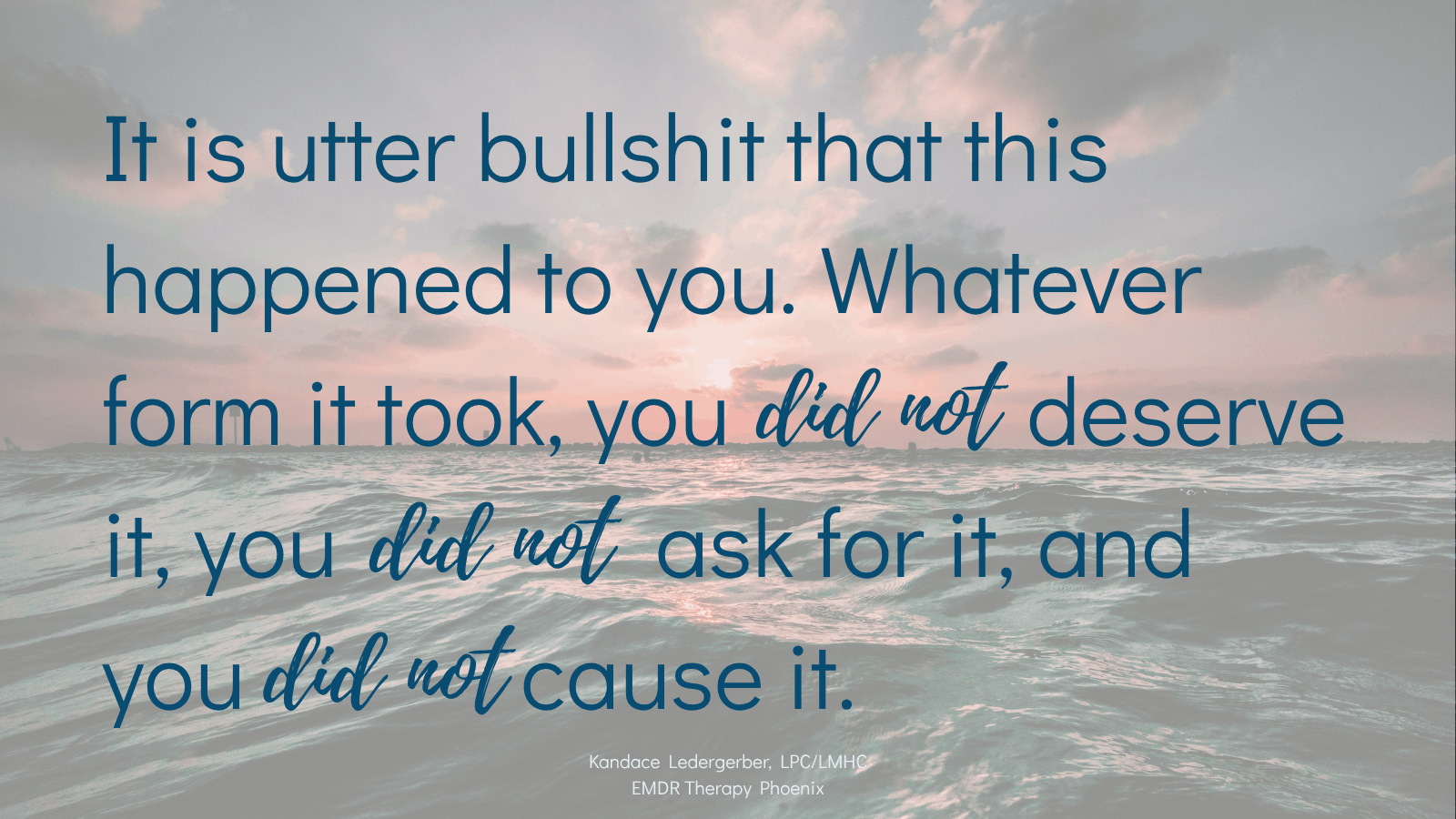
Photo by Silas Baisch on Unsplash
Photo Description: Quote graphic reading "It is utter bullshit that this happened to you. Whatever form it took, you did not deserve it, you did not ask for it, and you did not cause it." Attributed to Kandace Ledergerber, LPC/LMHC, Soft ocean horizon background in muted peach, grey, and blue sunset tones.
Sexual trauma does not come in one shape. For some people, it was a single assault, a specific moment that changed something permanently and without consent. For others, it was a relationship, one that may have included love or dependency or both, and that was also abusive in many ways, including sexually. Neither of these experiences is more legitimate than the other, and neither produces a neater or more manageable kind of aftermath. What they share is this: they happened in an intimate space, in or near the body, often by someone known, often in a context where trust was present or assumed.
And that is specifically why the effects show up where they do.
When something violating happens in an intimate space, the nervous system files it there. It does not separate "what happened in that relationship" from "what relationships are," at least not automatically, and not without real support. It learns, in the way that nervous systems learn (through experience, not through logic), that intimacy can be where harm lives. And then it does its job, which is to protect you, by staying alert in exactly that territory.
This is not a flaw in how you are wired. It is the system working as designed. Unfortunately, it’s just working from older and more painful information than the present moment deserves.
I will also say this plainly, because I think it does not get said plainly enough: it is utter bullshit that this happened to you. Whatever form it took, you did not deserve it, you did not ask for it, and you did not cause it. The fact that you are still carrying it is a reflection of how significant this kind of violation is, not of any weakness in you.
Why It Shows Up in Relationships Specifically
There is a reason that sexual trauma tends to surface most loudly in relationships and in moments of intimacy, and it is not complicated, even if it is painful. Trauma gets stored where it happened. And for most survivors of sexual trauma, it happened in close proximity to another person, often in a context that involved trust or vulnerability or both.
So when the nervous system encounters those conditions again (closeness, vulnerability, another person who wants access to you in some way), it does what it learned to do to keep you safe. It scans, and often it braces, looking for the thing that came before, the threat to safety. This happens below the level of conscious thought, which is part of why it can feel so disorienting. You can look at your partner and know, logically, that they are not the person who hurt you. And your body can still respond as though the threat is present, because for your nervous system, the pattern is close enough to warrant the alarm.
If you want to understand more about how implicit memory works and why the body holds on to what the mind tries to move past, this post on why your body remembers what your mind tries to forget goes deeper into that piece. The short version is this: the body is not overreacting. It is pattern-matching. And it needs something more than reassurance to update its information.
When Love Starts to Feel Like a Trap
One of the things I see most often in survivors of sexual trauma, and one of the things that can be the most quietly exhausting thing to live with, is the sense that the good things in a relationship are temporary. That safety is a trick. That the person in front of you, however trustworthy they have shown themselves to be, is one moment away from becoming something else or worse, walking out the door.
Rationally, survivors often know this is not accurate. They can say, clearly and with real awareness, "I know my partner is not my ex. I know this is different." And it still feels like the other shoe is about to drop, still feels like being loved means being positioned for a fall, because at some point in their history, that is exactly what being loved meant. A relationship that included real feeling also included real harm. And the nervous system does not easily untangle those two things.
This is not pessimism. I would even go as far as to say that it is not self-sabotage. It is a nervous system that learned, through direct experience, that intimacy and danger can exist in the same space, sometimes even in the same person. The vigilance that comes from that learning made sense when it was developed. The work of healing is not to shame yourself out of it, but to give your nervous system enough new evidence, slowly and with real support, that it can begin to tell the difference.
When the Body Pulls Back
Pulling away physically or emotionally in moments of closeness is another thing that can feel confusing and even shameful, especially when the person on the other side of it is someone you genuinely want to be close to. But dissociation, numbness, or the urge to create distance are not choices in the way we usually think of choices. They are protective responses, ones that developed because at some point, leaving (or going somewhere far away inside yourself) was the safest option available.
The body remembers that option and it can reach for it again in moments that feel similar, even when the similarity is just a texture of vulnerability rather than any real danger. This is not a reflection of how much you want connection. Most survivors I work with want connection very deeply. It is a reflection of how much the nervous system is still working to keep you safe from something that has already passed.
The Shame That Was Never Yours to Carry
Photo by Gatis Marcinkevics on Unsplash
Photo Description: Quote graphic reading "The shame is not yours to carry." Attributed to Kandace Ledergerber, LPC/LMHC. Aerial ocean wave background in bright teal and white water tones.
Shame is one of the most consistent companions of sexual trauma, and also one of the most unjust. It attaches itself to survivors with a kind of persistence that has nothing to do with what actually happened and everything to do with how sexual trauma gets treated, spoken about (or not spoken about), and responded to by the people and systems around it.
Survivors are often not believed. They are often asked what they were wearing, what they were drinking, why they stayed, why they didn't say something sooner. They carry secrets that were forced on them, sometimes for years, sometimes forever. And all of that silence and all of that questioning has a way of turning inward, into a belief that the shame belongs to them rather than to what was done to them.
It does not.
Something I often ask clients who are sitting with this kind of shame is what they would say to their closest friend if that friend came to them carrying the same experience. Almost without exception, the answer is gentler, more generous, and more accurate than anything they have been able to say to themselves. You probably already know, somewhere in you, what that friend deserves to hear. And you deserve to hear the same thing.
You did not choose this. The shame is not yours to carry.
Why It Still Hurts This Much, This Long After
There is sometimes a quiet, secondary wound that comes from the timeline itself, from the feeling that enough time has passed that this should be resolved by now, that you should have moved through it, that still being affected means something is wrong with your progress or your resilience.
I want to say clearly: the timeline of healing from sexual trauma has nothing to do with how much time has passed and everything to do with whether the body has had the chance to actually process what it is holding. And for most survivors, that chance requires something more than time alone. It requires the right kind of support, in a space that feels safe enough to do the work, which yes in some cases, that can mean a supportive partner, but in many it requires more.
Sexual trauma is intimate by nature. It happened in the body, often in a context of relationship or trust, often in silence. Of course it echoes in intimate spaces for years afterward. Of course it surfaces when you are closest to another person. That is not a sign that you are stuck. It is a sign that something significant happened, and that your nervous system is still trying to protect you from it happening again.
The length of time you have been carrying this is not a measure of weakness. It is a measure of how much this kind of wound asks of a person, and how much support real healing actually requires.
What Healing Actually Looks Like
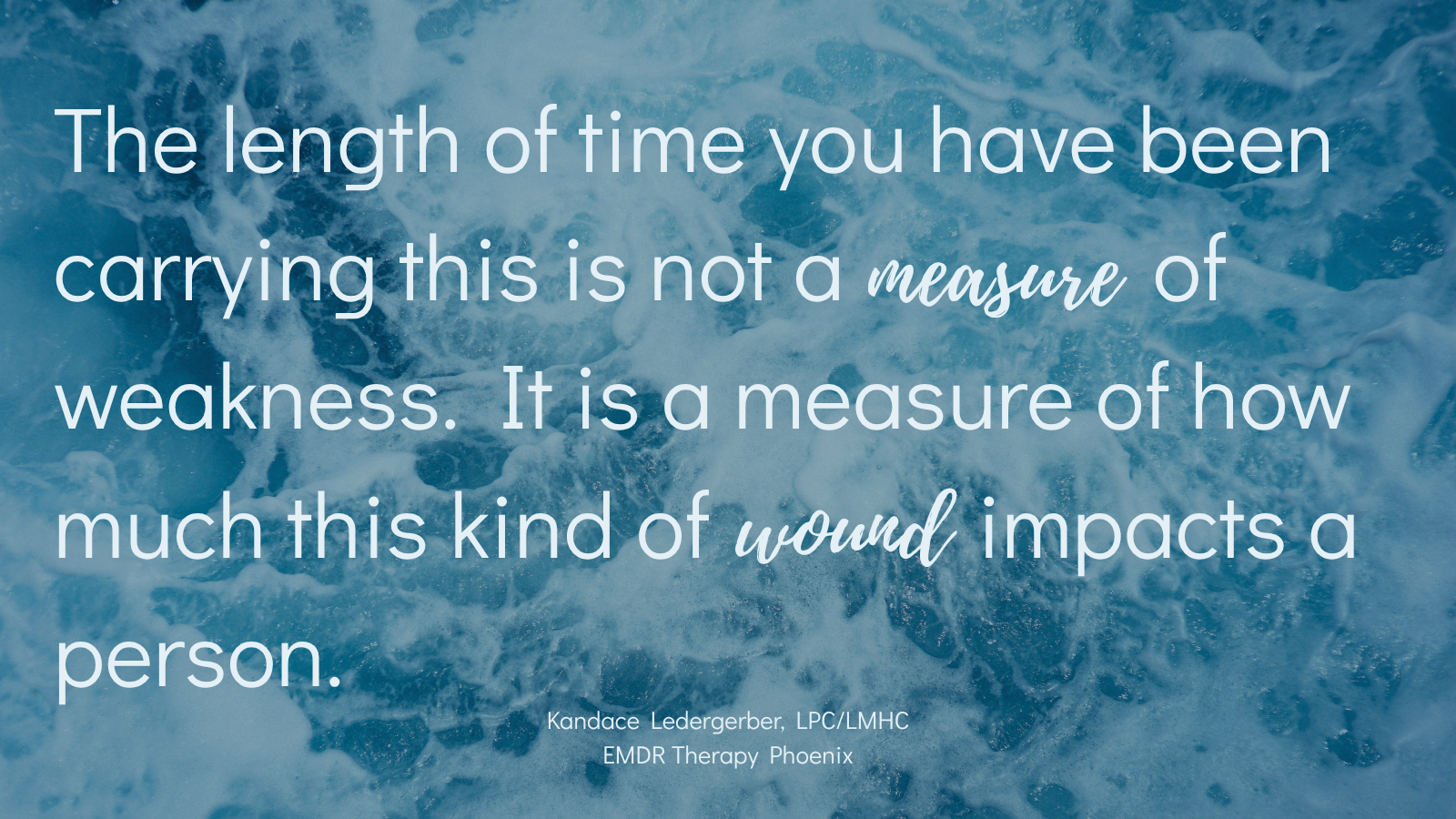
Photo by Christoffer Engströmon Unsplash
Photo Description: Quote graphic reading "The length of time you have been carrying this is not a measure of weakness. It is a measure of how much this kind of wound impacts a person." Attributed to Kandace Ledergerber, LPC/LMHC. Textured ocean surface background in deep blue and white water tones.
Healing from sexual trauma is not linear, and it does not look like erasing what happened or arriving at a place where it no longer matters. It looks more like building a different relationship with what the body is still holding, one that creates enough safety to let the nervous system begin to update its understanding of the present.
This is work that happens at the level of the body, not just the thinking brain. Talk therapy has real value, and a good therapeutic relationship is part of what makes healing possible. But for trauma that lives in the body (and sexual trauma almost always does), the work has to reach the body too. Approaches like EMDR are built specifically for this, starting not with the hardest material but with building safety and resourcing first, so that when you do approach something difficult, you have somewhere solid to return to.
If you are in Phoenix and you have been living with the aftereffects of sexual trauma in your relationships and in your body, this is the kind of work I do at Soul Mission EMDR Therapy. You can learn more about sexual trauma therapy in Phoenix and what that process looks like, or explore EMDR therapy in Phoenix if you want to understand more about the approach before reaching out. You can also read the complete guide to EMDR if you want to go deeper first.
You Don't Have to Have This Figured Out to Reach Out
If any part of this post resonated with you, you do not need to arrive at a consultation with a clear understanding of your history or a plan for what you want to work on. Most people don't. What matters is that something in you is ready to try a different kind of support, and that is enough to start with.
Reach out to schedule a free consultation, where we can have a conversation about where you are and whether the work I do might be a good fit for what you're carrying.
TL;DR
Sexual trauma is an intimate violation, and its effects showing up in intimate spaces is not a malfunction. It makes complete sense.
The nervous system learns where harm happened and stays alert there, even when the present moment is safe. That is pattern-matching, not brokenness.
Feeling like the other shoe is about to drop, or like love is a setup for devastation, is a nervous system response rooted in real experience, not a sign that you are incapable of closeness.
Shame is one of the most common companions of sexual trauma, and also one of the least deserved. You did not choose what happened to you.
Healing is possible, and it does not require minimizing what happened or performing a recovery you do not feel. It requires the right support, at the right pace, working with the body as well as the mind.

About the Author
Kandace Ledergerber, LPC/LMHC, Certified EMDR Therapist
Kandace helps adults who feel stuck in the hamster wheel of anxiety and perfectionism reconnect with a sense of grounding, self-trust, and emotional steadiness. Through EMDR therapy and nervous system-informed work, she supports clients in moving out of survival mode and into a more grounded, meaningful life.
She specializes in trauma recovery, anxiety and perfectionism, and healing the lingering effects of childhood and relational trauma. Her work focuses on helping clients process painful experiences that still feel "stuck" so they can move forward with greater peace, confidence, and emotional freedom.
She offers EMDR therapy in Phoenix, anxiety therapy, and EMDR Intensives in Arizona.
Learn more about Kandace's background, approach, and services on her About page.