Photo by Ant Rozetsky on Unsplash
Photo Description: Blog header graphic reading "Why You Calm Down Around Some People and Brace Around Others" with author credit "By Kandace Ledergerber, LPC/LMHC, Certified EMDR Therapist." White text over a deep blue ocean scene with rolling waves under a cloudy sky at dusk, with a semi-transparent blue overlay panel and a small coral dividing line beneath the title.
You walk into a room, and depending on who's in it, your body makes a decision before you have consciously made one yourself. With certain people, I'm willing to guess, your shoulders drop down from around your ears, your breathing settles a little lower into your chest, and you feel like you can finally breathe. With others, you might find yourself braced before they have said a single word, scanning their face for the temperature of the room, already trying to brace yourself for whatever might be coming.
Same you, with the same nervous system, but a completely different feeling, depending on who is sitting across from you.
We tend to explain this away with words like "chemistry" or "vibes," and sometimes we chalk it up to whether we simply click with a person or not. But there is something more specific happening under the hood, and it has a name. It is called co-regulation, and once you understand it, a whole lot of your relationships (the easy ones, the exhausting ones, and the genuinely confusing ones) start to make a different kind of sense.
Key Takeaways
We are wired to regulate our nervous systems with other people, not entirely on our own. This is biology, not a weakness.
A lot of people never reliably got that as kids, which makes regulating independently as an adult genuinely harder.
"Calm" and "safe" are not always the same thing. Sometimes a person feels regulating simply because they are familiar.
The right relationships can slowly re-pattern what you learned about what you are worth and how you deserve to be treated.
Your Nervous System Is Reading the Room (and the People In It)
Your nervous system is always doing math in the background, whether you have asked it to or not. It is reading faces, tones of voice, the speed of someone's movements, the tension sitting in a room, and it is asking one quiet question on a loop: am I safe here? And one of the biggest pieces of data it uses to answer that question is other people, specifically the state of the people around you.
When you are near someone whose own system is settled and grounded and not braced for impact, your nervous system gets to borrow a little of that. Their steadiness becomes information that tells your body it can come down a notch too. And the reverse is just as true, which you have probably felt more times than you can count. Sit next to someone who is wound tight, on edge, or barely holding it together, and your own system starts picking up the signal that something might be wrong here, even when nothing has been said out loud and nothing is actually happening.
This is what co-regulation can look like. Oftentimes this gets bypassed as a character quirk with a label slapped on it saying that you are "too sensitive" or "too dependent" by other people. But what it really is is the way human nervous systems are built. We were never designed to do this entirely on our own, and the belief that we should be able to is where a lot of people start beating themselves up.
Why You Never Learned to Do This Alone (and Weren't Supposed To)
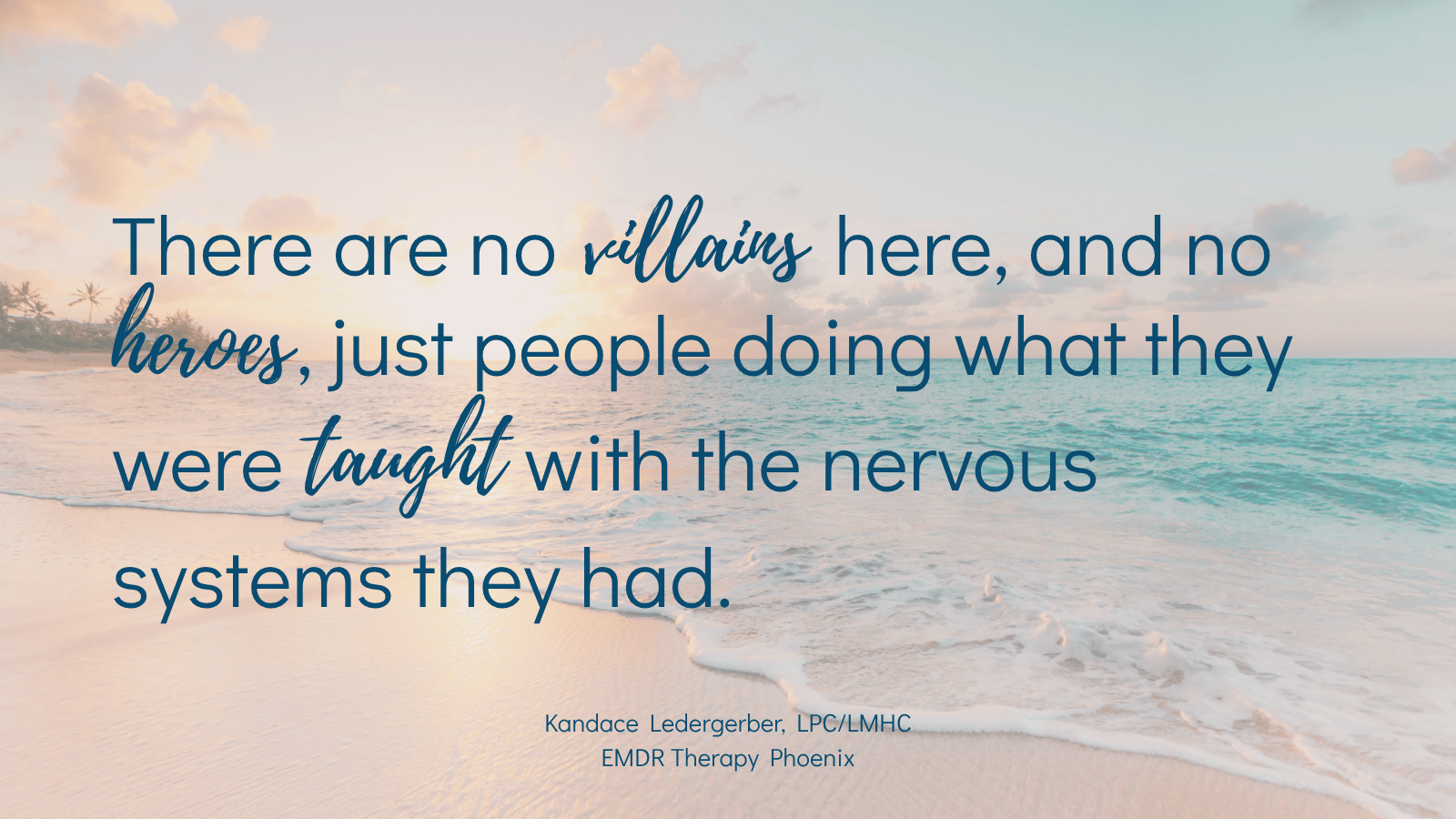
Photo by Sean Oulashin on Unsplash
Photo Description: Quote graphic reading "There are no villains here, and no heroes, just people doing what they were taught with the nervous systems they had." Attributed to Kandace Ledergerber, LPC/LMHC. Dark teal text over a soft beach at sunset with turquoise water, pale sand, and a pink and gold sky. The words villains, heroes, and taught appear in cursive script for emphasis.
Here is where it gets personal for a lot of the people I work with.
Co-regulation is supposed to start at the very beginning, long before you have words for any of it. A baby cannot calm its own nervous system down; it does not have the equipment yet. So it borrows from a regulated adult, over and over again, thousands of times. The baby cries, and a caregiver picks them up, and that steadiness gets transferred, body to body, until eventually the child's own system learns the pattern and can start to do a version of it for itself. That is how the wiring is supposed to get built. We learn to self-regulate only after we have been co-regulated enough times for our bodies to know what calm even feels like.
All too often, I see people sitting across from me who learned at an early age that they had to be the ones managing the room, calming the caregiver, from a place of survival. The place where the 3 year old has learned to try and soothe the adult who cannot calm themselves down, isn't just a one-off situation, it's the daily situation, and not doing so can lead to unpredictability and fear.
So if regulating yourself as an adult feels impossibly hard, like everyone else got a manual you never received, I'm here to say that you are not the only one, and it's nothing to feel ashamed of. You can't know what you haven't been taught, and it's a difficult thing to learn on your own, if not damn near impossible.
It may not be that you are bad at it. It may be that the foundation didn't get properly laid down in the first place, which makes it harder to build on top of. And the cultural message that you should just be able to self-soothe, journal it out, meditate, and handle it alone tends to make people feel like failures for struggling with something they were never actually taught. (This is the same reason insight alone does not regulate a fired-up nervous system, which I get into more in the nervous system is not a mindset.)
I will also say, that naming this is not about assigning blame to the people who raised you. Most of the time the caregivers who could not offer steady co-regulation did not have it offered to them either. There are usually no villains here, and no heroes, just people doing what they were taught with the nervous systems they had. It does not make the gap hurt less, and it is still a place of understanding and context.
When "Calm" Isn't the Same as "Safe"
Now here is the part I don't think gets talked about often enough, and I think it can be helpful to understand.
Your nervous system reads relationships and people against a standard of what feels familiar. Oftentimes, our bar is not set against good, healthy, or actually good for you, just familiar. Which, if we don't pause to look at it, can fly under the radar as the same thing, but they're not.
Here's what I mean by this: if you grew up around chaos, volatility, walking on eggshells, or a love that always came with conditions, then a relationship that recreates some version of that same intensity can feel oddly normal. It can even feel like a kind of relief, because your system recognizes it, and recognition reads as safety. Maybe you have noticed that the people who feel the most magnetic, the most "exciting" at first, the ones with that pull you cannot quite explain, are sometimes the ones who keep you a little off balance, and after a while in the relationship, you might start to notice common patterns that you saw growing up. Whereas meanwhile, the genuinely steady, kind, consistent person can feel almost boring at first, or can even make you weirdly uneasy, because calm is the unfamiliar thing and your nervous system does not have a file for it yet.
I see this most often as people are starting into newer relationships, feeling a kind of familiarity with them after a lifetime of poor abusive relationships. As the relationship continues to develop, little red flags pop up that remind them of their caregivers, they might dismiss it or address it, and that is where the relationship itself starts to take shape into something that can deviate from what they knew growing up or continue the same pattern.
Now, I am not saying every comfortable relationship is secretly bad, or that a spark means danger. That would be its own kind of nonsense. But I would invite you to get curious about the difference between a person who actually settles your nervous system and a person who just feels like home because home was chaotic.
The Relationships That Re-Pattern You
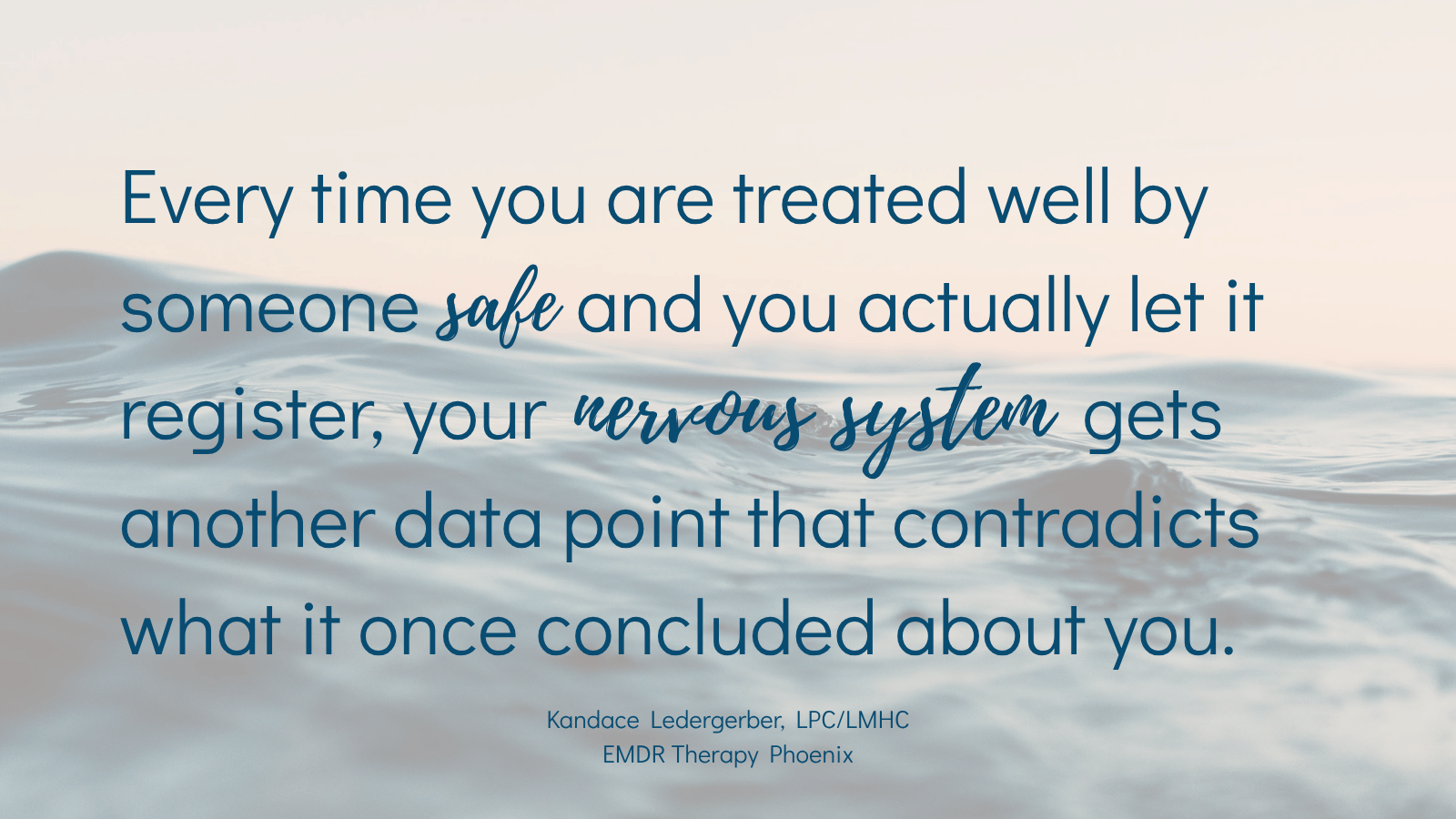
Photo by Matt Hardy on Unsplash
Photo Description: Quote graphic reading "Every time you are treated well by someone safe and you actually let it register, your nervous system gets another data point that contradicts what it once concluded about you." Attributed to Kandace Ledergerber, LPC/LMHC. Dark teal text over a calm ocean at sunrise with soft peach sky and gentle waves. The words safe and nervous system appear in cursive script for emphasis.
Because the flip side of all this is genuinely hopeful.
If your nervous system learned what it learned through relationships, then it can also learn something new through relationships. The partner who stays steady when you expect them to leave, or the friend who keeps showing up without keeping score. The people who, over time and without making a big deal of it, quietly teach your body a different set of rules: I deserve to be treated with respect. I do not have to bend over backwards to earn my place. I can be seen, and known, and supported, and it can be safe.
Those moments are not small. They are the lived evidence that slowly overwrites the old story, and if you have read my post on a different take on glimmers, you will recognize them as exactly that, glimmers that land at the level of belief. Every time you are treated well by someone safe and you actually let it register, your nervous system gets another data point that contradicts what it once concluded about you. That is co-regulation doing its quiet, long-game work of re-patterning.
Where EMDR Therapy Comes In
This is also a big part of why the therapeutic relationship itself can do something that an app, AI, or a workbook simply cannot.
One of the reasons many clients I've seen feel so safe in therapy is that it is a space unto itself, that they can come into with a person who is detached from the rest of their life, and feel supported and seen in the issues they need to bring up. That in real time, they can feel supported by someone when they bring up something that is genuinely difficult, which may differ from what they are able to do in their "normal" life.
It is part of why this work is so hard to do entirely on your own, and why white-knuckling your way through it with another breathing app rarely gets people where they want to go. (I wrote more about that particular trap in why your nervous system can't just calm down.) A regulated, attuned other person is not a luxury in this work. For a lot of people, it is the missing piece.
EMDR builds on exactly this. The resourcing phase, where we establish safety and steadiness before going anywhere near the hard material, happens inside a relationship that is itself a model of the thing we are trying to build. If you are in Phoenix and you are tired of trying to regulate a nervous system that was never meant to do this in isolation, this is the kind of work I do. You can learn more about EMDR therapy in Phoenix and what the process looks like, or read my complete guide to EMDR therapy if you want to go deeper before reaching out.
Ready to Stop Doing This Alone?
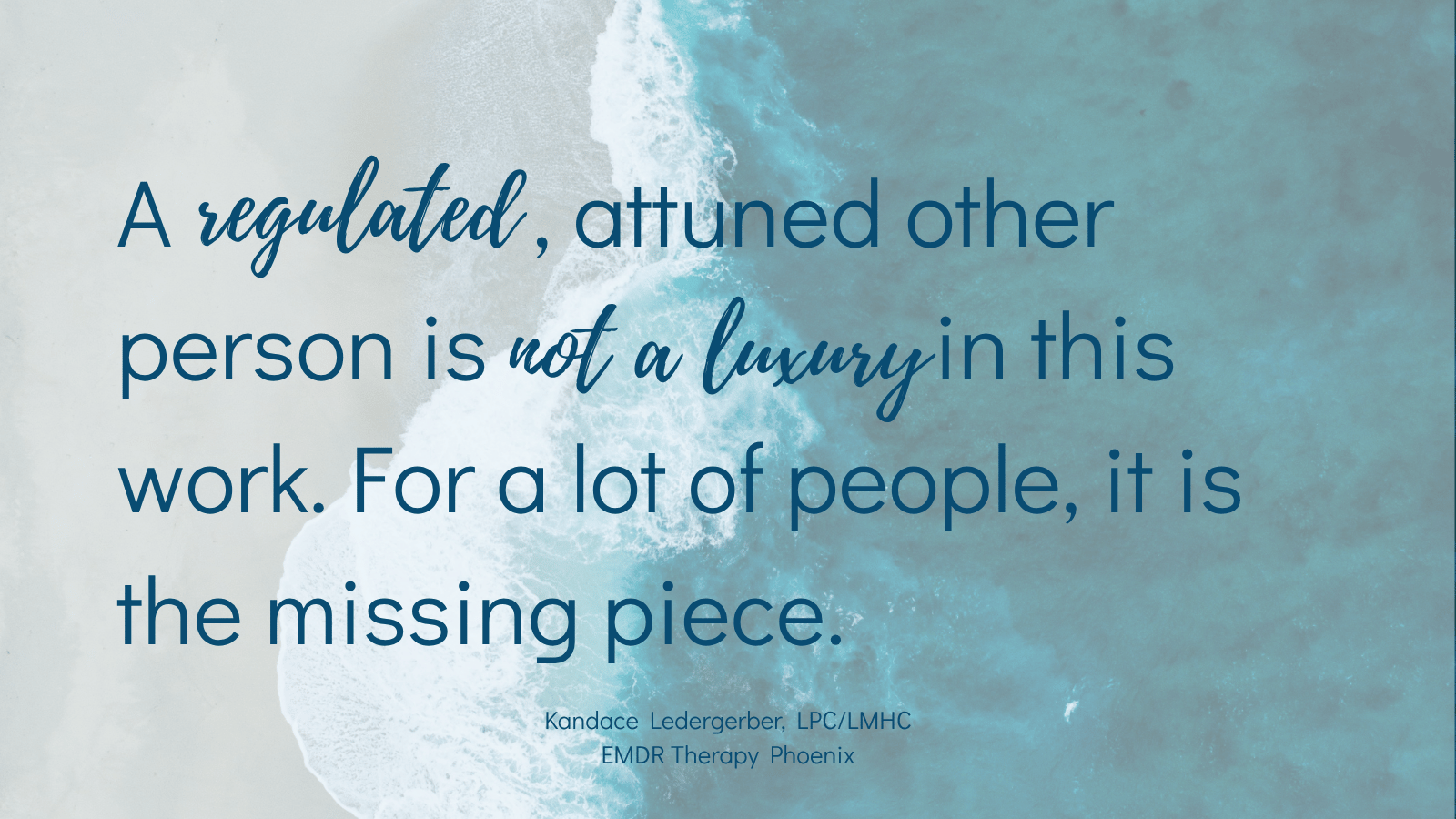
Photo by Shifaaz shamoon on Unsplash
Photo Description: Quote graphic reading "A regulated, attuned other person is not a luxury in this work. For a lot of people, it is the missing piece." Attributed to Kandace Ledergerber, LPC/LMHC. Dark teal text over an aerial view of turquoise ocean meeting pale sand and white sea foam. The words regulated and not a luxury appear in cursive script for emphasis.
If your nervous system settles around some people and braces around others, you are not needy and you are not broken. You are a human being whose body is doing exactly what human bodies do, reaching for connection to find its footing. The good news is that the right kind of connection can teach it something new.
If that sounds like what you have been looking for, I would love to talk. Reach out to schedule a free consultation, where we can talk about where you are and whether the kind of work I do might help.
TL;DR
Co-regulation is the reason your nervous system settles around some people and braces around others. It is borrowing (or losing) steadiness from the people around you.
We are wired to regulate with other people first and only learn to self-regulate after being co-regulated enough times. Struggling to do it alone is often a sign that foundation was never laid, not a personal failing.
Your nervous system reads familiar as safe, which is why a chaotic-but-familiar dynamic can feel more comfortable than a steady one. Familiar and safe are not the same thing.
The right relationships, including the therapy relationship, can re-pattern what you learned about your worth and how you deserve to be treated.
EMDR builds on this, doing the work inside an attuned relationship rather than asking you to white-knuckle it alone.

About the Author
Kandace Ledergerber, LPC/LMHC, Certified EMDR Therapist
Kandace helps adults who feel stuck in the hamster wheel of anxiety and perfectionism reconnect with a sense of grounding, self-trust, and emotional steadiness. Through EMDR therapy and nervous system-informed work, she supports clients in moving out of survival mode and into a more grounded, meaningful life.
She specializes in trauma recovery, anxiety and perfectionism, and healing the lingering effects of childhood and relational trauma. Her work focuses on helping clients process painful experiences that still feel "stuck" so they can move forward with greater peace, confidence, and emotional freedom.
She offers EMDR therapy in Phoenix, anxiety therapy, and EMDR Intensives in Arizona.
Learn more about Kandace's background, approach, and services on her About page.