When Your Body Says No Before Your Mind Does (And Your Mouth Still Says Yes)
Photo by Christoffer Engström on Unsplash
Photo Description: Title graphic for the blog post "When Your Body Says No Before Your Mind Does (And Your Mouth Still Says Yes)," by Kandace Ledergerber, LPC/LMHC, Certified EMDR Therapist. Deep blue ocean wave background with white sea foam framing a light blue center panel, orange divider line beneath the title.
You said yes before you finished reading the email. You smiled when someone asked you to take on one more thing, already calculating how you'd make it work, already dreading it on the inside and questioning your sanity. You apologized in the middle of someone else apologizing to you. And later, when you were on your own, maybe you wondered “what iswrong with me that I can’t say no?”
And I’m willing to guess this isn't the first time.
For a lot of people, people-pleasing after trauma doesn't look like weakness; it can actually look more like competence to start. Like the responsible kid, who just handles things, who never makes it weird or asks for more and just figures it out. As an adult, it can look like a packed calendar, a reputation for being so easy to work with, and a kind of low-grade exhaustion that never quite goes away, no matter how much you sleep over the weekend, how many shows you binge on repeat, or how many things you cross off the list.
What it doesn't look like, from the outside, is a nervous system doing exactly what it learned to do.
Key Takeaways
People-pleasing after trauma isn't a personality trait; it's a nervous system response your body developed when saying no felt dangerous.
The exhaustion underneath it isn't weakness, it's the cost of running a constant threat scan to your surroundings and relationships.
Understanding this doesn't stop the people-pleasing. This response fires before the thinking brain gets a chance to speak up.
The shift doesn't look like confidence at first. It looks like a pause, and then a very small no.
Working with the nervous system directly, rather than just understanding it, is what actually moves this.
What People Pleasing After Trauma Actually Is
The therapy term for this behavior is fawning. And like most therapy terms, it's more useful when you understand what it actually feels like than when you just know what it's called.
Fawning is what happens when your nervous system has learned that the safest move in the presence of conflict, tension, or even just the possibility of someone being upset with you is to smooth it over immediately. To agree, to be accommodating. To make yourself easier to be around so that whatever might be coming doesn't come. So that the inevitable threat will pass without actually blowing the hell up.
What catches a lot of people off guard is the fact that most often, this behavior, is not an actual choice. The yes comes out before you've decided to say yes, or even after you have mentally said no. The smile appears before you've decided to smile and by the time your thinking brain catches up to the situation, your body has already moved toward appeasement, and then it's harder to walk back out of.
In my experience, this form of people-pleasing is easiest to spot in the professional sphere first. It can look like saying yes to too many projects, taking on other people's work without being asked, struggling to draw a line even when you’re already running on empty and wondering why you are always so exhausted and can't quite see the weight you’ve been lugging around with you. The personal relationships often come into focus a little later, once someone starts actually looking. The pattern is usually there too, just quieter and older.
Why Your Nervous System Learned This
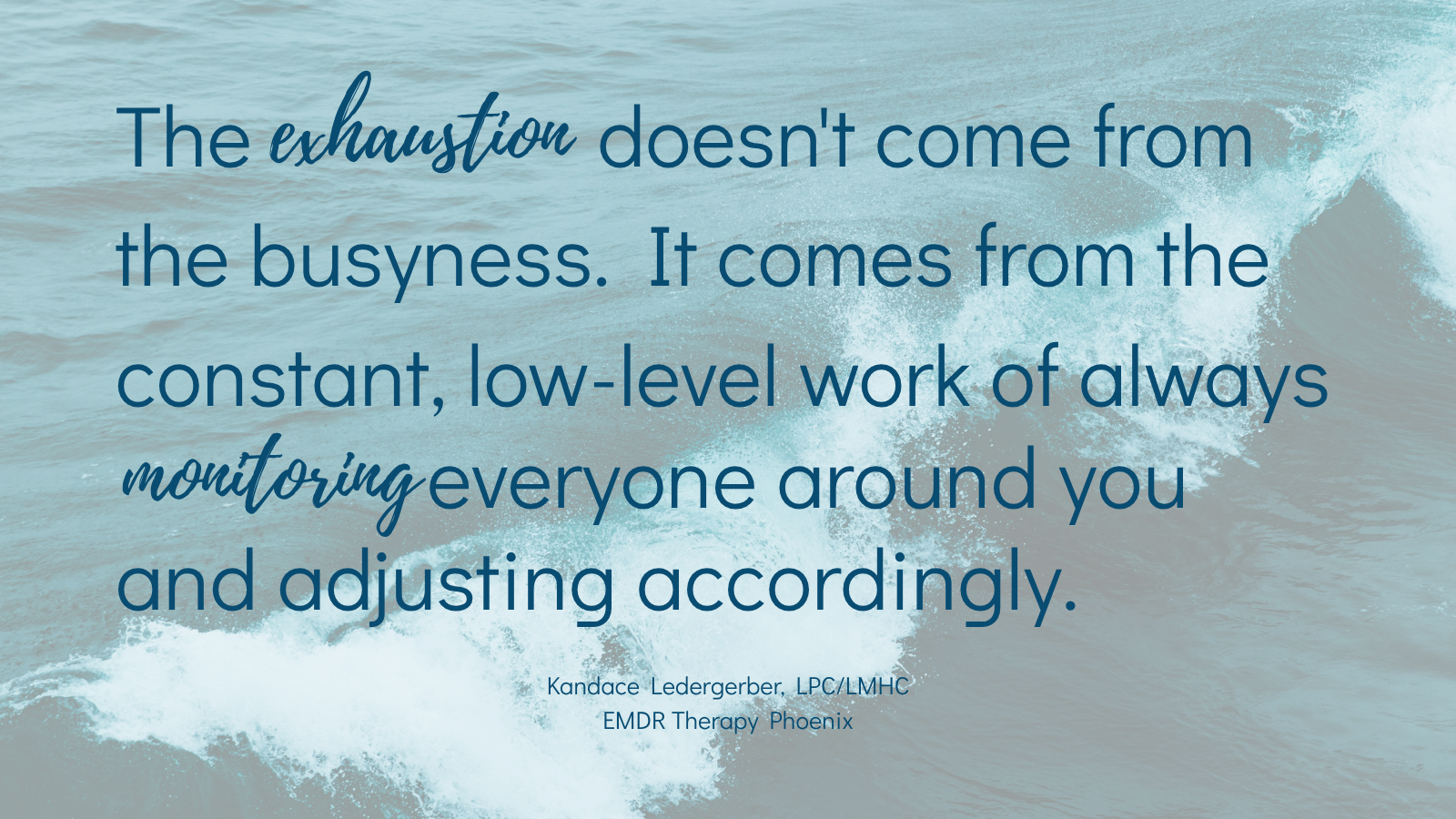
Photo by Nathan Dumlao on Unsplash
Photo Description: Quote graphic reading "The exhaustion doesn't come from the busyness. It comes from the constant, low-level work of always monitoring everyone around you and adjusting accordingly." Attributed to Kandace Ledergerber, LPC/LMHC, . Muted teal-toned ocean wave background.
Here's the part I find most useful to sit with, which is the acknowledgement that this behavior started somewhere and it served a purpose. Your nervous system didn't develop this pattern for no reason. It developed it because at some point, in some environment, saying yes was the only real option that you could see. Saying no meant danger, perceived danger, conflict, or someone important to you becoming someone who felt unpredictable. Saying yes, going along, reading the room, and acting accordingly, kept the peace. And sometimes, those actions maybe even kept you safe in a much more concrete, real sense, where a situation could have been actually dangerous.
The part of you that learned to do this was likely very young. A child in a situation where making themselves easy to be around was the most effective way to get through. Where saying no wasn't an option, not really, and saying yes was the only thing that kept things from getting worse.
That part of you was not wrong. Given what it was working with, given the options that were available, it made a reasonable and sometimes necessary choice.
Your nervous system learned this lesson well. The problem, as with so much of what we carry, is that it doesn't automatically unlearn it when the environment changes.
So now you're an adult, in a job or a relationship or a family situation that is not the original environment, and your body is still running the old program. Still scanning for tension and calculating the fastest route to make things okay. Still saying yes before you've had a chance to ask yourself if you actually want to.
Nothing is wrong with you for this. Your nervous system is being loyal to a strategy that once worked very well. It just doesn't have updated information yet.
The Part That's Hard to Admit
What tends to happen over time, when the fawn response has been running for years, is that it gets hard to find yourself underneath it, the real and truest version of you.
You've gotten so good at reading what other people need and moving toward it that you've lost touch with what you actually need, want, and even feel in a given moment. That threat scan kicks into gear and runs the previous script before you can even assess what you need.
Maybe you've noticed this, the way a question like "what do you want for dinner" can feel oddly stressful, or how hard it is to answer "how are you doing" with something true instead of the normal “I’m fine.” When you've spent years orienting to other people's emotional states first, your own can become a little hard to locate.
This is where I believe the exhaustion actually comes from. Not from the busyness, not from the obligations themselves, but from the constant, low-level work of monitoring everyone around you and adjusting accordingly. That's a full-time job running underneath your actual full-time job. A constant scanning that never allows you to fully rest.
If this is resonating, you might also recognize the pattern in how differently you feel around different people. Some people, you can breathe around. Others, you walk in the room and something in your body immediately starts working into overdrive. If you want to understand more about why that is, this post on why you calm down around some people and brace around others gets into the nervous system mechanics of that specifically.
Why Understanding It Doesn't Stop It
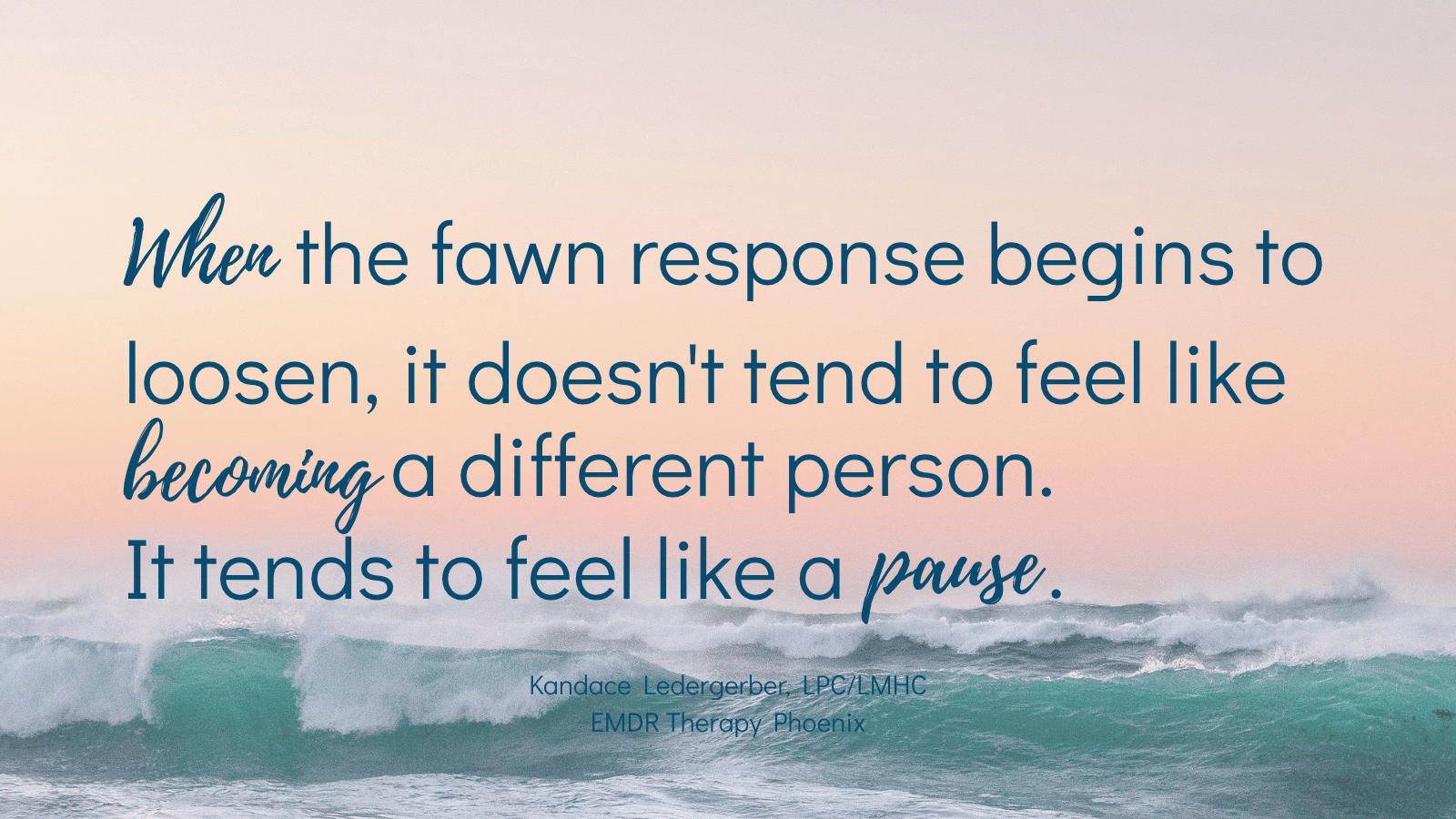
Photo by Laura Barry on Unsplash
Photo Description: Quote graphic reading "When the fawn response begins to loosen, it doesn't tend to feel like becoming a different person. It tends to feel like a pause." Attributed to Kandace Ledergerber, LPC/LMHC. Soft sunset-toned ocean wave background transitioning from peach sky to teal water.
This is the part that can feel so infuriating (especially for my Type-A perfectionists out there, I see you). You can read everything above, recognize yourself completely, even feel some relief at finally having a framework for it, and then walk into the next situation and do the exact same thing.
And here is what I really want you to leave with - this is not a failure of insight, this is how the nervous system works.
The fawn response fires fast, faster than conscious thought. By the time you've registered that you're in a situation where you might feel pressured, your body has already started moving toward accommodation. The thinking brain comes in after the fact, sometimes rationalizing the yes, sometimes feeling frustration at it, but rarely able to intervene in time.
This is why understanding the pattern, while genuinely useful, isn't the same as the pattern shifting. Understanding lives in the thinking brain, but the fawn response lives somewhere older and deeper than that.
EMDR works with the nervous system directly rather than through insight alone. Rather than talking yourself out of the reflex, you're working with the part of your system that learned the reflex in the first place, giving it updated information, not just the understanding that things are different now, but the felt sense of it.
There's a meaningful difference between knowing you're safe and your body actually feeling and registering it. If you want to understand more about why the nervous system holds on to things the mind has already tried to move past, this post on why your nervous system can't just calm down goes deeper into exactly that.
What Starts to Shift
When the fawn response begins to loosen, it doesn't tend to feel like suddenly becoming a different person who is confident and holding boundaries left and right and feeling easy breezy about saying no.
It tends to feel like a pause (yes, sometimes still followed by intense anxiety).
But it starts with a gentle pausing moment before the yes comes out. Long enough to notice the impulse. Long enough, sometimes, to let something else happen.
What I see in clients when this starts to move is that they begin testing it in smaller ways first, holding a no in a lower-stakes situation and watching what happens. And often what happens is that the other person is fine with it. The feared consequence doesn't materialize. The nervous system gets a small data point that says “Hey, nothing is on fire. We’re okay.”
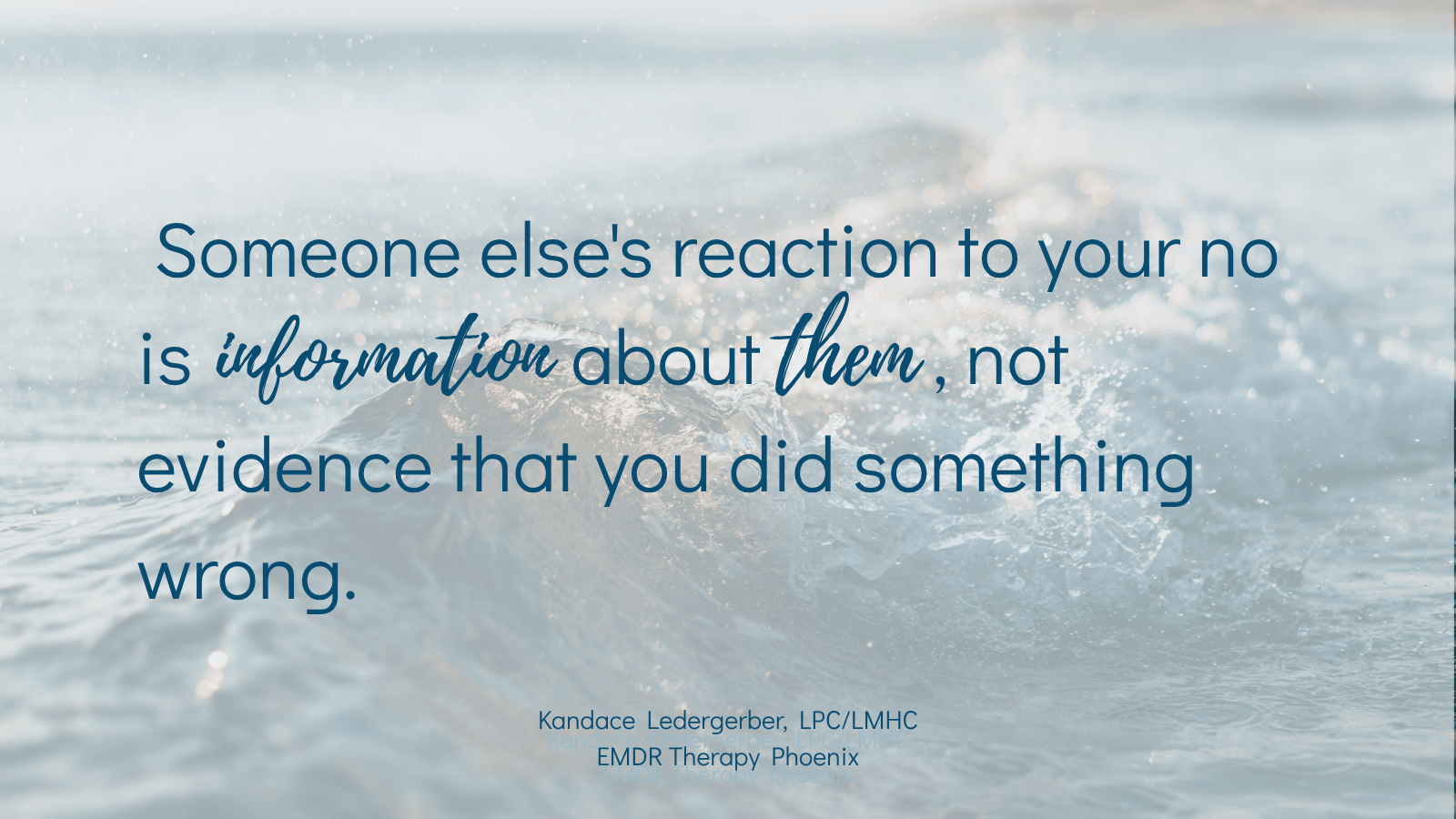
Photo by Mourad Saadi on Unsplash
Photo Description: Quote graphic reading "Someone else's reaction to your no is information about them, not evidence that you did something wrong." Attributed to Kandace Ledergerber, LPC/LMHC. Pale blue ocean wave background with white sea foam.m.
And then, sometimes, they hold a no somewhere that matters and someone in their life reacts badly. A person they thought was a safe relationship suddenly has a significant problem with them maintaining their own boundary. That moment is hard, and it also tends to be important, because it shows them something true about that relationship that the years of accommodating had been obscuring.
We work with that in sessions, validating the instinct to hold the boundary, reinforcing the fact that pushback from others doesn't mean the boundary was wrong. People who have been on the receiving end of chronic accommodation don't always respond well when that changes, and that's worth acknowledging. But someone else's reaction to your no is information about them, not evidence that you did something wrong.
The boundary is still valuable. Even when, maybe especially when, someone pushes back on it.
If You Recognized Yourself Up There
If you've been the one who handles things, who never makes it weird or difficult, who says yes before finishing the thought, and you've started to wonder what it would feel like to actually mean it when you say no, that wondering is worth paying attention to.
This kind of work tends to go better with support. You can learn more about how EMDR therapy in Phoenix works and whether it might be a fit, or reach out to schedule a free consultation. The part of you that learned to say yes to keep the peace was doing the best it could. You don't have to keep running that program forever.
TL;DR
People pleasing after trauma (also called fawning) is a nervous system response, not a personality trait
It developed because at some point, saying no felt dangerous and accommodation kept you safe
The exhaustion isn't from being too nice, it's from running a constant threat scan underneath everything
Insight helps, but doesn't stop the reflex, because the fawn response fires before the thinking brain gets a vote
The shift starts small: a pause, a small no, watching what happens
Working with the nervous system directly, not just the understanding of it, is what actually moves this

About the Author
Kandace Ledergerber, LPC/LMHC, Certified EMDR Therapist
Kandace helps adults who feel stuck in the hamster wheel of anxiety and perfectionism reconnect with a sense of grounding, self-trust, and emotional steadiness. Through EMDR therapy and nervous system-informed work, she supports clients in moving out of survival mode and into a more grounded, meaningful life.
She specializes in trauma recovery, anxiety and perfectionism, and healing the lingering effects of childhood and relational trauma.
She offers EMDR therapy in Phoenix, anxiety therapy in Phoenix, and EMDR Intensives in Arizona.
Learn more about Kandace's background, approach, and services on her About page.