Why Your Body Remembers What Your Mind Tries to Forget

Photo by Ivan Bandura on Unsplash
Photo Description: Blog header graphic with the title "Why Your Body Remembers What Your Mind Tries to Forget" by Kandace Ledergerber, LPC/LMHC, Certified EMDR Therapist. Dark navy and teal ocean aerial photography with white water texture on either side of a centered text panel.
It was a completely normal Tuesday afternoon. Nothing happened, at least nothing notable. Nothing obviously hard, that you could point to later and say that was the thing that set all these feelings in motion. And then somewhere between your second cup of coffee and whatever came next, you slammed into a wall. Rage that came from nowhere, or perhaps the opposite, a kind of numbness so big that you were going through the motions of your day from somewhere very far away, watching yourself function without actually being there.
And the question underneath it, the one that might have followed you for hours or even days afterward: Why am I feeling like this right now? What is wrong with me?
Here is what I want you to know and what I share often in my therapy practice. I'm willing to guess that nothing is actually wrong with you. But something did happen, just not on Tuesday. Your body remembered something your mind doesn't have the language for. And it responded the only way it knows how.
That's what this post is about.
Key Takeaways
Trauma isn't always stored as a memory you can access. Sometimes it lives in the body as a reaction.
Implicit memory explains why you can be triggered without knowing what triggered you.
Your body's response isn't random. It's patterned, protective, and makes complete sense.
Healing isn't just about understanding what happened. It's about helping the body update what it's still holding.
Two Kinds of Memory (And Why One of Them Doesn't Give a Damn About Logic)
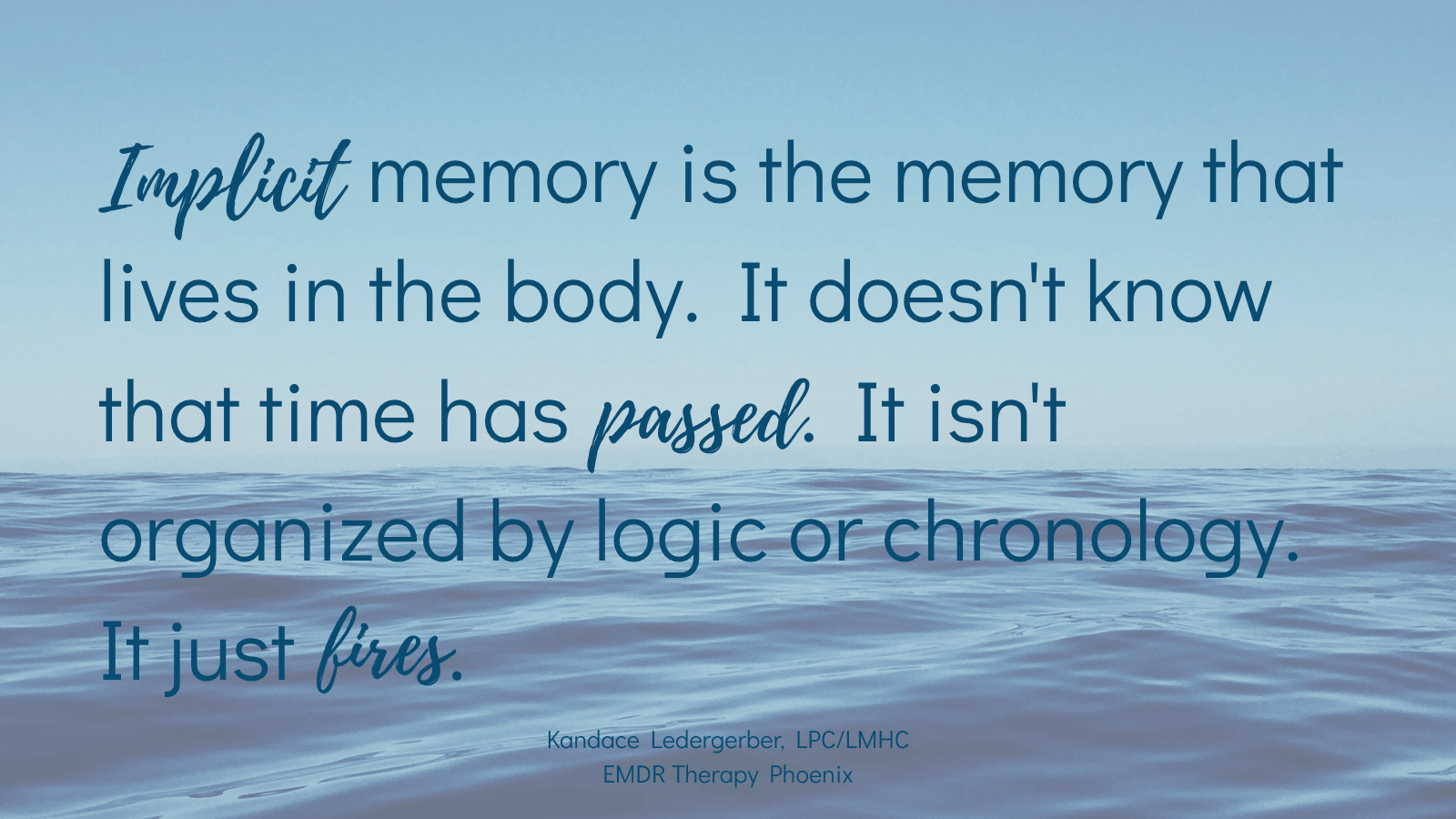
Photo by Greg Beckeron Unsplash
Photo Description: Quote graphic reading "Implicit memory is the memory that lives in the body. It doesn't know that time has passed. It isn't organized by logic or chronology. It just fires." Attributed to Kandace Ledergerber, LPC/LMHC. Calm open ocean background in muted blue and grey tones.
Most people think of memory as the stuff they can recall actively. The story, the timeline, the "here's what happened and when." That's called explicit memory, and it's the version we tend to work with in traditional talk therapy -- walking through events, making sense of them, building a narrative around what we've been through so we can make sense of it.
But there's another kind of memory that doesn't work that way at all.
Implicit memory is the memory that lives in the body. It has no story, no timestamp, no neat beginning or end. It's stored as sensation, emotional tone, reflex. Kind of like the reason you know how to ride a bike without thinking through each step. It's also the reason certain sounds make your stomach drop, certain tones of voice make you brace for impact, and certain rooms make you want to crawl into a dark hole. Before your thinking brain has had even a fraction of a second to catch up, your body is mid-reaction.
Implicit memory doesn't know that time has passed. It isn't organized by logic or chronology. It just fires. And when it does, it can feel completely disconnected from anything you can consciously name, because it is disconnected from anything you can consciously call to the surface. This doesn't mean something is wrong with you. In all actuality, it's evidence that the system is working exactly how it's designed (just not how we'd like it to.)
This is why you can spend years understanding your history intellectually and still get completely hijacked by a tone of voice, a smell, a particular quality of light in a room, and feel none the wiser. The thinking brain understood that was in the past. But the body is still working from an older file.
What the Body Is Actually Doing
When something happens that the nervous system registers as threatening (or even just as similar to something that was once threatening) it responds before you have a chance to think. This is by design, because in survival terms, fast is more important than accurate. After all, we'd probably prefer fast over accurate if we thought we spotted a tiger in our midst.
The body files experiences somatically first. It files the feeling before the actual story. Which leads us to have a reaction before reflection. And for experiences that were overwhelming, confusing, or happened before you had the language to process them (like trauma from birth, in utero, or at a very young age), the body may have filed them away in a way that the conscious mind can never fully retrieve.
So when you slam into that wall on a random Tuesday, what's actually happening (I'd guess) is that your nervous system found a pattern match. Something in your environment -- a sound, a feeling in your body, the way someone looked at you, even something you're not consciously aware of -- resembled something it learned to treat as a threat. And it executed the appropriate response. Shutdown, rage, dissociation, or hypervigilance, to name a few. This doesn't happen necessarily because you're unstable, but because your body is doing its job with the information it has.
The body isn't overreacting. It's pattern-matching.
I know it can be infuriating and feel very shaky to have this happen -- something that is outside of your control. Your body and brain are doing their best with old information on how to protect you, just like running your phone or computer on an old update. It's overheating because it needs the new update. But that does mean that aspects of this are in your control. When working with clients who are experiencing this, I often invite them (if they feel comfortable doing so) to recognize the next time they are experiencing an emotion that seems out of context. When did they start noticing that emotion or response creep in? Can they trace it back to a place in the day or the last few days? If they can, great -- now they have a storyline that might make sense. And if they can't, that's okay too. I would ask them to use a grounding exercise or resource that helps them tap back into a sense of security or grounding, and treat this as a reaction to a trigger, even if we can't name what it is for right now.
I find it often helps to remind ourselves in those moments that we are not in danger, and grounding ourselves in the present can help to pull us out of those somatic responses.
Why You Can't Think Your Way Out of It
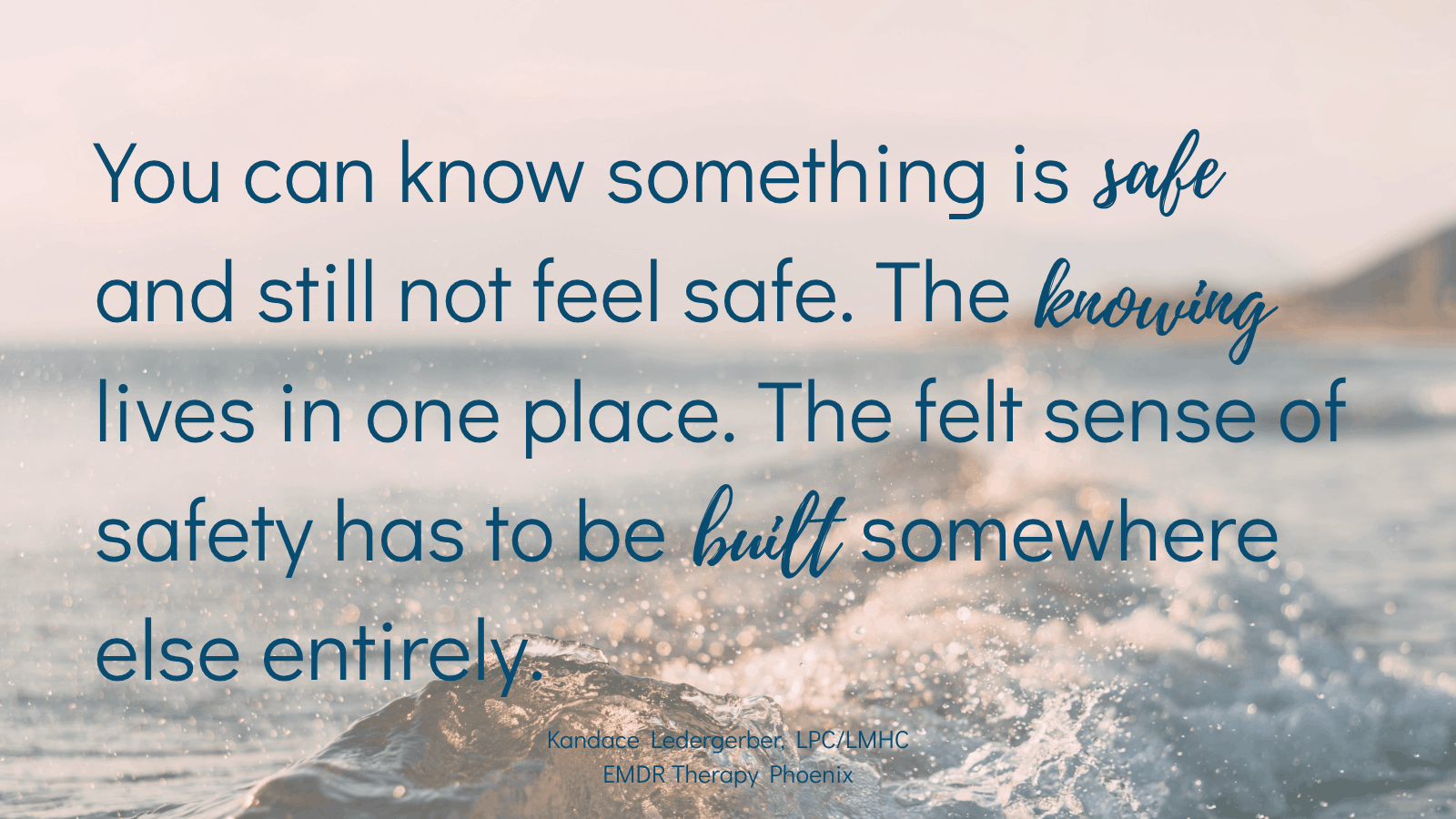
Photo by Mourad Saadion Unsplash
Photo Description: Quote graphic reading "You can know something is safe and still not feel safe. The knowing lives in one place. The felt sense of safety has to be built somewhere else entirely." Attributed to Kandace Ledergerber, LPC/LMHC. Soft peach and blue coastal ocean background with wave and rock.
It's understandable why this frustrates a lot of people, especially people who've done real work on themselves.
Perhaps you've been to therapy, and you've read the books. You understand, maybe better than most, where your reactions come from and what shaped them. And still your chest tightens in certain meetings, and you can go completely flat after certain conversations. Because at the end of the day, something in you braces before you even know what you're bracing for. And that is frustrating.
I don't think this is a lack of insight. It's a mismatch between the tools we're trying to use and where the memory actually lives.
Insight and understanding live in the thinking brain -- the part that can reflect, analyze, and make meaning. But implicit memory lives somewhere older and faster than that. It lives in the parts of the nervous system that were online long before language was, long before the capacity for reflection developed. And those parts don't take direction from insight. They respond to experience, viscerally.
This is why you can know something is safe and still not feel safe. (If that particular gap feels familiar, check out this post on why your nervous system can't just calm down, which goes deeper into exactly that.) The knowing lives in one place. The felt sense of safety has to be built somewhere else entirely.
Talk therapy is genuinely valuable, I truly believe that. I also believe a good support system where you can talk out what's going on in life is invaluable. But I also believe that for memory that lives in the body, the work has to reach the body too.
All too often, I have an insightful, bright human being in my office who has a checklist in front of them of all the steps they have tried, and they are ready to set that piece of paper on fire. The problem doesn't lie in them -- it's in the approach. If we change the approach, the hope is that we will get somewhere. I will also say that I am a firm believer that if we are not getting anywhere, something needs to change in any therapy relationship.
The Clues Your Body Has Been Leaving
Here's something that might be worth sitting with. Your body has probably been trying to communicate about this with you for a long time. Most people just haven't had a framework for understanding what it was trying to say.
Some of the ways implicit memory shows up that people rarely connect to trauma:
A tightening in the chest or throat that arrives before any conscious thought
Sudden, inexplicable exhaustion in certain situations or around certain people
Going flat or numb in moments that "should" feel meaningful
Irritability or rage that feels disproportionate and comes from nowhere
The urge to leave a room, a conversation, or a relationship without being able to articulate why
A sense of dread that has no object -- just a feeling that something is wrong, with no story attached
In my experience, these aren't random. And they aren't evidence that something is wrong with you -- they are the body's language. And like any language, they become easier to understand the more you learn to listen without immediately trying to fix or suppress what you're hearing.
The goal isn't to decode every reaction or trace every response back to its origin. (Most of the time that's not possible anyway, and honestly, it's not always necessary.) The goal is to start getting curious instead of alarmed. To treat the wall of rage or the sudden numbness as information rather than a malfunction.
Something many clients are surprised by (and continue to be surprised by) is how often a moment that felt big like this is linked back to a core trauma. They come into session feeling the pressing need to discuss what happened in the week, and when we truly flesh it out, the thread leads right back to the experiences we've been working with.
The opposite is also true (thankfully). Where clients will come in with something they feel so extremely proud about that they are bursting at the seams to share. That experience was them operating in a different space that went against that trauma, and they feel it in their bones.
What It Looks Like to Work With the Body Instead of Against It
If implicit memory is stored in the body, then healing it requires reaching the body. That's not a complicated idea, but it does require a different kind of work than most people have tried.
Most traditional approaches to therapy are top-down. They start with the thinking brain -- with insight, reflection, narrative, and understanding -- working through the list. And again, that work has real value. But for body memory, you often need to work in the other direction. This is known in the therapy world as bottom-up. Starting with sensation and nervous system experience, and letting understanding follow from there rather than lead.
This is where EMDR (and brainspotting) fits in a way that talk therapy alone often can't.
These approaches work at the level where the memory actually lives. Not by asking you to narrate your history, but by working with the body's experience of it directly. And it doesn't start by going straight to the hard material. It starts exactly where it needs to -- with building safety first. The resourcing phase of EMDR is where we develop the tools your nervous system needs before we approach anything difficult, so that when we do, you have somewhere solid to return to.
For people whose bodies have been holding something the mind could never quite reach, that approach can be genuinely different from anything they've tried before. And it definitely beats a meditation app.
If you're in Phoenix and you've been living with reactions you can't explain and a body that feels like it's working against you, this is the kind of work I do at Soul Mission EMDR Therapy. You can learn more about EMDR therapy in Phoenix and what that process looks like, or read the complete guide to EMDR therapy if you want to go deeper before reaching out.
I will say that clients who come in (especially those who have tried talk therapy for this) often feel uneasy about trying a new approach, but also are willing to try something different because they want the hell away from these responses. It takes some effort to get into the rhythm of EMDR or a more bottom-up approach for these clients, but I'd say the evidence is in how they feel after getting into that rhythm.
It Wasn't a Random Tuesday
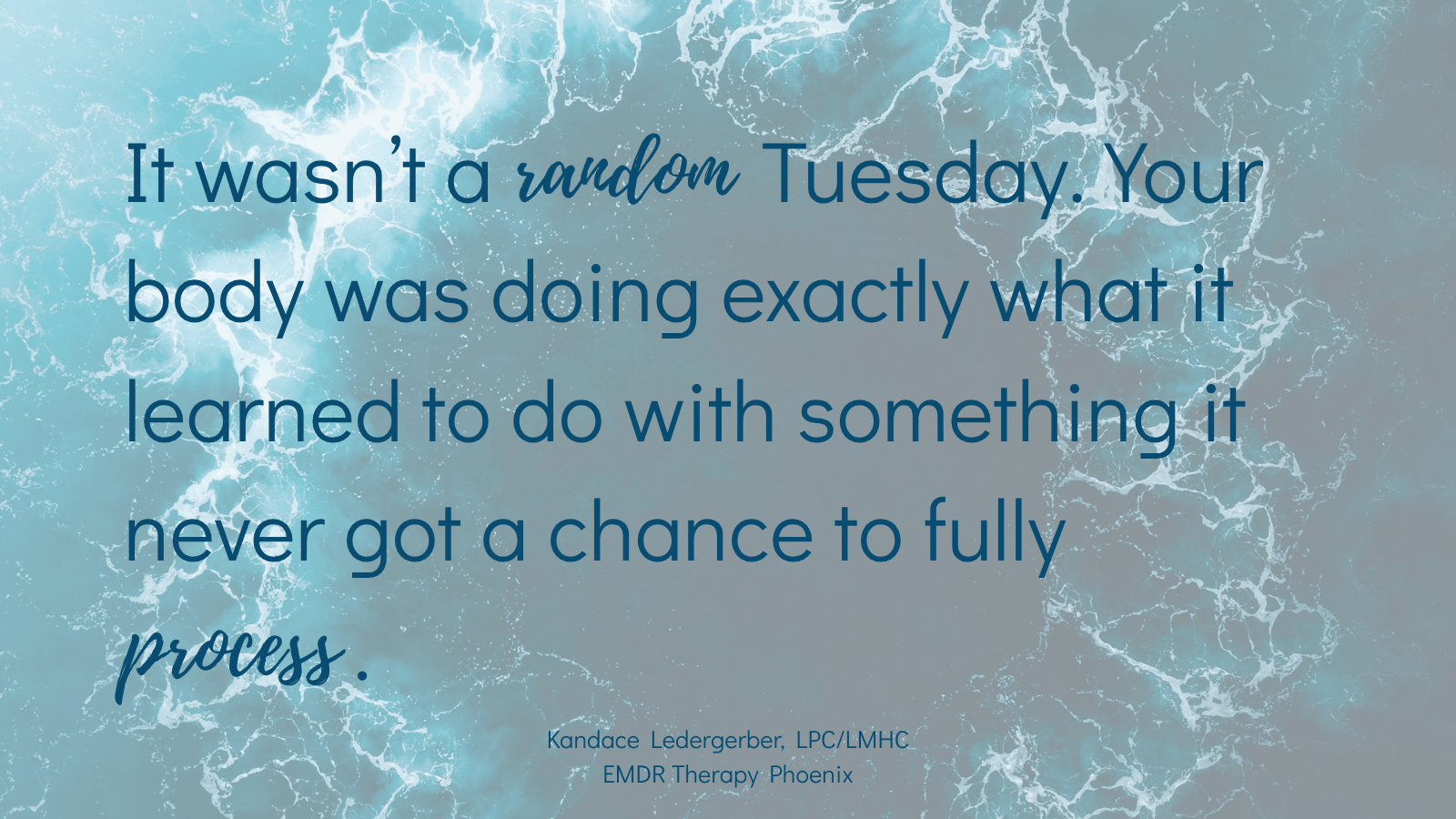
Photo by Matheo JBTon Unsplash
Photo Description: Quote graphic reading "It wasn't a random Tuesday. Your body was doing exactly what it learned to do with something it never got a chance to fully process." Attributed to Kandace Ledergerber, LPC/LMHC. Teal and grey abstract water texture background.
So no, you weren't falling apart for no reason. You weren't being dramatic or unstable or broken. Your body was doing exactly what it learned to do with something it never got a chance to fully process. It held on to it the only way it knew how -- as sensation, as reflex, as a pattern that fires before you can think.
The good news is that it can change. And I'm sorry my type-A friends, but not by understanding it harder -- by giving the body a different experience. One that teaches it, slowly and with real support, that it's safe to let the old file go.
If that sounds like the kind of work you've been looking for, I would love to connect. Reach out to schedule a free consultation, where we can have a conversation about where you are and whether what I do might help.
TL;DR
Your body stores experiences your conscious mind may never be able to fully access or explain.
Implicit memory is why you can be triggered without knowing why -- no narrative, no timestamp, just a reaction that fires from somewhere older and faster than thought.
The body isn't overreacting. It's pattern-matching based on what it learned.
Healing means working with the body, not just the thinking brain.
EMDR is one way to do exactly that -- starting with safety and building from there.

About the Author
Kandace Ledergerber, LPC/LMHC, Certified EMDR Therapist
Kandace helps adults who feel stuck in the hamster wheel of anxiety and perfectionism reconnect with a sense of grounding, self-trust, and emotional steadiness. Through EMDR therapy and nervous system-informed work, she supports clients in moving out of survival mode and into a more grounded, meaningful life.
She specializes in trauma recovery, anxiety and perfectionism, and healing the lingering effects of childhood and relational trauma. Her work focuses on helping clients process painful experiences that still feel "stuck" so they can move forward with greater peace, confidence, and emotional freedom.
She offers EMDR therapy in Phoenix, anxiety therapy, and EMDR Intensives in Arizona.
Learn more about Kandace's background, approach, and services on her About page.